


Receiving a fine for a traffic violation is an unpleasant experience in itself. However, the situation becomes significantly worse when drivers learn that the actual fine amount is much lower than what they are required to pay. The difference is made up of numerous hidden fees that often have no relation to traffic safety.
Hidden Fees: How $100 Becomes $500


An investigation revealed that in California, nearly a dozen additional fees are quietly added to standard fines, turning a common violation into a financially punitive event. As an example, a $100 fine for running a red light can balloon to a bill of nearly $500 after all the surcharges are added.
One driver, Kris Cars, was bewildered upon seeing the breakdown of her fine. She noted:
“It feels like something is being hidden”
, as only a small portion of her payment covered the actual violation.
Some of these fees fund purposes completely unrelated to driving, roads, or safety. For instance, one of them supports the Fish and Wildlife Preservation Fund. While this goal is worthy in itself, funding it through people who accidentally didn’t come to a complete stop at a stop sign seems odd. Furthermore, this practice is non-transparent, as all fees are lumped into a single amount without a clear explanation to the driver.
Calls for System Reform
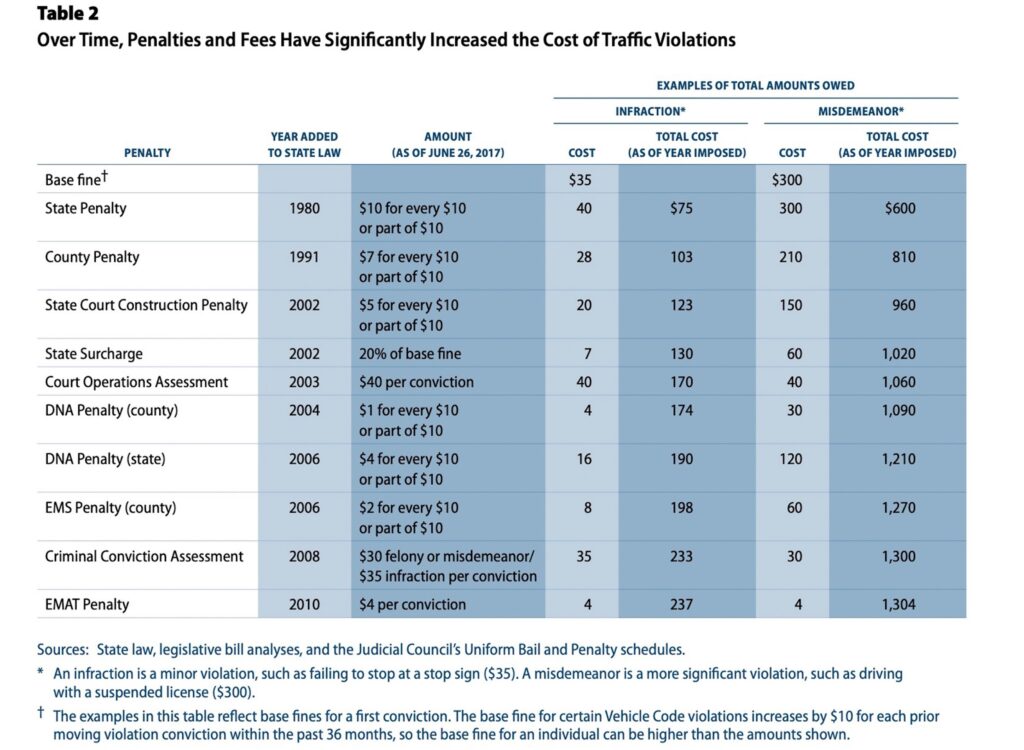

A state audit conducted nearly a decade ago already labeled this system as arbitrary and disconnected from the actual offenses. Auditors found that the fees
“have no direct connection to the violation”
and are instead based on the financial needs of unrelated programs.
Auditors urged lawmakers to
“review the entire structure of fines and fees”
, but this has yet to happen. Instead, the state continues to use traffic violation fines as a quiet source of budget replenishment, even though such revenues are consistently declining.
Who Bears the Real Burden?


The main issue is who actually pays this price. According to advocates, inflated fines hit low-income drivers the hardest, often becoming unaffordable for them. This triggers a spiral of late fees, additional penalties, and driver’s license suspensions. Those most affected are the least likely to complain to legislators or hire a lawyer.
As the auditor noted:
“It’s not very effective because it’s inefficient. People cannot pay what they do not have”
.
State officials express a desire for a fair and transparent system that promotes safety. However, even the chair of the state assembly’s transportation committee admitted to not knowing about the problem until journalists reported on it.
Thus, the system remains unchanged. A minor mistake on the road turns into a serious financial problem, and the highest price for it is often paid by those who can afford it the least.
This situation in California points to a broader problem of fiscal policy, where administrative fees are used to fund unrelated programs, creating a non-transparent and regressive system. Experience shows that such practices are not only unfair but also inefficient in the long term, as they place an unbearable financial burden on the most vulnerable segments of the population, which can lead to increased debt and diminished trust in law enforcement institutions. Transparency in the formation and allocation of fines is a key element of a fair legal system.