


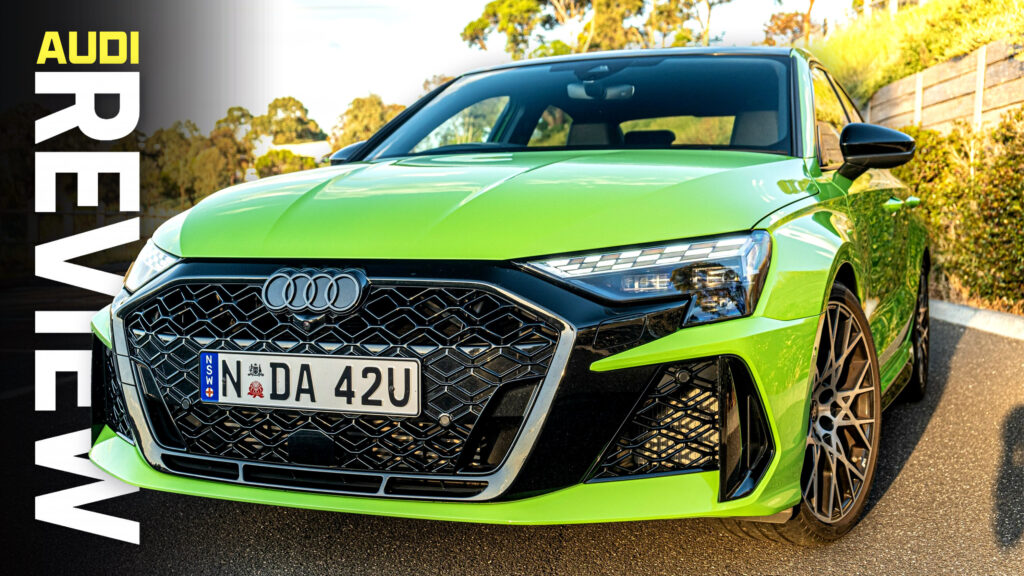
Could this be the sweet spot in the world of high-performance compacts? After spending a week with the Audi RS3 Sedan, that possibility kept resurfacing in my mind. For drivers left cold by today’s crop of turbocharged hatchbacks and sedans, the RS3 doesn’t just feel more powerful, it feels like it belongs in another league entirely.
With its latest updates for 2026, it might just be closer than ever to being the all-rounder that enthusiasts have been waiting for.
Review: The 2026 Audi S5 Sedan Is Better Than Ever, But One Detail Spoils It
This generation of RS3 originally launched in 2022, but received a substantial update in late 2024. While the core engine and all-wheel drive trickery remain, Audi has sharpened the design, made subtle changes to the interior, and given the car even more edge behind the wheel. What, then, makes this latest RS3 stand apart from the rest?
QUICK FACTS
| › Model: | 2026 Audi RS3 Sedan |
| › Starting Price: | AU$113,050 ($75,900) as tested |
| › Dimensions: | 4,542 mm (178.8 in.) Length
1,984 mm (78.1 in.) Width 1,417 mm (55.7 in.) Height 2,629 mm (103.5 in.) Wheelbasee |
| › Curb Weight: | 1,625 kg (3,582 lbs) |
| › Powertrain: | 2.5-liter turbocharged five-cylinder |
| › Output: | 394 hp (294 kW) / 369 lb-ft (500 Nm) |
| › 0-62 mph | 3.7 seconds |
| › Transmission: | Seven-speed S tronic dual-clutch automatic |
| › Efficiency: | 12.1 l/100 km (19.4 US mpg) as tested |
| › On Sale: | Now |
SWIPE
The RS3 is now the only compact performance car on sale with a five-cylinder engine. While rivals have moved to high-strung three- or four-cylinder turbo units, Audi’s 2.5-liter five-pot remains gloriously intact. It’s the defining trait of the RS3 and a huge part of its appeal.
Power has gone unchanged for 2026, meaning it continues to deliver 294 kW (394 hp) and 500 Nm (369 lb-ft) in Australian spec, identical figures to the US model. The Mercedes-AMG A 45 S, with its bonkers 310 kW (421 hp) 2.0-liter turbo four-cylinder, has more power, but you’re never left wanting for more grunt with the RS3.
What Does the Facelift Bring?
Photos Brad Anderson/Carscoops
Audi has made some important updates to the RS3’s trick torque splitter and fully variable torque distribution system for 2026. The company says these systems react more acutely to different driving situations, noting that refinements to the brake torque vectoring increase the car’s responsiveness at turn-in and contribute to less understeer. As we’ll soon discuss, understeer is nonexistent and has been replaced by graceful oversteer.
The performance changes made to the RS3 don’t just make for interesting reading on the spec sheet; they have real-world results. At the legendary Nurburgring, the 2025 model was more than 5 seconds quicker than the old car, setting an astonishing time of 7:33.123.
Several changes have also been made to the RS3’s design. This is most obvious at the front, where there’s a new hexagonal Singleframe black grille that sits far wider than before, accompanied by sharp air intakes. Oddly, the RS3 badge once fitted to the grille has been removed, which is a disappointment. Upgrades made to the rear include new taillight graphics, a larger diffuser, and new oval tailpipes.
In Australia, prices for the Audi RS3 hatchback start at AU$104,800 ($70,300), while the Sedan version we drove begins at AU$107,800 ($72,300) before on-road costs. Several options brought our test car to AU$113,050 ($75,900).
That’s not exactly cheap, but it still comes in well below the A45 S, which starts at AU$122,500 ($82,200), and for this level of hyper performance, it feels like fair value, at least until you start looking closely at the cabin.
Flashes Of Color Inside
Photos Brad Anderson/Carscoops
The interior of the RS3 has both highlights and shortcomings, but overall, it remains a focused and well-appointed place to spend time.
Our test car, painted in Kyalami Green, was optioned with the AU$2,150 ($1,400) RS styling package plus, adding an Alcantara steering wheel with green stitching and a green 12 o’clock marker. There were also green accents on the air vents, seats, and floor mats, giving the car an exceptionally sporty and striking feel.
New for 2026 is a flat-topped and flat-bottomed steering wheel. It looks a lot more modern than the circular wheel on pre-2025 models and includes two bright red RS buttons that let drivers quickly enable either the RS Individual or RS Performance driving modes. The wheel is the perfect size and looks great. However, the haptic buttons aren’t as good as the old models’ physical buttons and switches.
Photos Brad Anderson/Carscoops
Fitted as standard are a set of superb sport seats that provide excellent all-round support on the road. They could be improved with better bolstering, however, particularly for owners who plan to tack their RS3s to the track. In Europe, carbon fiber-backed bucket seats are available, but Australia sadly doesn’t get them.
Other key features include Audi’s familiar 12.3-inch digital instrument cluster and a 10-inch infotainment display. There is also a head-up display, a 15-speaker audio system, and a configurable ambient lighting system.
Read: 2025 Audi RS3 Corners Harder, Oversteers Easier, And Smells Even Nicer
However, like so many other current Audi models, there are some elements of the cabin that feel a little cheap. The dash, door panels, and transmission tunnel have a little too much hard, black plastic for my liking, and the piano black around the shifter is easy to scratch and leave fingerprints on. The rear seats are also very cramped.
A Rare Breed of Performer
Once you start driving the RS3 in anger, the slightest concerns about some of the cabin’s materials fade into insignificance. This thing is an absolute ball to drive, at any speed.
Thanks to the meaty five-cylinder and the all-wheel drive quattro traction, Audi says the 2025 RS3 Sedan needs just 3.8 seconds to hit 100 km/h (62 mph). We narrowly beat that with a GPS-verified 3.78 seconds, a number that just over 15 years ago was the realm of supercars like the Lamborghini Gallardo LP560-4.
Traction off the line is never an issue, even if the road is slightly wet, as the car’s Bridgestone Potenza Sport tires ferociously bite into the pavement and rocket you forward. The seven-speed dual-clutch transmission is equally as impressive, delivering lightning-quick changes that feel far more refined than the brutal changes we recently experienced in the new Audi S5.
However, like so many other dual-clutch gearboxes, this one can feel a little clunky at low speeds.
Photos Brad Anderson/Carscoops
There are a grand total of seven different drive modes on offer. I must admit, I spent precious little time testing the RS3 in Efficiency, Comfort, Auto, or its Dynamic modes, spending most of my time in my configured RS Individual mode, with the powertrain and exhaust in their most aggressive settings and the suspension in its softest mode.
Review: The 2026 LBX Morizo RR Is A GR Corolla Disguised As A Lexus SUV
In RS Individual, or RS Performance, the flaps in the exhaust open, and the RS3 delivers an utterly intoxicating sound, far more exotic than any four-cylinder out there. I wouldn’t go as far as to say it sounds like a baby-V10, but it’s not far off. Drop the windows, and you can enjoy the sound even more. It is so intoxicating that while driving around town, I didn’t even bother loading up my favorite Spotify playlist.
Trick AWD Tech
Audi took a major step forward in the handling department with this generation of RS3, thanks to the implementation of its torque splitter, which is able to send 100 percent of available rear torque to a single wheel. Understeer has been banished, and depending on what driving mode you’re in, the handling balance shifts from completely neutral to frisky at the rear end.
The turn-in is incredibly sharp, backed by perfectly tuned steering and those grippy Bridgestone tires. Finding the limits of the front tires is pretty much impossible on the road, but the same cannot be said about the rear. In either the RS Individual or RS Performance models, you can feel the rear of the Audi start to rotate through sharp bends, providing it with an almost uncanny ability to take turns at speed.
Review: 2026 Dodge Charger Sixpack Sounds Off But Drives Better Than You Think
If you want to get particularly feisty, the final drive mode on offer is RS Torque Rear. This is the most rear-biased setting, and could be best described as a Drift mode. When enabled, it switches the ESC into its sport setting, allowing for small powerslides, but still keeping everything in check. For drivers feeling particularly brave, and with access to a racetrack or private road, the ESC can be completely switched off in RS Torque Rear mode.
In this configuration, all that’s required to get the rear to step out is to aggressively tip the car into a turn, give it a touch of throttle, and the rear will controllably start to slide. It’s an absolute hoot. However, this mode isn’t so good if you just intend to drive quickly, as even in a straight line, it’s possible to feel the rear differential shifting power between the wheels.
Built For More Than Back Roads
The standard brakes are absolutely mighty, and Audi even offers carbon ceramic discs for the RS3, although they add AU$10,800 ($7,200) to the sticker price and won’t be needed unless you’re a track day fiend. I also have no complaints about the standard adaptive suspension, finding it to be comfortable in its softest setting and just right in the stiffer modes.
When you want to head to the highway and cruise, the RS3 feels right at home in that department, too. Unlike some other new Audi models recently launched in Australia, like the S5 and SQ5 e-tron, which don’t have an active lane-centering function, the RS3 does. It also includes adaptive cruise control and traffic jam assist technology.
Overall fuel efficiency is good given the performance. I beat the claimed 13.1 l/100 km (17.9 US mpg), ending my week at 12.1 l/100 km (19.4 US mpg) with a mix of urban roads, spirited driving, and highway cruising.
Final Thoughts
With the exception of some cheap interior materials and a relatively tight cabin, the latest and greatest RS3 is hard to fault. It is a dynamic powerhouse that will keep up with pretty much anything along a mountain road, and I can only begin to imagine how fun it must be to hustle around a racetrack.
Review: Toyota’s 2026 RAV4 GR Sport Doesn’t Play By Hybrid Rules
Throw in a brilliant engine and the fact that it’s a lot cheaper than the Mercedes-AMG A45 S, and it’s a no-brainer for those seeking the ultimate in hyper hatch or sedan performance.