


CONS ›› Obtrusive TC, price unknown, heavy
Most legacy brands gave up building wagons and Shooting Brake models years ago, no doubt realizing that most new-car buyers are only interested in an SUV. As a company that’s barely five years old, you’d expect Zeekr to do the same, focusing purely on the segments of the luxury market where sales are the strongest.
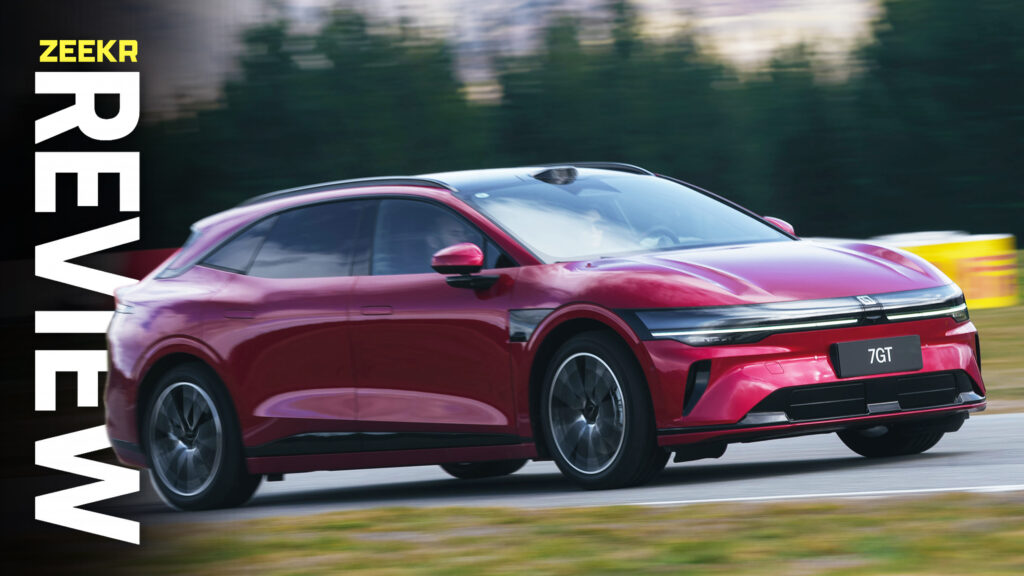
The 7GT, also badged as the 007 GT in China, proves that Zeekr is willing to take risks and offer a competitor to the Porsche Taycan Sport Turismo, a vehicle which itself hasn’t exactly been selling well. Based on the 007 sedan from a few years ago, it’s perhaps Zeekr’s most promising new model.
Review: We Drifted Zeekr’s Lineup On Ice, And The Cheapest One Surprised Us
Sales of the 7GT have been ongoing in China since last year, and it’ll soon launch in Australia and Europe as well. We recently had the opportunity to drive it on the track and in the snow to see whether it’s a legitimate rival to the Germans and whether it should be considered over other existing Zeekr models, like the 7X SUV.
QUICK FACTS
| › Model: | 2027 Zeekr 7GT |
| › Starting Price: | AU$TBC |
| › Dimensions: | 189.6 x 75.1 W x 57.3 in H (4,817 x 1,910 x 1,456 mm) |
| › Wheelbase: | 114.1 in (2,8900 mm) |
| › Curb Weight: | 2,285 kg (5,037 lbs) in Europe-spec |
| › Powertrain: | 75 – 103 kWh battery / RWD and AWD |
| › Output: | 671 hp (500 kW) / 516 lb-ft (700 Nm) |
| › 0-62 mph | 3.5 seconds (0-100 km/h) |
| › Transmission: | Single speed |
| › Efficiency: | TBC |
| › On Sale: | Now |
SWIPE
Photos Brad Anderson/Carscoops
Zeekr has been toying with the idea of bringing the 7GT to Australia since at least early 2025, showcasing it at car shows to gauge local appetite for the model. Prices have yet to be confirmed, but it’s expected to land at showrooms by the end of this year, or in early 2027.
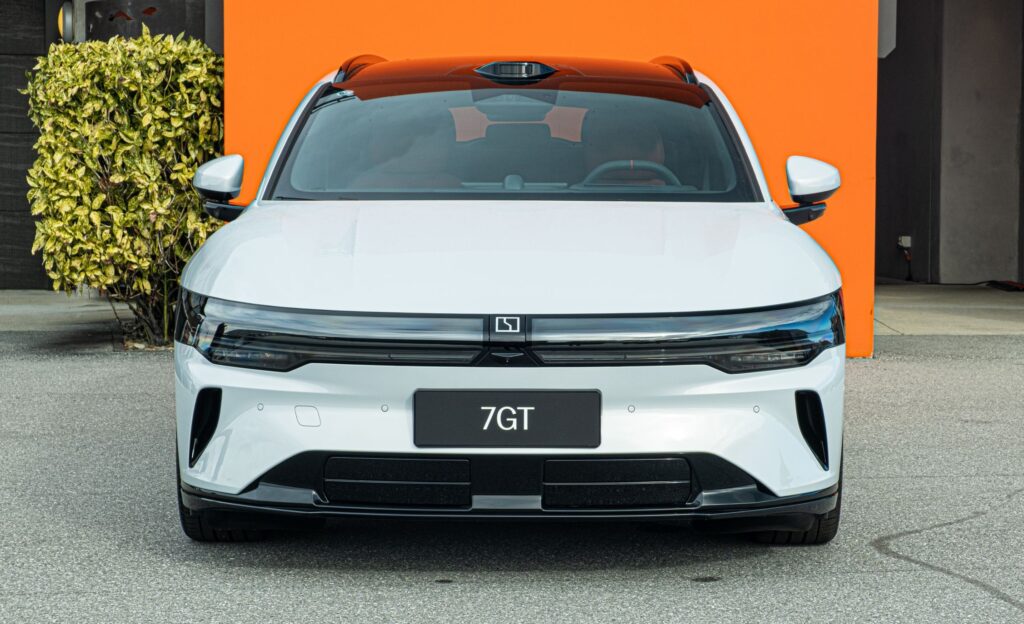
Visually, the front end shares much in common with the larger 7X, sporting a similar black band that incorporates a light bar and the main headlamps. Obviously, the extended roof, sloping rear window, and sharp D-pillars are the highlight, giving the 7GT an unmistakable presence when viewed in person.
Final specifications for Australia are still being ironed out, but the range is tipped to consist of three versions, and a potential fourth. Sitting at the base of the range will be a rear-wheel-drive model with a 75 kWh battery, 370 kW (496 hp) of power, and capable of hitting 100 km/h (62 mph) in a solid 4.8 seconds, all while covering as much as 702 km (436 miles) on a charge under the CLTC cycle. Sold alongside it will be a long-range rear-wheel-drive model with the same motor, paired with a larger 103 kWh pack.
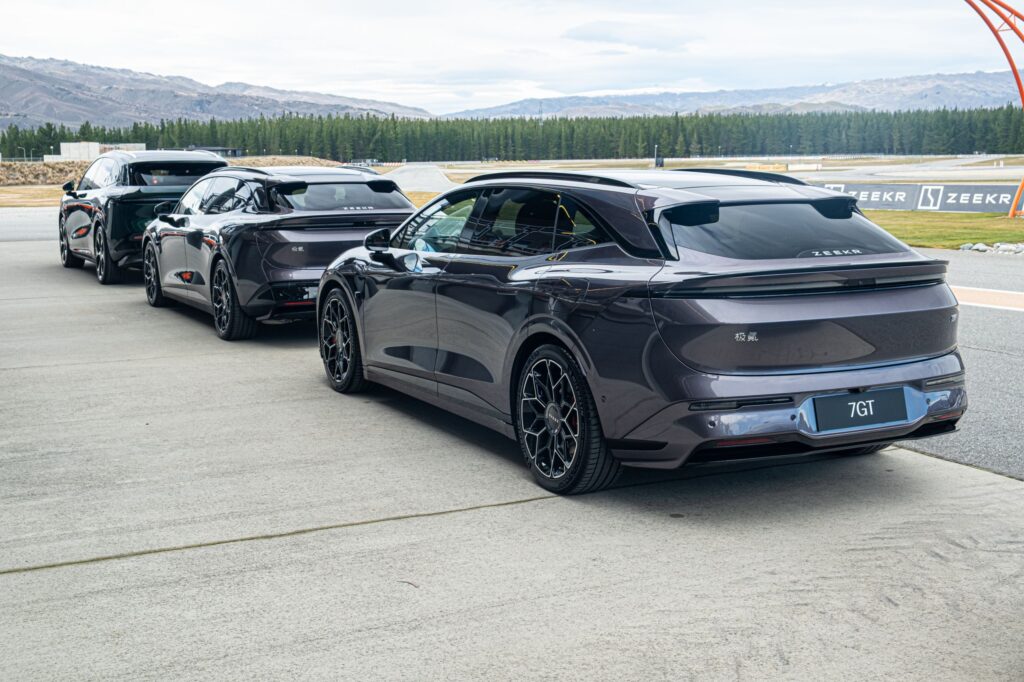

Sitting at the top of the 7GT family will be a dual-motor, all-wheel-drive model pairing the 103 kWh battery with two electric motors producing 500 kW (671 hp), up slightly from the 475 kW (637 hp) promised for the European-spec model. We drove the rear-wheel-drive and all-wheel-drive models. At a later date, the 7GT may become available Down Under with the recently announced FR-Line performance kit, which adds orange brake calipers and increases power up to an astonishing 585 kW (784 hp).
Models equipped with the 75 kWh ShenDun Golden Battery can charge from 10-80 percent in 10.5 minutes, while those with the more advanced 103 kWh CATL Qilin battery charge from 10-80 percent in 10 minutes flat.
Oozing Luxury
Photos Brad Anderson/Carscoops
As we’ve discovered in other Zeekr models, the cabin of the 7GT feels more premium than lots of the established competition, including models from BMW and even the Audi S5 Avant we tested earlier this year.
While the 7GT could simply be considered a Shooting Brake version of the regular 007 sedan, which won’t be sold in Australia or Europe, Zeekr actually took some lessons learned from that car and applied them to the 7GT. After finding out from Chinese buyers that the 7GT was overly reliant on the touchscreen and lacked enough physical buttons, Zeekr has added plenty of physical switchgear to the 7GT.
For example, there are shortcut buttons and a volume roller dial positioned directly below the central touchscreen. The 7GT also gets the same excellent steering wheel as the 7X, rather than the 007’s wheel, which is borrowed from the smaller X and comes with some odd physical buttons and switches.
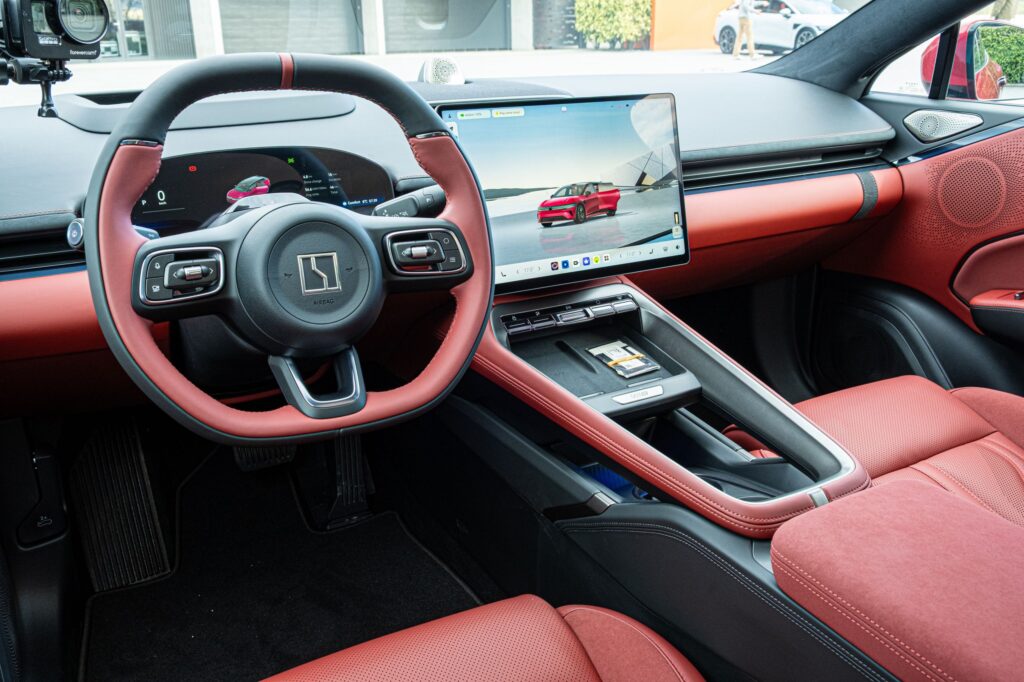
Obviously, much of the cabin is dominated by the 13.02-inch central infotainment display. As with the 7X and other Zeekr models, the carmaker’s software is excellent, largely mimicking Tesla’s in overall layout and operation. Those accustomed to driving new cars won’t have any trouble getting to grips with the detailed settings and menus, although others may find it a little overwhelming at first.
Positioned in front of the driver is a separate 15.4-inch display with a curved design that feels classy, although customization options for this screen are somewhat limited. The 7GT also comes standard with a 35.5-inch augmented reality head-up display.
The central tunnel houses two wireless smartphone charging pads, large storage cubbies, two cupholders, and a spacious center console. High-quality touches found throughout include the metal speaker grilles, the soft-touch leather across the door panels, dashboard, and seats, and the Alcantara-trimmed headliner. It feels fitting of a car worth well in excess of AU$100,000 (US$71,800), and the 7GT is expected to cost quite a bit less than that.
Photos Zeekr Australia
Other key features include 14-way power-adjustable front seats with heated, ventilated, and massaging functions. There’s also a heated steering wheel and acoustic glass, as well as a thumping audio system and a panoramic glass roof.
Viewed from the outside, you’d think that space in the rear of the 7GT would be incredibly limited, given how low the roof seems to sit. You can imagine my surprise when I slid my 6’2” frame into the rear and found I had roughly one inch of headroom, which is better than some SUVs out there and much better than something like the Audi S5 Avant. There’s also loads of legroom thanks to the 2,925 mm (115.1-inch) wheelbase.
In terms of practicality, the 7GT includes a ski hatch and 645 liters (22.7 cubic feet) of cargo space with the rear seats in position, or 1,737 liters (61.3 cubic feet) with them folded flat. That’s comparable to some SUVs so, clearly, the 7GT is not a vehicle that suffers from not being one of them.
How Does It Drive?
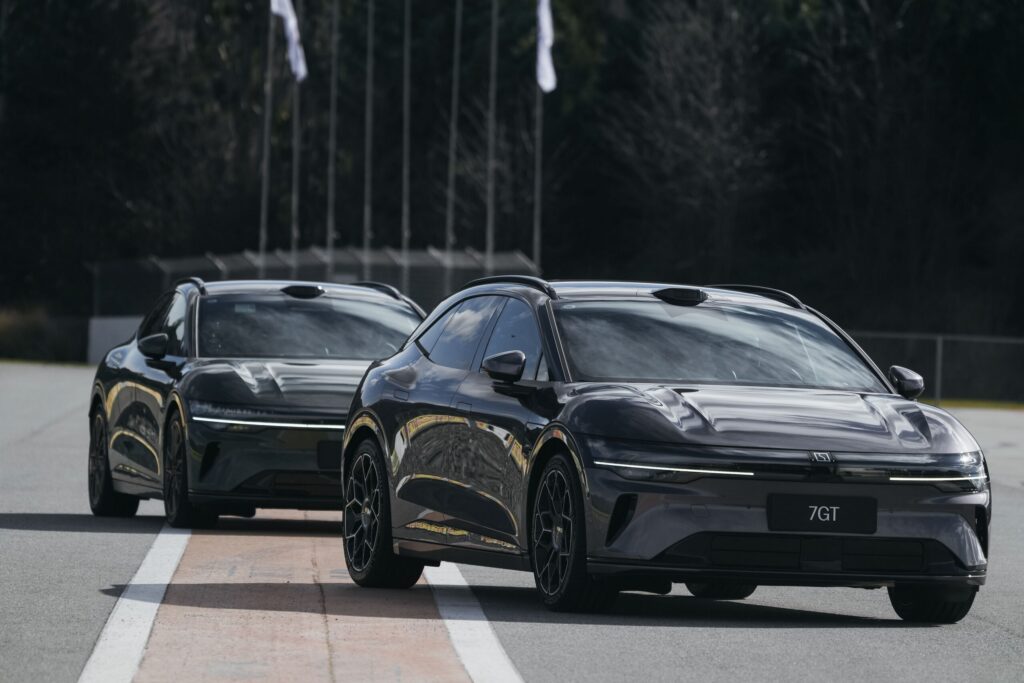

As development of the Australian-spec model is still ongoing, Zeekr shipped several left-hand-drive examples for us to test. While the steering wheel was on the opposite side, we were told everything else about the cars we tested was identical to the models that will be sold locally.
With a headline figure of 500 kW (671 hp) in the dual-motor, all-wheel drive 7GT, it’d be easy to confuse the EV as being a track-focused weapon in the same vein as the Hyundai Ioniq 6 N. But, as we learned while lapping the new Zeekr and completing tight, twisty Gymkhana setups, the track likely won’t be where the 7GT most excels.
RWD First
Our first experience was behind the wheel of a bright pink, rear-wheel-drive model on a Gymkhana course, designed to test the car’s low- and mid-speed dynamics. Immediately, the rear-wheel-drive model, with its 370 kW (496 hp), felt more than quick enough for fun.
Photos Brad Anderson/Carscoops
Local weight figures have yet to be confirmed, but the 7GT will obviously weigh north of 2,200 kg (4,850 lbs). It does a good job of carrying its weight, though, even as we punished the tires. The suspension feels more road- than track-focused, which is a good thing, soaking up bumps well and feeling quite plush, all while keeping the 7GT locked to the pavement. Of course, a road test will be needed to see just how comfortable Zeekr’s latest car is, but initial impressions are good.
Holding the 7GT back is the traction control system. Zeekr didn’t want us to adjust or turn it off, so we kept it on. Attempting to accelerate out of corners with the TC on can be a little frustrating, as it clamps down on power even when you’re pointed straight ahead. Interestingly, the stability control allows a little bit of slip at the rear axle without issue; it’s just under power that the traction control is too obtrusive.
Our time in the rear-wheel drive 7GT also included several high-speed lane changes, similar to a moose test at around 90 km/h (56 mph). The car performed exceptionally well in this environment, responding to aggressive steering inputs without understeer.

Later in the afternoon, we had the opportunity to test the all-wheel drive 7GT on the track, following a 7X Performance pace car. Our track experience consisted of a single warm-up lap and two hot laps, though they were more like ‘warm’ laps, as we were unable to push the 7GT beyond about 80 percent of its capabilities.
As we discovered during the Gymkhana sessions, the 7GT has a neutral balance through most turns, although it can be pushed into controllable understeer if you’re a little too greedy on the entrance to a corner. With 500 kW (671 hp) on tap, the 7GT then picks up speed at a startling rate when pulling out of a turn.
However, the traction control once again proved to be annoying on the track, cutting power when accelerating out of turns. The front-end of the all-wheel drive model also isn’t quite as reactive as the RWD.
Photos Zeekr Australia
The steering feel is good, and it’s easy to place the 7GT at speed. It’s also a piece of cake to control should the rear end want to get involved. Similarly, the brakes proved more than capable of a couple of reasonably quick laps, although we did hear some other journalists report a bit of fade.
The following day, we also had the chance to drive the all-wheel-drive 7GT on snow and ice, alongside other Zeekr models like the X, 7X, 8X, 9X, and 001 FR. Finally, we were given the go-ahead to turn off the traction control on the sleek Shooting Brake completely, and it proved to be an utter joy to drift around.
Photos Zeekr Australia
Unlike other Zeekr models we sampled, the 7GT felt quite rear-biased on the snow. Turning the wheel and pinning the throttle was enough to kick out the tail, and subtle pressure on the accelerator pedal allowed for some lovely drifts. Here’s hoping the 7GT delivers a similar feeling on the street or on the track if the traction and stability control systems are disabled.
The all-wheel-drive model Australia will get is expected to hit 100 km/h (62 mph) in about 3.5 seconds. Sadly, we didn’t get the opportunity to test this, but we have little reason to doubt it’ll be achievable in the real world. Cars like the Tesla Model 3 Performance and Hyundai Ioniq 6 N are a little faster, but anything under 4 seconds is definitely real quick.
Verdict
The Zeekr 7GT probably won’t be a huge seller, and almost certainly won’t sell in the same volumes as the larger 7X, but based on the first drive, it seems worthy of all the same praise handed out to its SUV sibling. Like the 7X, the build quality of the 7GT is excellent, as is the technology it’s been loaded with.
I think Zeekr has also nailed the design, creating an estate that looks incredibly sleek yet remains spacious inside, so it will absolutely work as a family car. Importantly, prospective buyers shouldn’t be talked out of a Porsche Taycan, Audi RS e-tron GT, or Hyundai Ioniq 6 N because they think the 7GT will be a phenomenal on-track performer. It does well enough on the track, but we think it’ll feel even better on the road, and hopefully won’t have to wait too long to test it where owners will likely spend most, if not all, of their time behind the Chinese shooting brake’s wheel.