


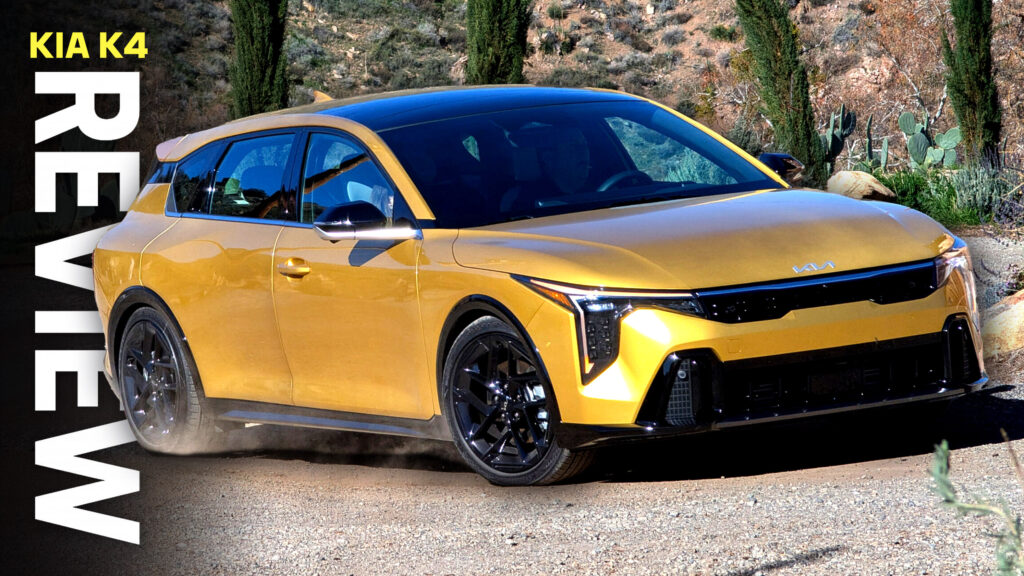
The Kia K4 is a truly intriguing car, and it’s not because of any special engine, unique hybridization, or one wild trim that costs double that of the base model. It’s because it manages to stand out when it’s sitting still. Love or hate it, Kia’s design of the K4 is a bit different than anything else in the market.
Now, for 2026, it’s adding the K4 Hatchback, which manages to keep the quirkiness while also looking a bit more mature and cohesive.
Review: 2026 Dodge Charger Sixpack Sounds Off But Drives Better Than You Think
What’s interesting about the hatchback is that it’s zeroed in on a specific subset of Kia’s audience. It’s only available in three trims, rather than the five that buyers can choose from in the sedan. It’s almost a foot shorter than the sedan, and yet it manages to increase both passenger volume and cargo space. Best of all, it costs just $500 extra when compared to the sedan.
| Model | 2026 Kia K4 Hatchback GT-Line Turbo |
| Engine | 1.6-liter Turbocharged four-cylinder |
| Transmission | 8-Speed Automatic |
| Output | 190 Hp (142 kW) 195 lb-ft (264 Nm) |
| Fuel Economy | 26 MPG City / 33 MPG Highway / 28 Combined |
| Dimensions | Overall Length: 4,440 mm (174.8 in)
Overall Width: 1,850 mm (72.8 in) Overall Height: 1,435–1,450 mm (56.5–57.1 in) Wheelbase: 2,720 mm (107.1 in) |
| Cargo | 22.2 Cu-Ft (59.3 Cu-Ft with rear seats down) |
| MSRP | $28,890 + $1,245 Destination |
SWIPE
We’ve seen all of the specs on paper for this car before. What we hadn’t done was have a chance to drive it. Last week, we took the new K4 into just about every environment a buyer could ever intend to. We drove it in Los Angeles traffic, took it over gravel roads to a winery, and even ripped it around Angeles Crest to see how it would handle one of the world’s most well-loved driving roads.
A Wagon in Disguise
Photos Stephen Rivers / Carscoops
Don’t look now, but the Kia K4 Hatchback kind of looks like a stubby wagon, and that’s absolutely a compliment. With the K4 Sportswagon not coming to the U.S., this hatchback is as wagon-like as American buyers are going to get, and the proportions work beautifully.
At roughly 11 inches shorter than the K4 sedan, the hatch looks tighter, more athletic, and more resolved. The rear end, in particular, feels far more cohesive than the sedan’s, helping the entire design come together in a way that suggests the hatchback was always the intended final form.
There’s a subtle aggressiveness here, especially in GT-Line and GT-Line Turbo trim, but it’s not try-hard. The K4 Hatchback looks sporty without pretending to be something it isn’t, and that restraint is refreshing in a segment where visual noise is often mistaken for character.
A Spacious and Practical Cabin
While we didn’t get hands-on time with the base interior, the GT-Line Turbo we tested sets a strong tone for the rest of the lineup. The dashboard and steering wheel design feel modern without being overly stylized, and, mercifully, Kia has committed to real physical buttons and switches for climate and media controls. That alone puts it ahead of several competitors still clinging to haptic touch bars that frustrate more than they impress.
The steering wheel does have one misstep: the scroll wheels lack sufficient knurling, making them harder to operate cleanly while driving. Other Kias have simple three-way switches that work better for the same feature set. It’s a small issue, but noticeable. Otherwise, the switchgear feels solid, intuitive, and refreshingly normal.
More: Kia’s K4 Just Struck A Killer Blow To The VW Golf
The seats strike a nice balance between comfort and support. They’re moderately adjustable, comfortable over long drives, and offer enough lateral bolstering to keep you planted when the road gets twisty. A run up the Angeles Crest Highway never had us bracing ourselves in corners, and that’s about as good as it gets in a mainstream hatchback.
Photos Stephen Rivers / Carscoops
Ingress and egress are generally fine, though the K4 does sit lower than some buyers may expect, especially those cross-shopping small crossovers. Rear-seat amenities are mostly solid, though only GT-Line Turbo models get rear climate vents, which feels like an unnecessary omission on lower trims. Ventilated seats are optional on GT-Line and above, which is impressive at this price point.
Space That Surprises
Photos Stephen Rivers / Carscoops
Despite being 11 inches shorter than the sedan, the hatchback actually offers more rear headroom and significantly more usable cargo space. At 6’6”, sitting behind my own driving position required no slouching or contortion. There was legitimate legroom and headroom to spare, and the rear seats felt every bit as thoughtfully designed as the fronts. There are nice little holders on the rear of the front seats for rear-seat passengers, too.
Cargo capacity checks in at 22.2 cubic feet, expanding to 59.3 cubic feet with the rear seats folded. That’s more than some compact crossovers manage, and it underscores just how efficient Kia’s packaging is here. Interestingly, the hatchback only weighs about 55 pounds more than the sedan, despite additional structural reinforcement. That’s a small penalty for a meaningful gain in usability.
Tech-Heavy Without the Gimmicks
Kia continues to be a standout regarding standard equipment, and the K4 Hatchback is no exception. The base model comes with lane-following assist, lane-keeping assist, adaptive cruise control with stop-and-go, four USB-C charging ports, a wireless charging pad, and a 12.3-inch infotainment screen.
Kia also offers pop culture–inspired display themes like Marvel, FIFA, Star Wars, and more, which won’t matter to everyone, but younger buyers will likely appreciate.
The GT-Line Turbo adds a 12.3-inch digital gauge cluster, an eight-speaker Harman Kardon audio system with subwoofer and external amplifier, and Kia’s Highway Driving Assist. Notably, this is HDA 1.0, not the vastly improved Highway Driving Assist II. Buyers who want HDA II will need to spend more, which is worth noting given how good Kia’s latest driver-assist tech has become.
In addition to the tech available or standard inside the car, Kia offers a slew of accessories that add to the outdoorsy/adventure vibe. That includes a roof-mounted bike rack, a roof-mounted cargo rack, and even an integrated tent that connects to the rear of the car. These won’t sell buyers by themselves, but they show a desire from Kia to support buyers who want to use the K4 Hatchback to its fullest potential.
Drive Impressions
From the get-go, let’s be clear about performance. The Kia K4 Hatchback is not a hot hatch, and it doesn’t pretend to be. It’s not fast, it’s not especially exciting, and it doesn’t have the sharpness of a Mazda3 Turbo. But it is well balanced, predictable, and easy to drive quickly without effort or intimidation. On everyday streets and on the highway, it’s comfortable and mostly quiet. Odd pavement can produce some loud-ish tire noise, but vibration and harshness rarely make their way into the cabin.
Review: The 2026 Kia EV6 GT-Line Still Feels Great Yet Something’s Missing
The turbocharged 1.6-liter engine produces 190 horsepower and 195 lb-ft of torque, and it’s paired with a conventional eight-speed automatic. That’s an increasingly rare and welcome choice in this class. Paddle shifter response is quick, the gear changes are clean, and the powerband is easy to manage.
Photos Stephen Rivers / Carscoops
The chassis feels composed, with minimal body roll and good overall balance. Push harder, and the car will understeer, but it does so progressively. The sightlines are good, rear visibility is better than expected for a modern hatch, and the brakes are excellent. They’re especially easy to modulate with virtually no learning curve.
Read: Kia Might Offer A Manual K4 Hatch In America, But The Wagon’s Another Story
Throttle calibration could use a bit more refinement, but once you get comfortable with it, the K4 becomes more engaging than its spec sheet suggests. In some ways, it feels like a single step away from Honda Civic Si territory… one that would ideally include a limited-slip differential and a manual gearbox. The hatchback body style alone already gives it an advantage over the Si.
The biggest downside is the engine note. Under heavy load at low revs, like on a highway on-ramp, the turbo four can sound gravelly and coarse. It’s not pleasant, but it’s also not something you encounter often in everyday driving. We didn’t get a chance to drive the base 2.0-liter CVT model, but expectations are modest. Still, the fundamental dynamics of the K4 platform should carry over.
Kia says the K4 Hatchback will get 26 mpg in the city, 33 on the highway, and 28 combined. In our testing, it mostly blew those figures away. Driving from the city up into the hills, we climbed over 2,000 feet with a heavy foot and achieved 21.4 mpg.
That sounds rough until you take into account going back down later, where we managed 39.8 mpg. Combined, that’s 27.8 mpg, and it doesn’t take into account our third leg of driving, where we achieved 33.5. In other words, it met or beat its EPA mark in our testing, and that’s impressive.
What Else Is Out There?
Plenty of segments today are packed with great options. The compact hatchback class isn’t as big as others in North America, but the competition is fierce nonetheless. The Honda Civic Hybrid Hatchback is probably the elephant in the room, so to speak.
It’s not much more expensive ($30,595) than the K4 Hatchback GT-Line Turbo ($28,990). That extra cash provides Civic Hybrid buyers with more power, more cargo space, and wildly improved fuel economy. The downside is the CVT, which blunts driver engagement, but if speed is all one cares about, the Honda is quicker overall.
Speaking of quicker, not even the Honda can hold a candle to the Mazda3 Hatchback Turbo. It’s unequivocally the driver’s choice in this segment as it offers the most power, available AWD, and the sharpest dynamics of the bunch. At the same time, it’s the most expensive, least efficient, and least practical, too.
Review: Audi’s 2026 RS3 Sedan Is A Hyper Compact In Every Way But One
Toyota’s Corolla hatchback deserves mention here as well. It’s efficient and reliable, but underpowered, cramped, and CVT-only. It’s hard to recommend over the Kia unless fuel economy is your top priority. Finally, there’s the Subaru Impreza. There’s not much to say about it, though. It exists. All-wheel drive is its lone standout feature, but in almost every other measurable way, the K4 outclasses it.
There’s also something to be said of Kia’s dominating warranty coverage. It offers five years or 60,000-miles of limited warranty coverage. That’s the same amount of time that most of its rivals see their powertrain coverage end. Those same rivals often only offer three years and 36,000 miles of limited coverage. Kia covers the powertrain for 10 years or 100,000 miles.
It’s worth noting again that we didn’t drive the non-turbo version of the K4 Hatchback because it wasn’t available. That said, it could be more compelling against its competition at the lower end of the spectrum. Hopefully, Kia will help us get into a K4 Hatchback EX or GT-Line sooner rather than later so we can sort that out.
Final Thoughts
The K4 Hatchback drives away from this review having done all it needed to do and a little more. It’s a competent car with good styling, above-average content, good build quality, solid driving dynamics, and a reasonable price point. Don’t get us wrong. It’s far from a perfect car.
Read: Subaru Just Made Its 2026 Impreza A Lot Pricier And Weaker
We’d love to see Kia offer it with a hybrid powertrain, a manual gearbox, available all-wheel drive, and if we had a crazy fever dream wish… a proper performance spec with an AWD system. Hey, Genesis could do it, and we’d be almost as stoked.
That said, what’s already here is worth a look for anyone with $30,000 at most to spend and the desire for something that drives well, isn’t a crossover, and offers a lot of practicality. As long as buyers are comfortable embracing something that looks a bit more like a wagon than a traditional hatchback, this should be a genuine success for Kia.