 by
by Updated Hyundai Tucson Sheds Its Camouflage
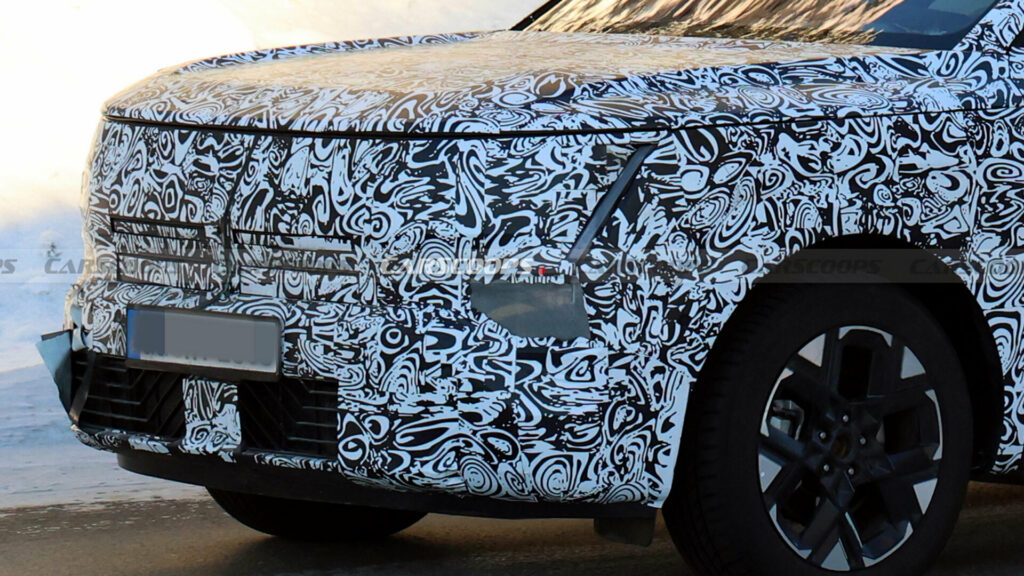
Test prototypes of the updated Hyundai Tucson have repeatedly been caught by spy cameras, but always under thick black camouflage. Now the situation has changed – one of the prototypes was spotted practically without heavy protective equipment.
This allows for the best look yet at the future model, which has inherited some features from last year’s Crater concept car. However, the production crossover looks noticeably less aggressive and has a completely different front end.
Details of the New Design
The car appears to have received a fully enclosed radiator grille or a smooth surface in its place. It is framed by strict daytime running lights that flow into large headlight units. Below are the central air intake and a wide lower grille. The latter is decorated with horizontal crossbars that curve upward in the central section, adding expressiveness to the design.
Continuing the review, one can notice a clamshell-type hood and a relatively straight window line. These are not the only changes – the pronounced body curves of the predecessor have given way to more dynamic and clean surfaces, as well as flush door handles. Designers have also significantly increased the front overhang of the body and added pronounced wheel arches, which in these photos are still hidden under black-and-white camouflage.
Changes at the Rear and Expected Technologies
The rear reveals fewer details, but the characteristic claw-shaped taillights have been replaced by large vertical units located at the edges. The license plate niche has also moved from the tailgate to the bumper.
Hyundai is keeping the details secret, but the updated Tucson is expected to debut later this year with a new hybrid powertrain.
A significantly improved plug-in hybrid version and a possible modification from the high-performance N division are also expected.
Prospective High-Performance Version
It is the N version that generates the most interest. Rumors suggest it will receive a new generation of the 1.6-liter turbo engine, as well as a rear electric axle. Such a combination will provide all-wheel drive and, according to unconfirmed data, power of around 300 horsepower.
The presentation of the completely new Tucson will mark an important step for Hyundai in the compact crossover segment. The transition to a more dynamic and electrified design aligns with general market trends. The emphasis on hybrid technologies and the possibility of a powerful N version indicate the brand’s desire to meet both environmental requirements and the demand for driving excitement. The success of this model will largely depend on how successfully it manages to combine the new look, advanced powertrains, and the Tucson’s familiar practicality.