
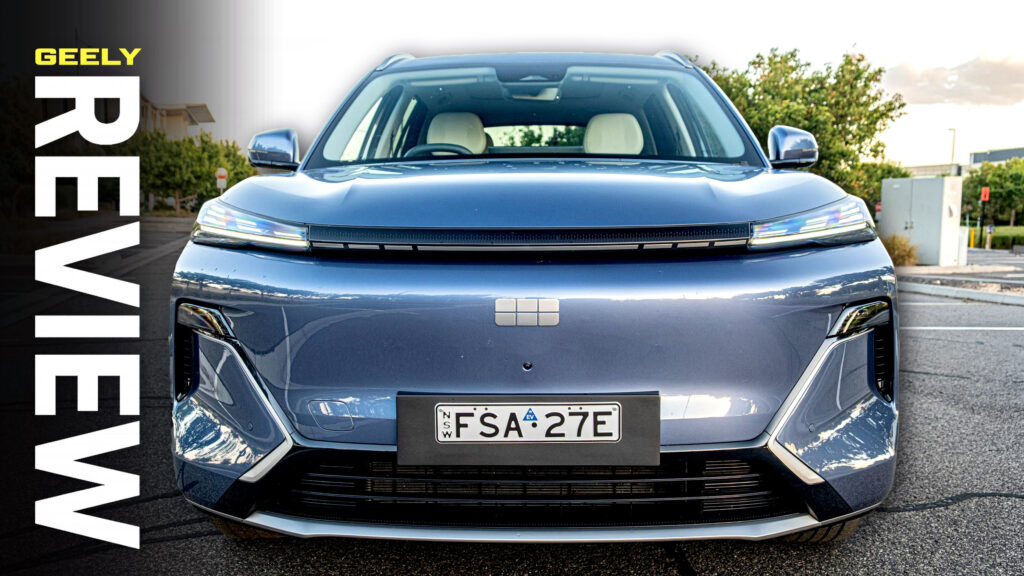
 by
by While much of the recent spotlight has been fixed on BYD’s meteoric ascent, another Chinese heavyweight has been quietly building scale and influence of its own. Geely has spent the past few years expanding its footprint, and the results now speak for themselves. The company has steadily climbed the global ranks and established itself as a leader not just in China, but worldwide.
Last year, the Geely Group sold 4.12 million vehicles, making it the eighth-best-selling car group globally. That puts it ahead of both Honda and Nissan, and fewer than 300,000 units behind Ford. Not bad for a brand that, until recently, many Western buyers still considered an emerging player.
Much of the recent attention surrounding Geely has centered on its expanding portfolio of brands. Volvo, Polestar, Lotus, Lynk & Co, Riddara, Smart, and most recently, Zeekr. However, the Geely brand itself also has several intriguing models of its own on sale.
QUICK FACTS
| › Model: | 2026 Geely Starray EM-i Inspire |
| › Starting Price: | AU$39,990 (US$28,100) as tested |
| › Dimensions: | 186.6 L x 75.0 W x 66.3 in H (4,740 x 1,905 x 1,685 mm) |
| › Wheelbase: | 108.4 in wheelbase (2,755 mm) |
| › Curb Weight: | 1,739 kg (3,212 lbs) |
| › Powertrain: | 1.5-liter four-cylinder / single electric motor |
| › Output: | 259 hp (193 kW) / 92 lb-ft (125 Nm ICE) + 193 lb-ft (262 Nm EV) |
| › 0-62 mph | 8.0 seconds |
| › Transmission: | Single-speed |
| › Efficiency: | 5.1l/100 km (46.1 US mpg) / 16.1 kWh/100 km as tested |
| › On Sale: | Now |
SWIPE
The latest example is the Geely Starray EM-i. It enters the market as a direct rival to the BYD Sealion 6, as well as established plug-in hybrids such as the Mitsubishi Outlander PHEV and Mazda CX-60 PHEV. In Australia, it arrives with sharp pricing and a generous equipment list, positioning itself as a serious value proposition in a crowded segment.
What Exactly Is It?
Photos Brad Anderson / Carscoops
The Starray EM-i is just the second Geely-branded vehicle to be sold in Australia, joining the all-electric EX-5 in the local family. It’s offered in two configurations, known as the Complete and the Inspire. We recently had the opportunity to live with the flagship Inspire.
The starting price of the Starray EM-i is quite remarkable. The base model is priced from AU$37,490 (US$26,400), while the Inspire starts at AU$39,990 (US$28,100). This means it undercuts the BYD Sealion 6 and Toyota RAV4 Hybrid by almost AU$5,000 (US$3,500) and is more affordable than even the most basic petrol Kia Sportage, which starts at AU$38,490 (US$27,100).
So, what do you get for your money? As it turns out, a lot. Power is provided by a 1.5-liter four-cylinder petrol engine, an 18.4 kWh lithium-ion battery, and an electric motor. It delivers a combined 193 kW (259 hp), while the engine muscles up 125 Nm (92 lb-ft), and the electric motor is rated at 262 Nm (193 lb-ft) of torque. Geely claims an all-electric driving range of 83 km (52 miles) and a combined range of 943 km (586 miles).
A Cabin Above Its Price
Photos Brad Anderson / Carscoops
The cabin of the Starray EM-i is a pleasure to spend time in and does not reflect its bargain price point. If you welcomed someone into the cabin who didn’t know how little the Geely cost, they’d probably think it’s worth north of AU$70,000 (US$49,300). Indeed, I know someone who recently bought a new Lexus NX who felt a little buyer’s remorse after test-driving a Starray.
Review: BYD Sealion 6 Makes Plug-In Hybrids Feel Seamless But Fun Is Optional
Sitting in the center of the dashboard is a large 15.4-inch infotainment display. It includes wireless Apple CarPlay, but at the time of writing, it did not have any Android Auto functionality, which is a shame. Fortunately, Geely will add it via an over-the-air software update for the Starray and EX5 in the coming weeks.
As it stands, the included software is good. The display is crystal clear and responsive, though it can take 7-8 seconds to boot, unlike the Zeekr 7X’s instantaneous start. On the plus side, the reverse camera does load instantly if you jump inside and immediately put the Starray into reverse. The same cannot be said about the Leapmotor C10 we recently tested.
How Smart Is The Software?
Photos Brad Anderson / Carscoops
The software is easy to use and understand, with large icons and fonts that are easier to read than those of some competitors. At the base of the screen are several configurable shortcuts, including one for the climate-control temperature, which is common on many cars with large screens like this. What’s not so common is to have a fan speed adjustment shortcut, which I really appreciated for on-the-fly adjustments.
Elsewhere, the Starray EM-i has a 10.2-inch digital instrument cluster. Like the main display, it’s clear and bright but offers virtually no customization options, which is unfortunate.
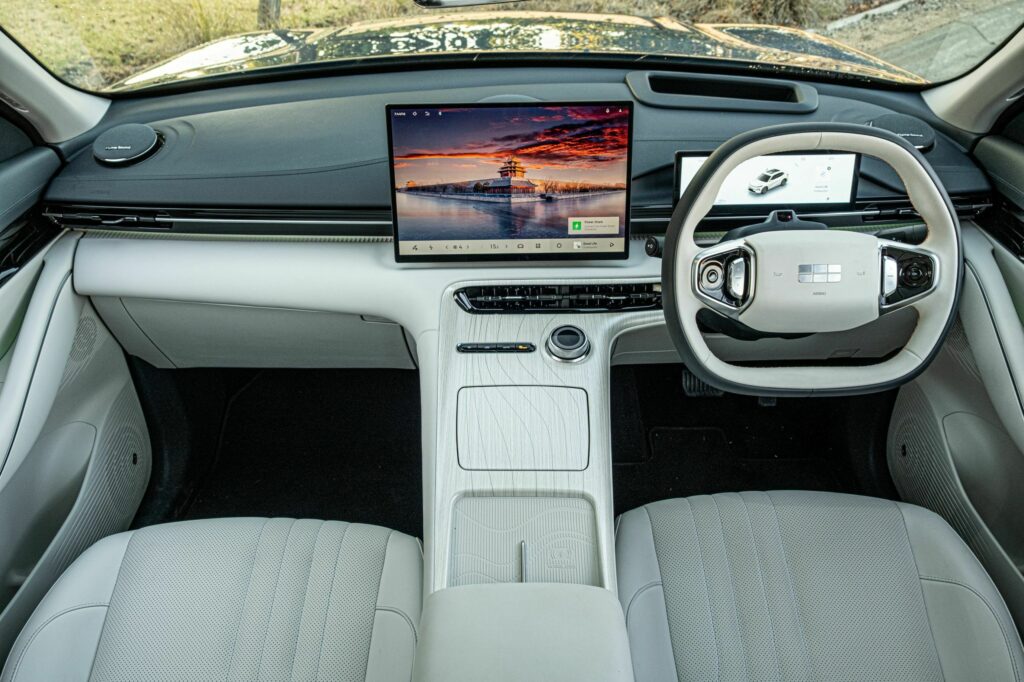
Overall, the dashboard and floating center console are elegant, particularly with the Ivory White finish on the vehicle we tested. There’s no cheap piano black plastic, and instead, the floating console has a faux wood finish that looks elegant and classy. There are also two cupholders, two wireless phone chargers, and a large storage compartment.
Added features include a 13.4-inch head-up display, heated and ventilated front seats, and a 16-speaker, 1,000-watt audio system in the Inspire. Curiously, there’s no adjustable lumbar support, and that alone may turn off some potential buyers.
Perhaps my favorite feature of the cabin was the large dial on the console. In addition to volume adjustment, it can be configured to control temperature and fan speed, which is useful.
Comfort And Practicality
Overall comfort is good, and the fit and finish are excellent. With that being said, the flat-bottomed and flat-top two-spoke steering wheel won’t be to everyone’s taste, but I quickly grew accustomed to it. It’s also nice to see not only a full-length panoramic glass roof, but one that includes a sliding shade (unlike Tesla’s) and a sunroof that actually opens.
The second row also feels more luxurious than the price tag suggests, and there’s good headroom for even those over 6 feet tall. Amenities include cupholders, USB-A and USB-C ports, and air vents, but there are no fan-speed or temperature controls for rear-seat passengers. Cargo space is solid, with 428 liters (15.1 cubic-feet) in the rear with the seats up, or 2,065 liters (72.9 cubic-feet) with them folded away.
The Drive
Photos Brad Anderson / Carscoops
Driving the Starray EM-i could be best described as a serene experience, and that’s a very good thing.
If the battery is charged, it’ll happily putt around on electric power for much of the time, only calling on the engine at higher speeds and if you plant your foot on the throttle. I didn’t have the opportunity to perform a range test on EV power alone, but when I was driving on electric power, I averaged a solid 16 kWh/100 km. Owners who keep the battery charged could run on electric power alone for most of their daily driving.
When the combustion engine is running, it operates largely in the background, and it’s often hard to tell if it’s on or if it’s off, as it runs so quietly. Geely says the Starray EM-i can hit 100 km/h (62 mph) in 8 seconds, and while that’s not quick by any means, it’s more than rapid enough for most buyers.
Photos Brad Anderson / Carscoops
Unlike many PHEVs and EVs which are rear- or all-wheel drive, the Starray EM-i is front-wheel drive. That’s generally not a bad thing, resulting in predictable and safe handling. However, there were a couple of occasions when the front inside wheel briefly spun up while I was accelerating out of a tight bend, or while the wheel was unloaded while pulling out of a driveway.
There are several driving modes available for the powertrain, including pure EV, Hybrid, and Power, the latter two of which enable the engine and electric motor to operate in unison. There is also a mode (hidden within the menu) to get the four-cylinder to slowly replenish the battery for some all-electric driving, which comes in handy if you don’t have easy access to a charger. It’s also possible to adjust the level of brake regeneration, so you can also recoup some electric power this way.
Ride Comfort Prioritized
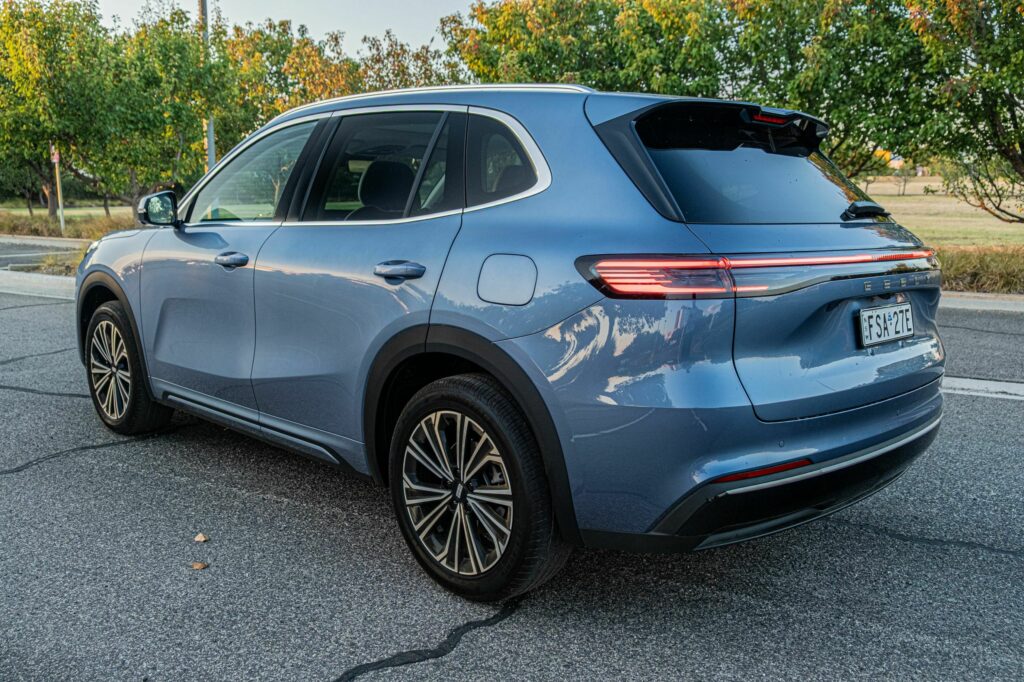
The ride of the Starray EM-i is beautifully plush. Many electrified SUVs are too stiff, but that’s not the case here. It remains soft over road imperfections and soaks up speed bumps well. The downside of the soft ride is that the Geely can take a few meters to settle after taking a speed bump.
I was also rather fond of the steering of the Starray. It offers configurable stiffness levels, but I kept it in the lightest Comfort setting, making the SUV easy to maneuver with minimal effort.
Efficiency is good. As mentioned, I averaged 16 kWh/100 km on electric power, slightly higher than the 14.7 kWh/100 km quoted by Geely. When operating with the petrol engine, I averaged 5.1 l/100 km (46.1 US mpg), slightly better than I managed in the BYD Sealion 6 last year.
Many of the frustrations of the Starray EM-i relate to some of the safety tech. For example, there’s a speed limit warning that’ll start ringing even if you’re just 1 km/h over the limit. Turning it off requires diving into the menu and five presses. Similarly, the driver monitoring system is overactive, catching you for looking away for a couple of seconds, and ringing the moment you yawn.
Verdict
The Geely Starray EM-i is an impressive piece of kit, particularly given its price. It feels just as well-built as any competitor from a legacy brand and has a surprisingly plush and spacious interior. Combined with a 7-year, unlimited-kilometer warranty, it’s hardly a surprise that it’s becoming an increasingly common sight on Aussie roads.