 by
by Corvette ZR1X will be the pace car for the Indianapolis 500
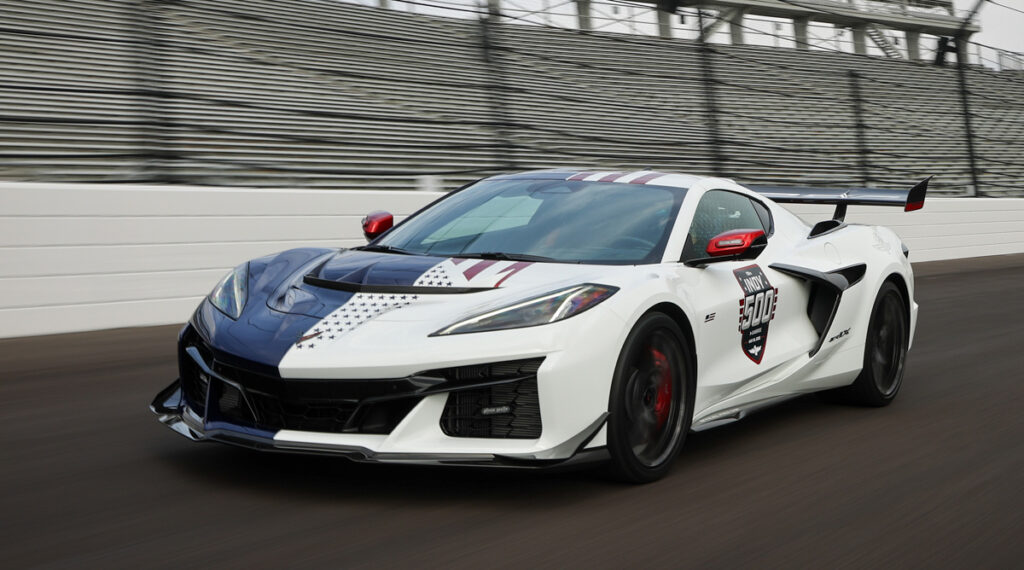
This year’s pace car for the legendary “Indianapolis 500” race will not just be a fast car, but a true hypercar. The Chevrolet Corvette ZR1X will perform the role of leader on the track on May 24 during the 110th race. This is the first time a safety car nearly matches the speed of the Indy cars themselves.
The Corvette has traditionally served as the Indy 500 pace car since 2017, but this time it’s different. The new ZR1X can accelerate to 233 miles per hour (375 km/h), which is very close to the speeds achieved by Indy cars on the oval during qualifying (230-240 mph or 370-386 km/h).
This does not mean it could maintain such a pace for a full lap. Indy cars use slick tires, have specific geometry for ovals, and weigh half as much as the most powerful C8. But it highlights how extreme the new Chevrolet flagship is. This is not a typical pace car, but an accessible hypercar with characteristics that seemed impossible until recently.
Technical Specifications and Performance
The heart of the ZR1X is a 5.5-liter twin-turbocharged V8 engine that delivers 1064 hp (1079 hp) to the rear wheels. Paired with it is a front electric motor producing 186 hp (189 hp). The total system power reaches an incredible 1250 hp (1267 hp), which is transmitted to all four wheels for maximum road grip.
The car’s performance is as impressive as the power figures. Chevrolet claims the ZR1X can accelerate to 60 mph (96 km/h) in less than 2 seconds, putting it on par with the world’s best hypercars.
Aerodynamics and Design
To perform the duties of a pace car, the ZR1X is equipped with the Carbon Aero package. It includes front splitters, aerodynamic fins underneath, and a large rear wing, which together generate over 1,200 pounds (544 kg) of downforce at speed.
Along with performance, design plays an important role. The Corvette’s livery is done in a patriotic style to honor America’s 250th anniversary. One side of the car is painted Arctic White, the other Admiral Blue. Red accents and star-spangled graphic elements complete the theme. Inside the cabin, the patriotic mood is supported by Santorini Blue seats, red seat belts, and floor mats with matching embroidery.
Driver and Historical Context
The task of driving the pace car during the 110th race has been assigned to the head football coach of Indiana University, Curt Cignetti. He will lead the field of 33 cars to the start. The Corvette has a long history at Indianapolis, but never before has the gap between the safety car and the race car been so small, at least when it comes to straight-line speed.
This move by Chevrolet demonstrates how hybrid supercar technologies are approaching the level of professional racing series. Although the ZR1X cannot compete with an IndyCar on the turns due to its significant weight and lack of specialized oval suspension geometry, its straight-line dynamics are impressive. In fact, this is a symbolic moment when a “road-going” car almost catches up with “thoroughbred” race cars in terms of top speed, highlighting the incredible progress in the development of production hypercars over the last decade.