 by
by New Lexus electric flagship: three-row TZ crossover unveiled
Lexus has officially introduced the TZ model — a fully electric three-row six-seat SUV that will become the brand’s flagship family EV, positioned above the RZ model in the lineup. The new vehicle is built on the same platform as the Toyota bZ Highlander, but features a redesigned body, a more premium interior, and a more powerful all-wheel drive powertrain, justifying the Lexus badge on the hood.
Design and dimensions
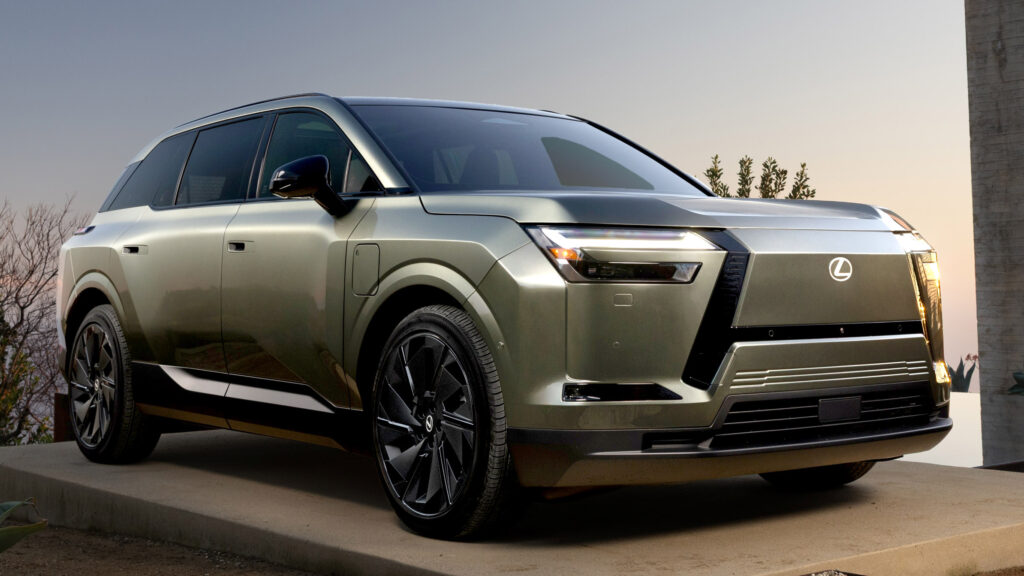
The Lexus TZ measures 5,100 mm in length, which is 50 mm longer than its Toyota counterpart, although both models share an identical wheelbase of 3,050 mm. Stylistically, the vehicles differ significantly. The front end of the TZ features a closed spindle-shaped grille framed by two-tier LED headlights, while the squared-off hood borrows visual cues from the more rugged Lexus GX. The side panels have pronounced stamping around the wheel arches, drawing attention to the standard 22-inch wheels (20-inch wheels are available as an option for those seeking a more comfortable ride and, likely, greater range).
The semi-flush door handles and roof pillars appear to be carried over from the Toyota, but the roofline slopes toward the rear, forming a slightly longer rear overhang. The rear of the vehicle features a large roof spoiler, full-width LED taillights, and vertical L-shaped turn signals.
The quietest Lexus with a soundtrack from the LFA
Inside, Lexus positions the TZ as a “relaxing lounge experience” for all passengers. The cabin is designed to seat six passengers across three rows. Engineers paid significant attention to sound insulation and NVH tuning, claiming the TZ will be the quietest vehicle in the brand’s SUV lineup, including the flagship LX.
However, the TZ is not obligated to always remain silent. The Active Sound Control system reproduces synthesized sound scenes tied to accelerator pedal input, including “musical chord sequences” and, more interestingly, a mode that mimics the wail of the V10 engine from the LFA supercar.
Three rows of seats and hidden touch controls
The first and second-row seats feature ventilation and power footrests, and even the third-row seats promise “couch-like softness.” The second and third rows are equipped with a one-touch folding function to increase cargo space. Passengers will also find various storage compartments, including a removable rear console.
The dashboard is dominated by a large touchscreen for the new infotainment system, complemented by a digital instrument cluster. Unlike the Toyota, which has a row of physical buttons beneath the screen, Lexus uses touch-sensitive buttons that remain hidden on the dashboard and steering wheel when not in use, combined with a textured volume cylinder.
Other features include a panoramic roof, soft-close doors, configurable ambient lighting, and a 21-speaker Mark Levinson audio system. Eco-friendly materials are used in the trim: forged bamboo inserts and bio-ultrasuede. The latest Lexus Safety System+ 4.0 safety suite is fitted as standard.
All-wheel drive and up to 300 miles of range
The SUV is based on a reinforced version of the TNGA architecture and will be available exclusively as an electric vehicle. Two electric motors produce a combined 402 hp and 500 Nm of torque, surpassing the most powerful version of its Toyota counterpart. Power is sent to all four wheels via the standard Direct4 AWD system. The driver has access to an active rear steering system, five drive modes (Normal, Sport, Eco, Range, Rear Comfort), and five levels of regenerative braking.
According to Lexus, the 0-100 km/h sprint takes 5.4 seconds, and the towing capacity is 1,588 kg.
Buyers will be able to choose between two lithium-ion batteries with capacities of 76.96 kWh and 95.82 kWh. The larger battery provides an EPA-estimated range of approximately 483 km, which is 32 km less than the Highlander’s maximum range, likely due to the higher power output. For global markets, the following figures are claimed: WLTP — 530 km, WLTC — 620 km, CLTC — 640 km.
The North American version of the TZ is equipped with a NACS port, making it compatible with Tesla Supercharger stations. The global version uses a CCS2 port. Both support DC fast charging at up to 150 kW, allowing the battery to be charged from 10% to 80% in 35 minutes.
Production and availability
The new Lexus EV will be produced at two plants. Vehicles for North America will be assembled at the Georgetown, Kentucky plant, alongside the Toyota Highlander. Deliveries for Europe and Asia will come from the Miyata plant in Japan.
The 2027 Lexus TZ is expected to arrive at North American dealers in late 2026, and in markets in Europe, Japan, China, and other countries in early 2027. Detailed pricing and trim information will be announced later this year.
Thus, the Lexus TZ becomes a significant player in the large electric crossover market, offering not only a spacious cabin and a powerful powertrain but also unique features such as the synthesized LFA engine sound. The choice between two batteries and different charging standards (NACS for the US, CCS2 for other markets) reflects the company’s desire to meet the needs of different regions. At the same time, the slightly lower range compared to the technically related Toyota may be a compromise in favor of power and premium equipment, which is typical for the Lexus brand.