 by
by Review of GAC M8 PHEV: Chinese competitor of luxury minivans
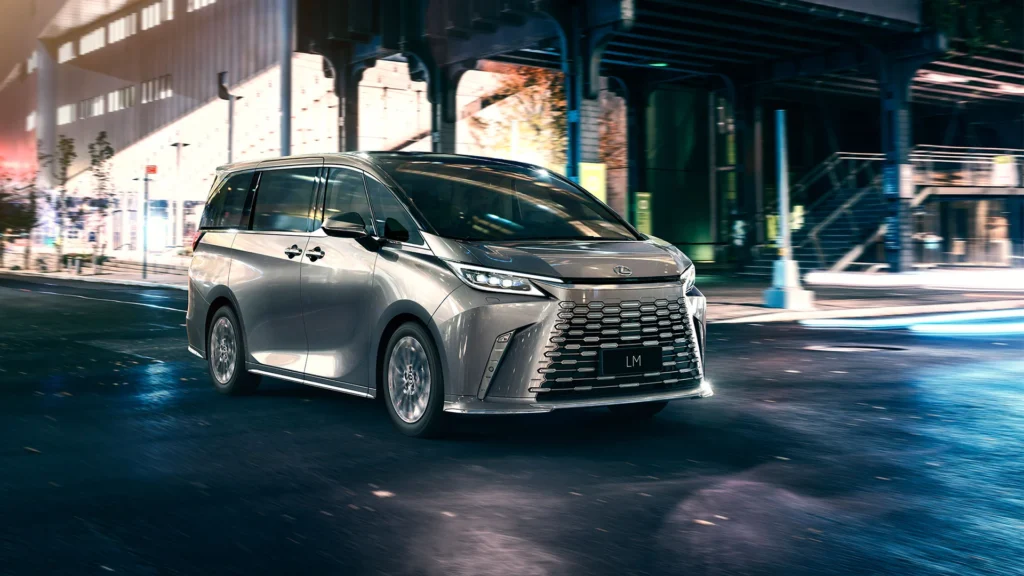
For decades, Japan has been home to the world’s best luxury minivans. Models such as the Lexus LM, Toyota Alphard, Vellfire, and Nissan Elgrand have become icons, perfectly serving those who wish to travel in something akin to a private jet on wheels.
However, in recent years, Chinese manufacturers have begun to explore this market. Companies like Denza, Zeekr, Li Auto, Nio, Hongqi, Maextro, BYD, and others have their own luxury minivans. One of the new offerings in foreign markets is the M8 model from GAC (Guangzhou Automobile Group).
Wanting to check if it lives up to expectations, we spent a week with it, driving through cities, on long highway trips, and on narrow gravel roads. The car turned out to be surprisingly balanced, although the market for such a vehicle is small.
Quick Facts
Price and Competitors
The M8 is the third model GAC has introduced in Australia. It does not try to compete in the upper segment of the luxury minivan market like the alternatives from Denza and Maextro, and it costs less than competitors like the VW ID. Buzz, competing in a niche similar to the LDV Mifa 9. The Kia Carnival is also available for similar money.
Only two versions of the M8 are sold. The first, known as Premium, starts from AU$76,590 ($53,000) before on-road costs, while the flagship Luxury we tested starts at AU$83,590 ($57,900). For comparison, the ID. Buzz starts at AU$87,990 ($60,900), LDV Mifa prices range from AU$63,501 ($44,000) to AU$129,000 ($89,300), and the Kia Carnival costs from AU$56,490 ($39,100) to AU$79,540 ($55,000).
As for the Lexus LM, it starts from AU$147,571 (US$103,000) before on-road costs for the Sports Luxury 2WD LM 350h, or AU$183,744 (US$128,253) with all costs. The LM 500h, which matches the M8 in power (366 hp), starts at AU$193,809 (US$135,279) excluding on-road costs and AU$249,272 (US$173,992) with them. For the price of one LM 500h, you can buy two M8s and still have AU$26,629 left over.
Interestingly, the M8 is the only hybrid minivan sold in Australia. It is exclusively equipped with a 2.0-liter turbocharged four-cylinder engine working together with one electric motor and a 25.57 kWh battery. Overall, it produces 274 kW (367 hp) and 630 Nm of torque, which are very solid figures. However, as we found, it doesn’t feel as fast as these numbers suggest. Drive is exclusively front-wheel via a two-speed automatic transmission.
Interior: Like a Private Jet
Such cars must have a luxurious interior, and the GAC M8 achieves this. The M8 is sold exclusively as a seven-seater with captain’s chairs in the second row. Of course, the second row has received the most attention, but the driver and front passenger are not forgotten either.
The dashboard is trimmed in soft leather, which is also used on the steering wheel, seats, and door panels. By the standards of new Chinese cars, the dashboard layout is quite traditional, without a huge tablet screen. Instead, it has a 12.3-inch digital instrument cluster and a 10.1-inch central display.
The instrument cluster screen is excellent, though customization is limited. The central screen suffers from sun glare due to its angle, so it was often hard to see in good weather. We also couldn’t find a way to automatically adjust the screen brightness depending on whether the headlights are on.
There is a lot of glossy black plastic on the center console, which isn’t very pleasant. However, we liked the unusual detail — a UFO-shaped crystal built into the gear selector. The front seats have heating and ventilation, but no massage function, which is a drawback.
Second Row: True Luxury
The main action happens in the second row. The captain’s chairs are superb, each equipped with a small touchscreen for precise adjustment and activating the massage. Other nice touches include a flat floor and a cup holder with heating and cooling. There are even airplane-style tables that fold down from the front seat backs.
Luxury is complemented by two glass roofs and a soft suede headliner. GAC has also added power sliding doors, footrests, and pleasant ambient lighting, which includes colored GAC emblems in the second roof panel.
However, the third row disappoints. There is no easy way to quickly fold the second-row seats, and the rear seats themselves are extremely cramped. Adults can only fit there for short trips, as legroom and headroom are very limited. This reduces the M8’s usefulness as a family car.
Quiet and Refined
Despite the impressive power figures, the M8 doesn’t feel like a “beast” behind the wheel, which isn’t needed for such a car. GAC claims the M8 PHEV accelerates to 100 km/h in about 8.8 seconds, but it feels a bit slower. During hard acceleration, the M8 initially uses only electric power up to 50 km/h, then the turbo engine kicks in, adding power.
The front-wheel drive works surprisingly well. Despite the significant torque, the M8 does not suffer from understeer. Wheel spin on slippery roads is minimal, possibly due to the lazy power delivery.
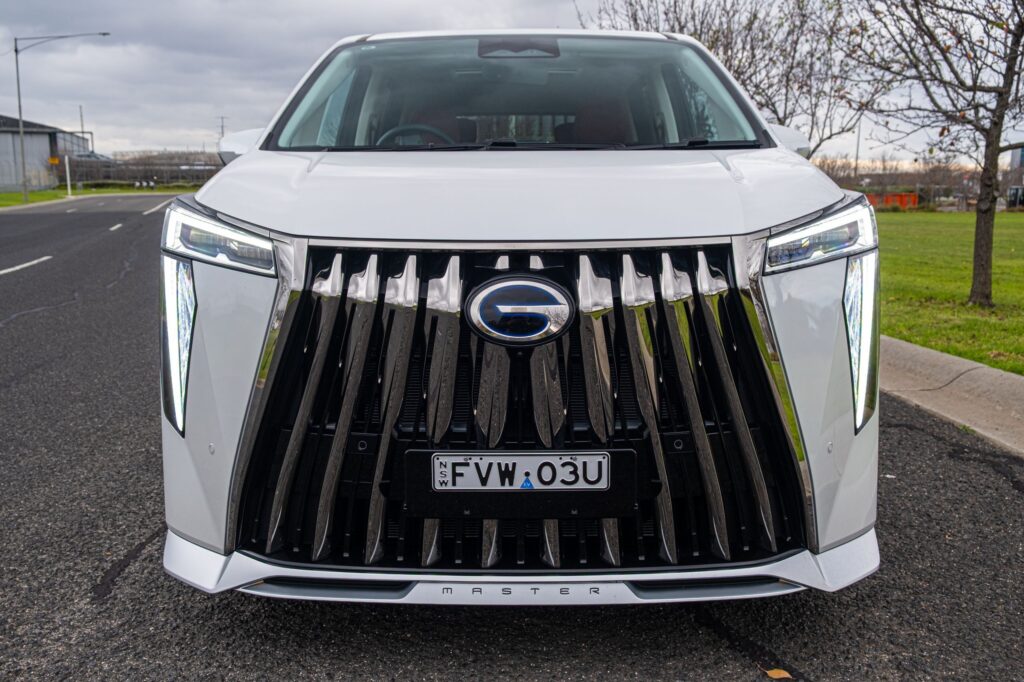
The M8 PHEV is surprisingly quiet on the highway thanks to thick dual-pane side windows. The exterior design, especially the massive chrome grille and intricate headlights, attracts a lot of attention.
The 26 kWh battery provides an electric-only range of up to 106 km. Charging speed is modest (6.6 kW AC and 39 kW DC). There is a mode that uses the engine to charge the battery, which works quite quickly, although it temporarily increases fuel consumption.
Over a week, the average consumption was 6.4 L/100 km and 4.6 kWh/100 km. This is a respectable figure for a car weighing 2,420 kg.
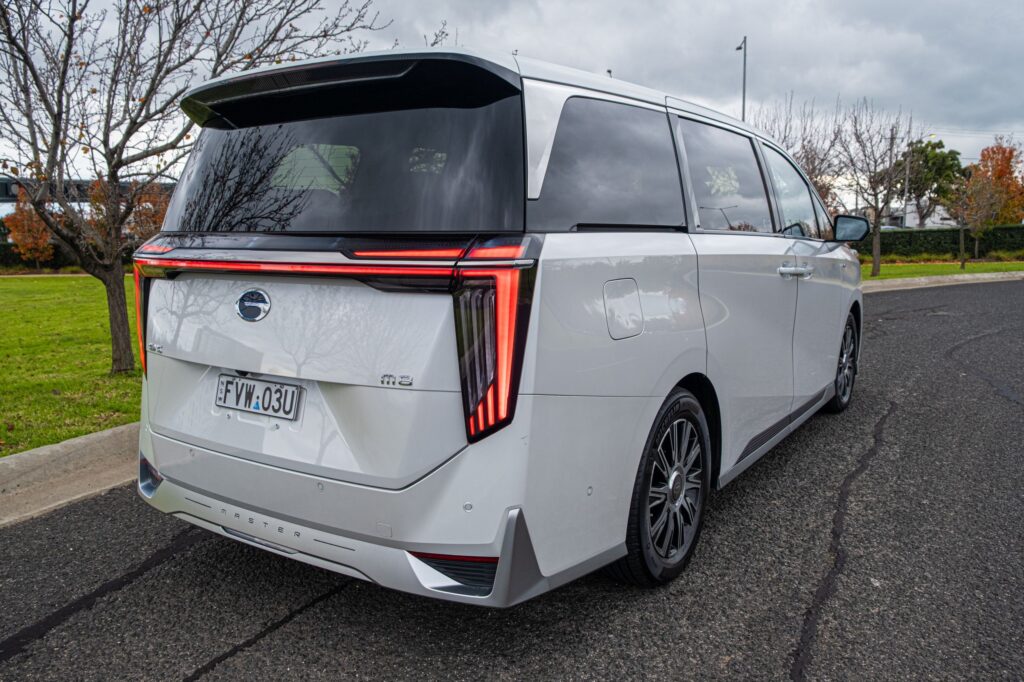
The ride quality of the M8 PHEV is excellent. The car holds the road well, effectively smoothing out even the worst bumps without feeling like a bus in corners. The steering is perfectly tuned, providing the right weight and precision.
Verdict
Like many other new Chinese cars, the M8 PHEV impresses. Buyers will have to accept the bold design, but in return, they get a car that feels premium and drives the way a luxury minivan should, for less than half the price of a Lexus LM 500h.
Due to the seat layout and cramped third row, the M8 is unlikely to be a bestseller and won’t meet the needs of many families. But as a first attempt, it is very impressive.
It is worth noting that the appearance of models like the GAC M8 signals the serious ambitions of Chinese automakers in the premium car segment. They offer a high level of comfort and technology at a significantly lower price than traditional Japanese competitors. However, the limited practicality of the third row could be a significant drawback for families looking for a truly versatile vehicle. For those who plan to use the M8 mainly as a comfortable transporter for four or five people, it could be a very attractive alternative.