 by
by Unique modifications of the Alfa Romeo 164: from a fire pickup to a racing car
The Alfa Romeo 164 holds a special place in the company’s history, as it was the last model developed independently before control passed to Fiat. However, the true uniqueness of this sedan is revealed through its unusual modifications. At the Alfa Romeo museum, two of these can be seen: a modified two-door pickup truck and a racing car with a V10 engine that has almost nothing in common with the original sedan.
Fire pickup based on the 164
The history of the Alfa Romeo fire fleet begins with the Balocco test track, opened in 1962. For rapid response to incidents during high-speed tests, firefighters worked on the track, using special vehicles created by the internal division Alfa Romeo Reparto Esperienze.
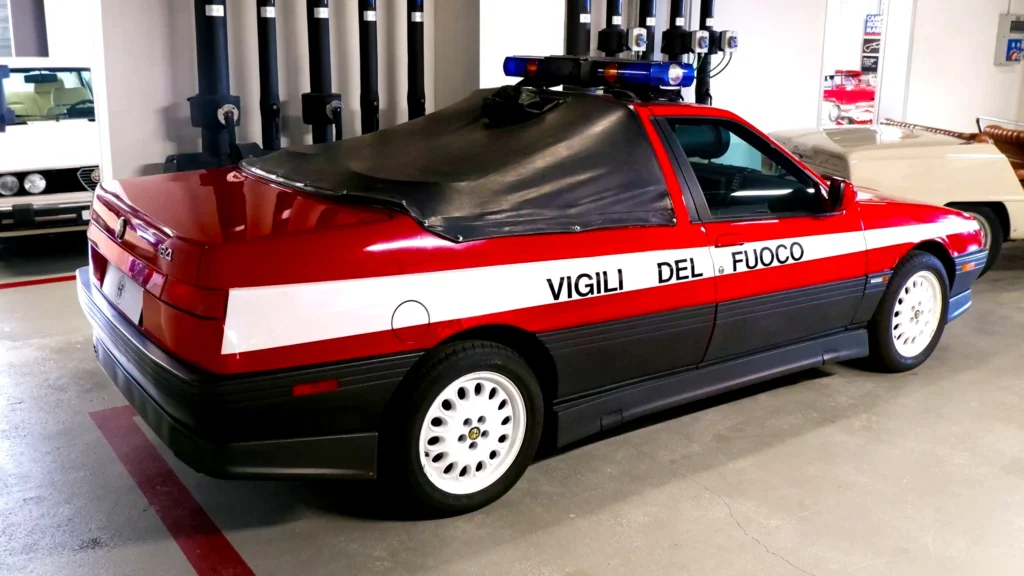
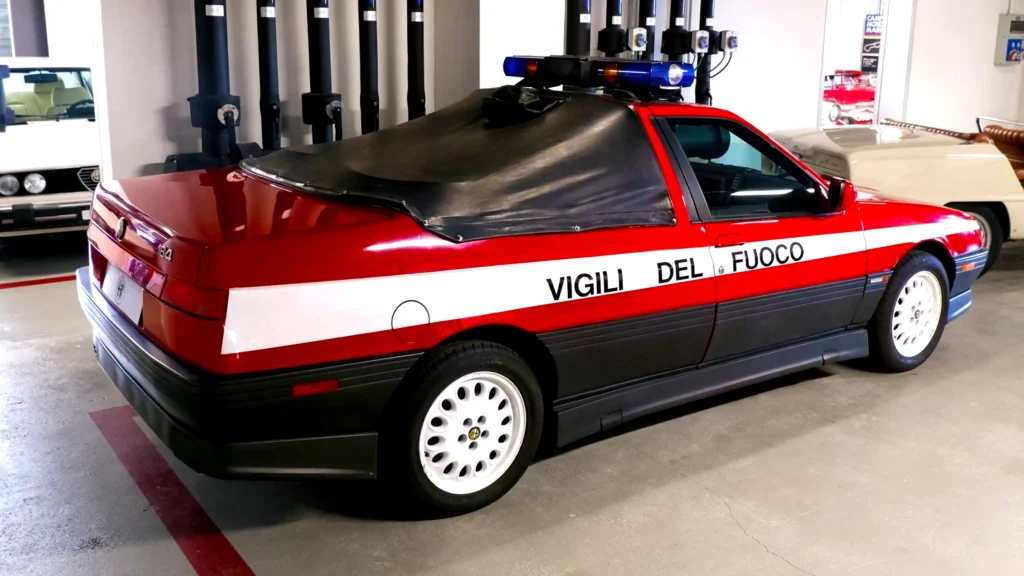
After creating fire versions based on the 1750 Berlina, Alfetta, Alfa 6, and Giulietta, engineers applied the same approach to the 164 model. The donor was an all-wheel drive Quadrifoglio 4 with a 3.0-liter V6 engine producing 229 hp (171 kW).
For the needs of the fire service, the rear part of the sedan’s roof was cut off, turning it into a pickup truck with a cargo platform. This space was used to store hoses and water pumps, which were hidden under an aerodynamic cover so as not to impair the vehicle’s handling. The car also received flashing beacons on the roof and special white markings on the red body. After its service ended, this one-of-a-kind pickup truck ended up in the museum, preserving a little-known page in Alfa Romeo’s history.
Racing car with a V10 engine
The second special car based on the 164 has even less in common with the production sedan. It was built in 1988 for the ProCar series, which the FIA planned as a support category for Formula 1. The project was closed before the first race, as Alfa Romeo turned out to be the only manufacturer that took part in it.
The rules required the car to retain the silhouette of the road model, so the Alfa Romeo 164 ProCar from a distance resembles a hot version of the sedan. However, under the hood everything is completely different. The model is based on a special carbon fiber chassis developed by Brabham, which allowed a weight of just 750 kg. Power comes from a 3.5-liter V10 engine, originally created for the Ligier F1 team, producing an impressive 620 hp (462 kW). Although the car never participated in any race, it was publicly presented at the 1988 Italian Grand Prix in Monza.
Concept cars on the 164 platform
The pickup truck and the racing car are not the only unusual derivatives of the 164 platform. It also served as the basis for two concept cars.
The 1991 Alfa Romeo 164 Proteo concept, designed by Walter de Silva, featured a two-door body that could transform from a coupe into a convertible thanks to a folding glass roof. It used a shortened sedan platform and a 3.0-liter V6 engine with all-wheel drive and four-wheel steering. Although the concept did not go into production, its design influenced the GTV and Spider sports cars.
The 1997 Scighera concept, kept at the Italdesign headquarters, was conceived as a road-going supercar with a racing version. Its low body with removable gullwing doors was made of aluminum for the road version and carbon fiber for the track version. Under the hood was a 3.0-liter twin-turbocharged V6 engine producing 400 hp (298 kW) and an all-wheel drive system borrowed from the 155 model.
The 164 sedan itself, which served as the basis for all these projects, appeared in 1987 with a body by Pininfarina. Its front- and all-wheel drive platform was developed jointly with the Saab 9000, Lancia Thema, and Fiat Croma. The model sold well and was produced until 1997, after which it was replaced by the 166 model.
These stories show just how flexible and promising the Alfa Romeo 164 platform turned out to be. It not only served as the basis for a successful production car but also allowed engineers to experiment, creating highly specialized machines for various needs — from firefighting to racing tracks. This speaks to the company’s engineering potential during a period when it still retained a certain degree of independence. Today, these rare specimens are not just museum exhibits, but living testimonies to bold ideas and unconventional solutions that often remain behind the scenes of mass production. They remind us that even an ordinary sedan can become the foundation for something truly unique.