 by
by A Dry Track Is a Critical Condition for Testing
Waiting is unpleasant. It doesn’t matter whether you’re waiting for friends who are late or for a pizza delivery that never arrives.
At home it’s usually a minor annoyance, but at work it’s a different story. At Toyota, the problem is well known: engineers had to wait for hours for the test asphalt to dry.
Straight section No. 3 at the Higashi-Fuji Technical Center is used by three teams working on automatic braking systems, including the collision avoidance system. Such tests require a dry surface, but nature doesn’t always cooperate.
To get around the weather, employees had to come to work on weekends. Toyota cites this fact:
In 2023, those employees worked on weekends more than three times as often as employees in other departments.
The Sponge That Saves Weekends
Nobody wants to work on Saturday or Sunday, so several employees decided to build a device to dry the track. The solution turned out to be surprisingly simple.
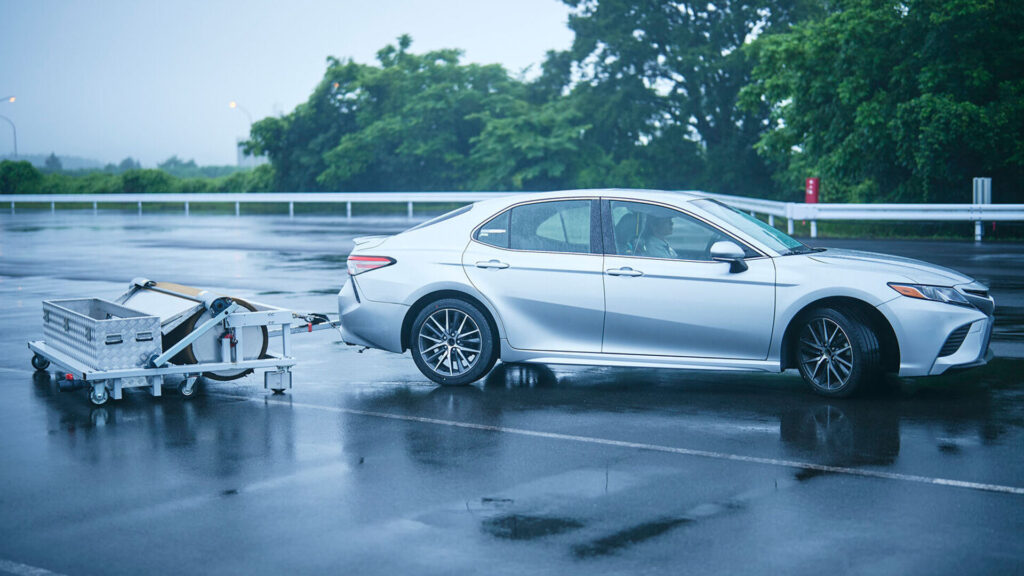
It is a huge sponge roller towed behind a car.
The roller is nearly 2 meters wide and is mounted on a wheeled cart. The sponge absorbs water, and a steel rod at the top squeezes it out. The water then goes into a rear collection tank that resembles a ribbed tool box often seen in pickup truck beds. The tank holds about 320 liters of water, and when it is full, it can be quickly emptied.
How the Idea Was Born
Despite the apparent simplicity, the team tried several approaches. Among them were heaters, vacuum cleaners, blowers, and wiper-like structures. The vacuum method worked best, but the prototype was too small, and enlarging it would have been too expensive.
Eventually, the engineers settled on a sponge and refined the concept over seven iterations. In March 2024, the device began to be used. Depending on the weather, it is used once or twice a month.
The Practical Significance of the Discovery
At first glance, it is just a sponge roller, but for the technical center it means far less downtime, faster testing, and fewer off-schedule workdays. The solution requires no complex energy-intensive equipment; in fact, it works from the motion of the towing vehicle.
This case shows that even in the high-tech automotive industry, sometimes the simplest approach is the most effective. It also reminds us that when a team has the freedom to experiment and find its own solutions, it can save hundreds of people from unpleasant routine. For Toyota, this “sponge” roller became not just a tool but also an example of how engineering ingenuity changes everyday work.