 by
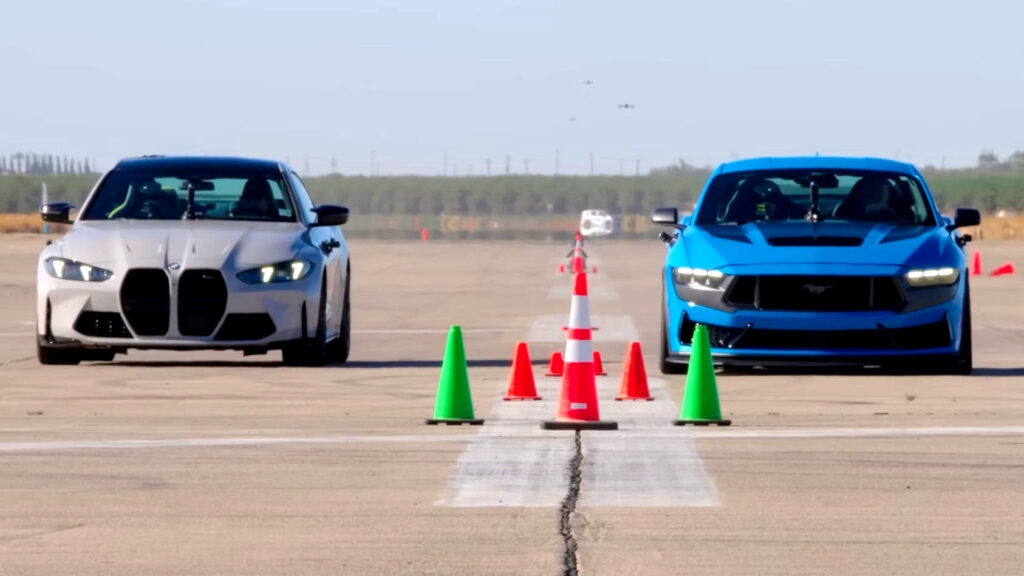
by In the unusual U-drag format race, which tests not only acceleration but also braking and cornering, the supercharged Ford Mustang Dark Horse managed to overtake the BMW M4 Competition. The main takeaways from the competition were:
The Concept of U-Drag Racing
Straight lines are made for fast cars. But how do those same cars behave during hard braking, a sharp turn, and a subsequent roll race? This is exactly what a U-drag race aims to find out, and today we see how the supercharged Ford Mustang Dark Horse stacks up against the BMW M4 Competition.
Both cars have serious specifications, great power, and more in common than one might expect. However, on the track, it’s the differences that matter.
Does Raw Power Always Win?
The first race immediately sets the tone. The rear-wheel-drive M4 Competition launches off the line swiftly and opens up a convincing lead of two to three car lengths before the Mustang can fully deploy its power to the rear wheels. However, by the end of the first quarter-mile, the gap is already starting to close.
The Dark Horse closes to within one car length before both cars brake hard. This is where everything changes.
Due to better braking stability, the Ford pulls level with the BMW, and both cars dive into the U-turn simultaneously. Exiting the turn, the Mustang finds better traction first. Once that happens, the supercharged 5.0-liter V8 spreads its wings. By the end of the second quarter-mile, the Dark Horse completely turns the tables, securing a clear victory with a two-car-length lead, while its supercharger screams all the way.
The second race unfolds almost identically, but even more decisively. The BMW again gets a perfect start and grabs the lead off the line, but this time the Mustang catches up even before reaching the braking zone. From there, it’s déjà vu. The Ford brakes later, navigates the U-turn more confidently, and pulls ahead. The final result is a clear, indisputable victory. But how did the “pony” car manage to outrun one of the best German cars?
The Answer Lies in the Numbers
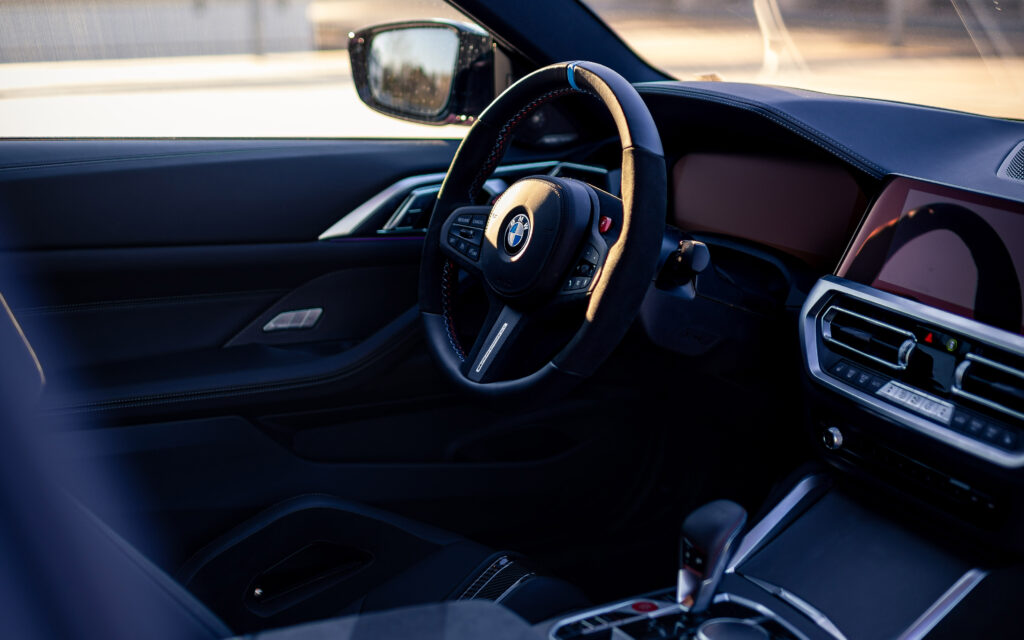
On paper, this matchup seems almost unfair. The experts at Edmunds fitted this Dark Horse with a supercharger, so it now has 810 hp (604 kW) and 615 lb-ft (834 Nm) of torque, compared to the BMW’s standard 503 hp and 479 lb-ft. Despite a higher weight of 4,122 lbs (1,870 kg), Ford’s power-to-weight ratio of 5.09 lbs per horsepower easily surpasses the M4’s 7.49.
Of course, such power comes at a price. The cost of the Mustang Dark Horse in the test configuration with the supercharger kit installed rises to $90,111, although it is still significantly, almost $19,000, lower than the BMW’s price of $108,945. In base configurations, the Ford starts at around $59,000, while the M4 Competition is over $84,000.
BMW gets its revenge at the start, accelerating to 60 mph (96 km/h) in 3.7 seconds compared to the Ford’s 3.9 seconds. But over the quarter-mile distance, the Mustang takes the lead with a time of 11.4 seconds at a speed of 129 mph (208 km/h), beating the BMW’s 11.6 seconds and 124 mph (200 km/h).
Where the Mustang Really Pulls Away
Where the Dark Horse truly separates itself is in the corners. It demonstrates a staggering 1.33 g of lateral grip compared to the BMW’s 1.18 g, and this advantage is reflected on the stopwatch. The best overall time? Ford – 32.9 seconds, with the BMW lagging at 33.7 seconds.
These races clearly demonstrate that in modern high-performance competition, straight-line acceleration alone is no longer enough. A comprehensive advantage, which includes controlled dynamics, effective braking, and the ability to navigate corners quickly, often proves decisive. Despite its greater weight, the Mustang, thanks to a significant power boost from the supercharger and impressive handling, not only compensated for but surpassed the lighter and more technologically advanced BMW on the mixed-format track. This is a reminder that in automotive competition, the balance of characteristics and the ability to use power effectively are often more important than the absolute numbers on the spec sheet.