
 by
Speed that matters more than design
Fast electric SUVs have long ceased to be news. But the new BYD Atto 8 stands out not only for straight-line dynamics but also for its pace at the charging station. Under certain conditions, the driver can spend less time replenishing the battery than refueling a petrol SUV, and without a fuel bill.
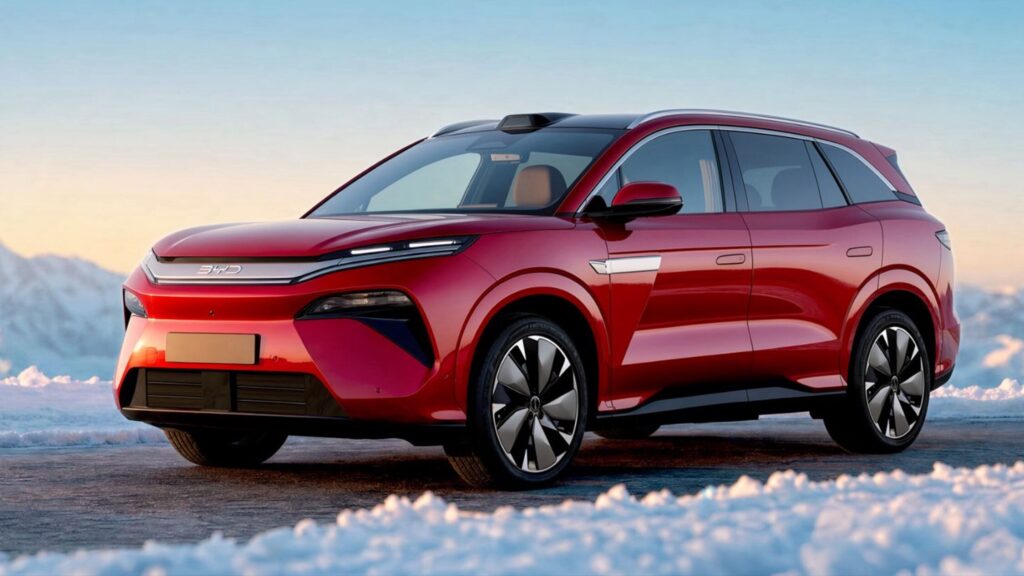
The Atto 8 debuted in Europe at this year’s Paris Motor Show. On the stand, it doesn’t look particularly revolutionary. Yes, it is BYD’s first three-row vehicle for Europe, where it is to compete with the new Skoda Peaq. However, the design — a predictable mix of already familiar BYD styling cues — is quickly forgotten.
Review: BYD Seal 6 — a quite decent electric sedan, but nothing more
Under the body, the story is completely different. The Atto 8 is powered by a second-generation Blade battery. The large capacity — 115 kWh — is actually not its most interesting feature. The main thing is the ability to replenish this large reserve from 10% to 97% in just nine minutes.
And if you stop at the 10–70% range, the time can be cut almost in half, since the last percentages charge more slowly. Even in cold down to -30 °C, charging from 20% to 97% takes 12 minutes. For comparison: the new Skoda Peaq needs 28 minutes to go from 10% to 80%.
This speed is provided by BYD Flash Charging technology, but it can only be used at compatible stations. The infrastructure is still being built, so such chargers are still scarce. BYD promises that by the end of 2027, 3,000 Flash stations will be operating in Europe.
Choose 456 hp or 764 hp
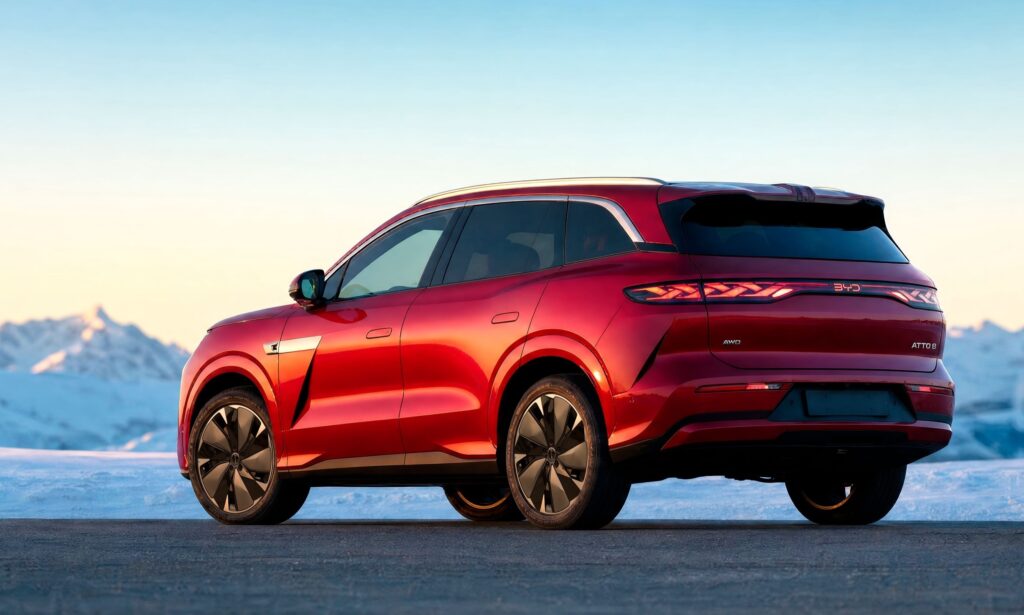
Both versions of the 5-meter SUV have the same battery and the same charging capabilities, but different powertrains. The entry-level Design is equipped with a 456 hp (462 PS / 340 kW) electric motor and rear-wheel drive. The figure sounds convincing, but due to the weight of the large battery, acceleration from 0 to 100 km/h takes a calm 8 seconds.
The Atto 8 Excellence adds a second motor, raising total output to 764 hp (775 PS / 570 kW). This cuts acceleration to 100 km/h to 4.6 seconds. But at the same time it reduces range. The rear-wheel-drive Atto 8 travels up to 405 miles (652 km) on a single charge, while the dual-motor version does up to 374 miles (602 km).
26-inch display on the windshield
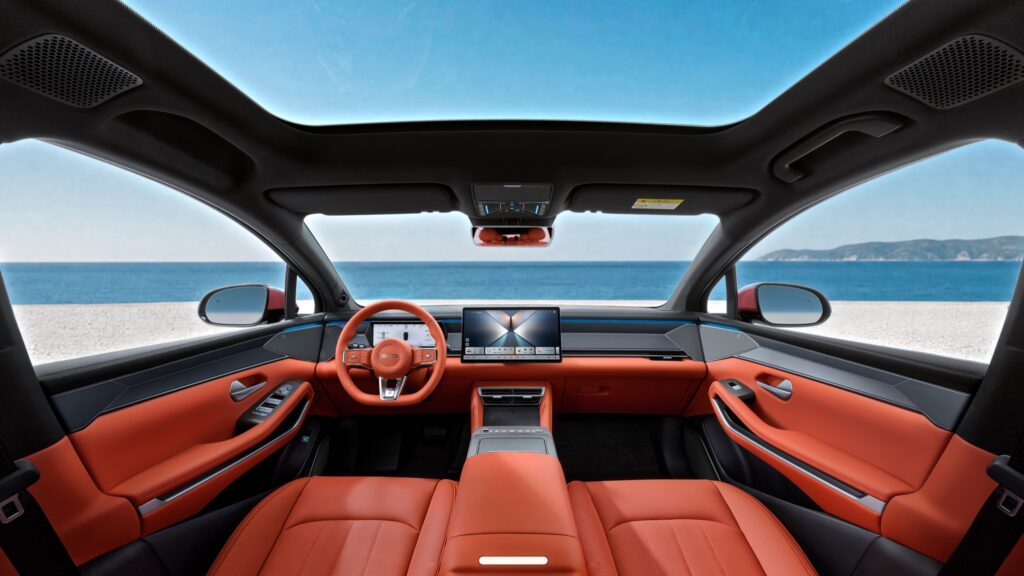
As the flagship model in BYD’s lineup, the Atto 8 has rich standard equipment. Among it — a panoramic glass roof, a 26-inch head-up display on the windshield, as well as heating, ventilation and massage functions for the front seats and the outer seats in the second row. Both versions get two 50-watt smartphone chargers, and the Excellence adds a refrigerator, as if trying to justify its name.
Will it be just as good value for money? We’ll find out closer to the start of sales in spring 2027; prices are to be announced later this year. By then, BYD will likely have managed to connect a few more Flash stations.
What the Atto 8 changes for European buyers
For BYD, the Atto 8 is not just another electric SUV, but an attempt to shift competition from the plane of acceleration and design to the plane of charging speed. If the company really manages to deploy the Flash Charging network within the stated deadlines, this could become a stronger argument than a few tenths of a second in acceleration. Buyers of three-row EVs often choose a model not only by range, but also by how much time they will have to wait at a charger on a family trip.
At the same time, for now the Atto 8’s advantage depends on infrastructure. At ordinary fast chargers it will not be able to show those same nine minutes. That is why the decisive factor will be not so much the battery itself as the availability of Flash stations in different countries. The Skoda Peaq and other competitors are not standing still either, so the struggle promises to be not only for power, but also for ease of ownership.
The Atto 8 also shows that battery capacity is gradually ceasing to be the main indicator. Charging speed, thermal management and real-world behavior in cold weather are becoming more important. For Ukraine, where fast-charging infrastructure is still developing, such models are interesting primarily as a benchmark: they demonstrate what the next stage of EV competition in Europe will be like.