 by
by Police PIT maneuver at 133 mph nearly leads to disaster
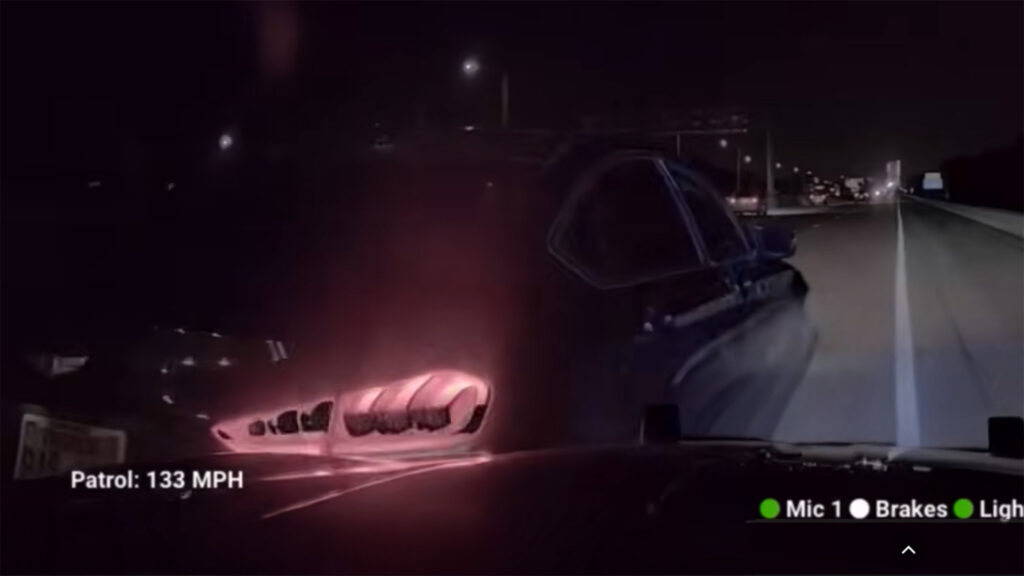
Most police departments consider the PIT maneuver (Precision Immobilization Technique) a last resort, especially on busy highways. When it goes according to plan, it can quickly end a pursuit. But when it doesn’t, the consequences can affect not only the suspect or the officer but also other road users. The pursuit that occurred on April 24, 2026, vividly demonstrates this danger. Although innocent drivers avoided injury, they were inches away from disaster after an officer executed a PIT maneuver on a suspect at 133 mph (214 km/h).
Incident details and dashcam video
Dashcam footage circulating online shows Arkansas State Trooper Collier Wright performing a PIT maneuver at 9:31 PM. This time is important because other vehicles are on the road besides the suspect’s. Within seconds, the maneuver spirals out of control. Instead of simply stopping the suspect’s vehicle, a Ford Fusion, both cars become involved in a crash.
The suspect crashes into the wall on the right, and we lose sight of his vehicle. Trooper Wright almost immediately also loses control of his own car. There are three innocent drivers ahead of him, and he avoids colliding with them only by a miracle, after slamming into the right highway barrier, then his car, at over 100 mph (160 km/h), crosses the lanes, hits another barrier, and slides backward, scraping along the concrete divider.
It is unclear whether police managed to apprehend the suspect afterward.
Controversy over the safety of high-speed PIT maneuvers
This incident raises serious questions due to the scale of damage and the potential threat to life. Many police departments in the U.S. restrict the use of the PIT maneuver to low speeds or ban it entirely on busy highways. For example, the California Highway Patrol limits the speed for such a maneuver to 35 mph (56 km/h), and the North Carolina State Highway Patrol allows it up to 55 mph (89 km/h). Many agencies classify exceeding these thresholds as the use of deadly force.
The reason is simple: at speeds over 100 mph, the laws of physics become unforgiving. Cars do not spin predictably, tires lose traction differently, and small miscalculations lead to powerful crashes that can affect anyone nearby.
Context and possible reasons
Even for the Arkansas State Police, this case is atypical. Perhaps the fact that the suspect was approximately a mile from the state line prompted Wright to be more aggressive in trying to stop him before he left his jurisdiction. We have contacted Trooper Wright, hoping to get more information, and will update this article if we receive a response.
Credit: LRHN
This case once again raises the question of the balance between pursuit effectiveness and public safety. While the PIT maneuver can be a useful tool for stopping dangerous criminals, its use at extreme speeds, especially in heavy traffic conditions, creates an unacceptable risk to bystanders. The difference in approaches among various states indicates the lack of a uniform standard, and incidents like this will likely prompt further discussions about the need for stricter limitations or even a total ban on such maneuvers on high-speed highways. It is worth noting that even if the suspect was apprehended, the price of such success may have been too high.