 by
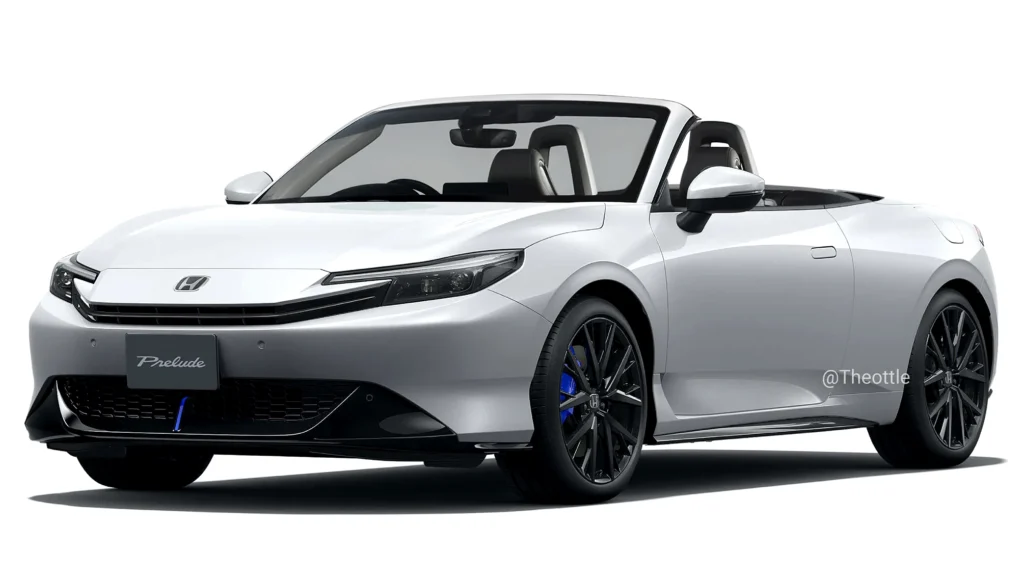
by The long-awaited return of the Honda Prelude sparked considerable debate among sports car enthusiasts. A year after the hybrid coupe’s debut, that conversation has taken an unexpected, albeit unofficial, turn. Independent digital artist Theophilus Chin decided to reimagine the car, and the result answers a question Honda never asked: what would a modern Prelude look like as a two-seat convertible?
A bold vision of a familiar silhouette
The digital concept retains the basic contours of the Prelude coupe, but Chin has cut away the rigid roof structure and replaced it with a folding fabric top. To make room for the folding mechanism, the cramped rear seats of the standard model had to be removed, transforming the car into a full-fledged two-seat coupe-convertible.
Of course, the imagined model gets a redesigned rear deck with a neat tonneau cover behind the headrests. The rest of the design carries over unchanged, including the smooth body lines inspired by glider drones. The final result looks as if it could have been created by the factory itself, although the front-wheel-drive proportions with a short hood inevitably become more pronounced because of the new body type.
Renderings: Theophilus Chin
Under the visual transformation, the mechanical side would remain unchanged: the 2.0-liter four-cylinder engine works in tandem with two electric motors, together producing 200 horsepower (149 kW / 203 PS).
Renderings: Theophilus Chin
The Prelude is built on the Civic platform with suspension components from the Type R. Power is sent exclusively to the front axle through the eCVT continuously variable transmission with Honda’s signature S+ Shift technology, which simulates stepped gear changes.
Does it have a right to exist?
Honda never produced a factory convertible based on the Prelude, but that does not mean such cars never existed at all. The most famous example is the Prelude Solaire from the 1980s, created by a California company based on the first generation of the model. However, open-top Preludes are extremely rare, and for good reason.
Theoretically, a workshop could perform a similar conversion of the modern Prelude, although it would require a huge amount of custom work. And instead of a complex fabric roof like in these renderings, such a project would most likely work better with a removable hardtop, which would avoid the expensive rework needed to integrate a retractable mechanism.
The most important question is who would actually buy an expensive front-wheel-drive hybrid convertible in a limited series in a segment that practically does not exist, rather than directing their money toward a more exotic sports car.
Will such concepts become reality?
The history of the automotive industry knows many examples where manufacturers initially categorically denied the appearance of certain versions, but later released them under pressure from the market and fans. Niche convertibles based on affordable coupes have always attracted interest, but their production requires significant investment in engineering, body strengthening, and testing without a roof. For a front-wheel-drive hybrid focused on efficiency, such a step looks dubious from a financial standpoint.
It is worth noting that Theophilus Chin is not the only one trying to look into the future of Japanese sports models. His works regularly spark lively discussions in the automotive community, and sometimes even inspire design studios to conduct real experiments. Although mass production of such a car seems unlikely, such concepts demonstrate how audiences see classic models in the new era of electrification. And while Honda focuses on hybrid technologies and limited special editions for the Japanese market, enthusiasts can only imagine what a true open-top Prelude of the modern era would be like.