
 by
by Spread of False Rumors
Rumors spread very quickly on the internet, and the recent news about Toyota gained unexpected publicity. Over the past few weeks, statements have been circulating on social networks that Toyota is relocating its manufacturing plant from Alabama to Ontario in Canada. The automaker categorically denies this information, stating that it is completely false.
Scale of Disinformation
Posts on platforms such as X, Facebook, TikTok, and even LinkedIn confidently reported that Toyota was closing its plant in Alabama in favor of a new facility in Canada. These posts were viewed and received tens of thousands of likes, spreading quickly among users. It was later revealed that the source of these rumors was likely accounts that regularly spread fake news created using artificial intelligence.
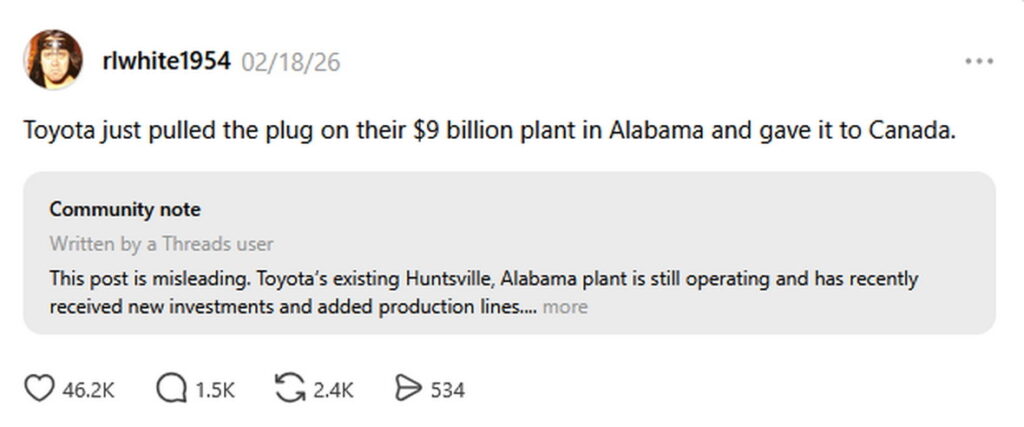
One post on Threads, published on February 19, claimed that “Toyota just stopped funding its $9 billion Alabama plant and handed it over to Canada.” The account that posted this information had only 404 followers, cited no sources, but still garnered over 46 thousand likes.
Toyota Company’s Reaction
The rumors spread so widely that Toyota was forced to intervene. In a comment to The Canadian Press, Toyota Canada spokesperson Michael Bouliane stated that there is “no truth” to these reports.
Such cases clearly demonstrate how easily disinformation can spread and why it is so important to be critical of information sources. Random posts on social networks from accounts with no authority are an extremely unreliable source of news.
Lack of Logical Explanation
The rumors about the plant relocation were not accompanied by any logical explanation as to why Toyota would take such a radical step as closing a plant in the US and opening a new one in Canada. Such a decision, if it were to take place, would undoubtedly attract close attention from politicians, especially from the Trump administration.
Involvement of Google’s Artificial Intelligence
According to The Canadian Press, while the rumors were circulating online, even Google’s AI Overview system supported these false claims for some time before the results were removed. Google representative Wendy Manton explained that “issues can arise when there is a lack of high-quality information on a topic online, and we use such examples for the general improvement of the AI Overview system.”

This incident served as another reminder of the vulnerability of the information space in the era of rapid content dissemination. Even tech giants developing complex algorithms to filter and present data are not immune to spreading unverified facts, especially when they are based on massive, but not always reliable, datasets from the internet. The speed at which false information can take on the appearance of credible news depends not only on social networks but also on automated systems striving to answer any query. This poses new challenges for users, who must develop media literacy, and for companies whose reputation can suffer from virtual rumors.