
 by
by Record Compensation for Rivian CEO: $403 Million in One Year
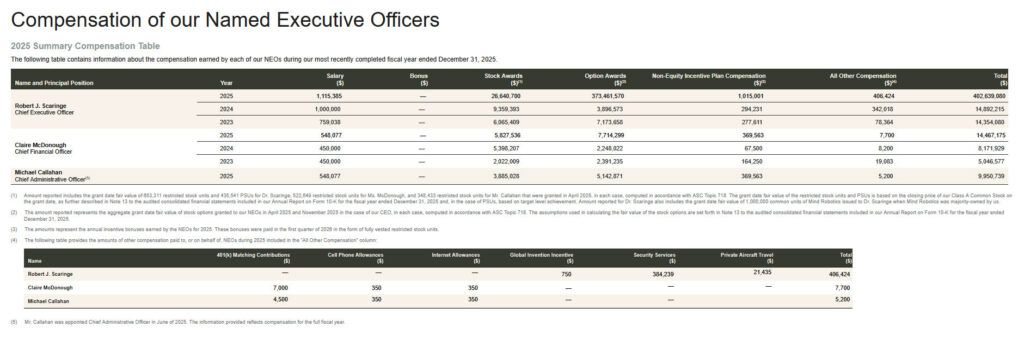
Founder and CEO of Rivian, RJ Scaringe, received a staggering compensation of $403 million last year, according to company documents. For comparison, during the same period, Ford and GM CEOs earned significantly less: Jim Farley — $27.5 million, and Mary Barra — $29.9 million. This makes Scaringe one of the highest-paid executives in the automotive industry worldwide.
Top executives of Detroit auto giants, such as Jim Farley from Ford and Mary Barra from GM, earn hundreds of times more than ordinary line workers, but their incomes look modest compared to the Rivian boss. Rivian delivered 42,247 electric vehicles in the US last year, while Ford sold 2.2 million vehicles, GM sold 2.85 million in the domestic market, and Tesla sold approximately 1.65 million cars worldwide in 2025.
Related: Mary Barra’s $29.9 Million Payday Came In The Same Year GM Lost $7.9 Billion On EVs
This makes Scaringe one of the highest-paid executives in the automotive industry worldwide, and his compensation is thousands of times greater than what the men and women who assemble Rivian cars and trucks receive. Although this is not quite the level of Tesla CEO Elon Musk’s pay package, which could bring him $1 trillion over the next decade, the amount is still enormous.
Sales Decline, CEO Salary Rises
What makes Scaringe’s compensation even more striking is that it comes at a time when Rivian has not shown consistent growth. Yes, the company managed to achieve its first gross profit in 2025 through cost reduction, and it began production of the smaller R2 SUV, but its stock price is still significantly below the 2021 peak, and sales fell last year.
Of course, Scaringe did not receive all $403 million in cash. The compensation consisted of $373.5 million in stock options, $26.6 million in shares, and a more modest $1.12 million in salary.
Compensation Could Reach $4.6 Billion
Rivian’s board voted in November last year to cancel the previous performance-based pay structure for Scaringe, which was set in 2021 and later deemed unrealistically ambitious. Under the terms of the new agreement, his salary will increase to $2 million, and he could receive $4.6 billion through stock options if he raises the company’s stock price to $140 over the next 10 years.
But given that the stock has mostly traded below $20 over the last three years, falling from $130 when Rivian went public in 2021, Scaringe has a lot of work to do.

Such a situation raises questions about corporate governance and executive compensation in companies that have not yet achieved stable profitability. Although Rivian shows some progress, including its first gross profit, falling sales and a low stock price indicate that the company is still in an early stage of development. The new pay structure, which involves potential payouts in the billions of dollars, could be a powerful incentive for the CEO, but it also creates risks for shareholders, especially if growth targets prove too ambitious. Comparisons with traditional automakers that sell tens of times more vehicles highlight the difference in approaches to compensation and expectations for executives in startups versus established companies.