 by
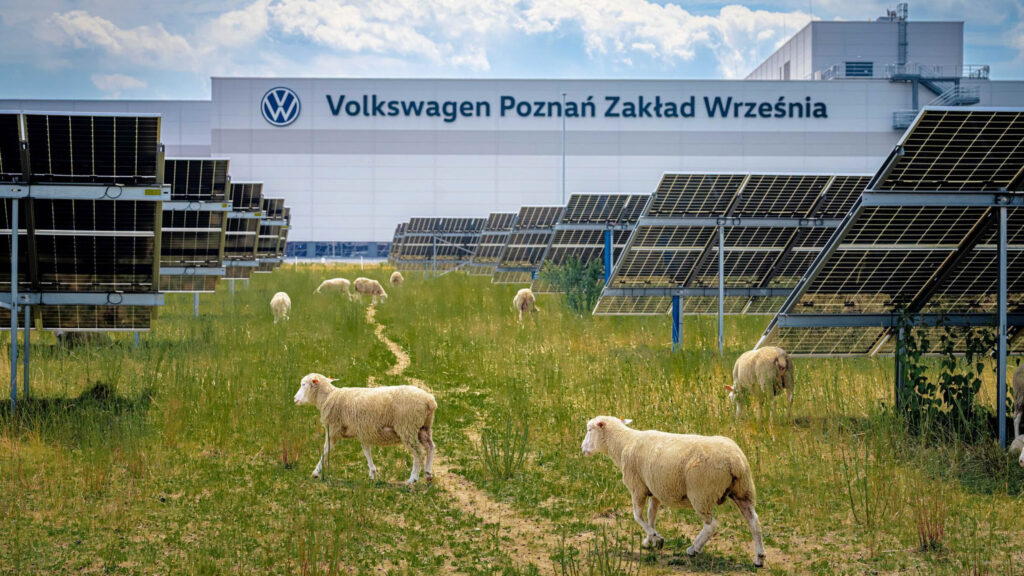
by At the Volkswagen plant in the Polish city of Poznań, an unusual replacement took place: instead of gasoline lawnmowers, 100 sheep now care for the grass. This decision is part of the company’s environmental approach.
New “employees” at the solar farm
A flock of sheep has taken over vegetation management on the grounds of the VW production plant in Poznań. A large solar power plant with a capacity of 18.3 MW, consisting of over 31,000 solar panels, is located there. On bright sunny days, this solar farm can fully cover the plant’s electricity needs, and overall, it supplies about a quarter of its annual consumption.
Instead of using mechanical mowers between the rows of panels, Volkswagen brought in a flock of sheep. They spend the grazing season naturally trimming the grass until autumn. This solution reduces the use of machinery and provides the animals with plenty of shade and space to move freely.
How did the animals adapt?
According to the flock’s owner, the sheep acclimated to their new location extremely quickly. They have split into smaller groups and are calmly grazing on the site, which is a good sign of their adaptation and comfort among the renewable energy equipment.
A scientific approach to grazing
The project also has a serious scientific component. Together with researchers from the Poznań University of Life Sciences, they are studying how sheep grazing affects biodiversity, soil quality, vegetation, animal welfare, and even the local microclimate. Researchers are also investigating whether the shade from the solar panels helps reduce heat stress for the animals.
Mutually beneficial cooperation
The combination of agriculture and solar generation, known as agrivoltaics, is attracting increasing interest. Landowners are looking for ways to make renewable energy projects more beneficial than just generating electricity. If livestock grazing can reduce maintenance costs and improve biodiversity, it is advantageous for all parties involved.
Scale of VW production in Poland
VW’s three sites in Poznań (including neighboring Swarzędz) produced 150,000 Caddy models and 25,000 Transporter models last year, as well as 4 million automotive components. The plant employs 7,000 people, making it the largest employer in Greater Poland. Soon, over 3,000 workers will start producing Crafter vans at a new plant in Września, about 50 km from Poznań.
This project demonstrates how large industrial enterprises can integrate natural solutions into their operations, reducing their carbon footprint and supporting biodiversity. Using sheep instead of lawnmowers not only saves resources but also creates a more sustainable ecosystem around the solar power plant. It is also an example of how traditional agriculture can coexist with modern technology, benefiting both business and the environment. Further research into the impact of such grazing could serve as a foundation for implementing similar practices at other enterprises around the world.