 by
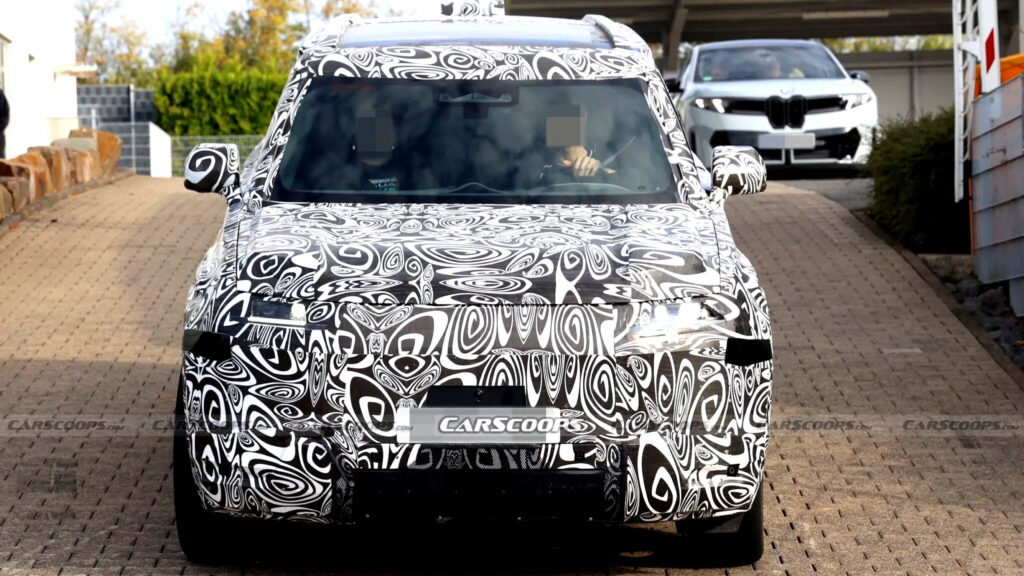
by Land Rover has again put its younger Defender in front of spy photographers’ lenses. At first glance, nothing has changed drastically: camouflage still hides details, and the overall proportions remain recognizable. However, now we can finally make out an important detail that clearly points to family kinship — the spare wheel on the rear door.
The spare wheel is not just a small detail
At first glance, this may seem like an insignificant element, but the externally mounted spare wheel is the visual calling card of both the modern Defender and the classic model that preceded it. By placing it on the compact crossover, engineers immediately set the newcomer apart from the vast number of premium soft-roaders of the same size.
Most modern crossovers have already abandoned spare wheels in favor of tire sealant. This allows them to save a few kilograms of weight and reduce CO2 emissions. Defender chooses a different path: practicality and a recognizable image are more important than a few extra kilograms.
Shared platform with the Range Rover GT
Unofficially, the newcomer is already being called the Defender Sport, although the model’s true name is still being kept secret. Interestingly, stylistically this car is the complete opposite of the upcoming electric Range Rover GT. Both models are built on the shared EMA architecture and use the same chassis, but they look completely different.
The Range Rover GT will have a very low, sleek profile with a smooth roofline. In contrast, the compact Defender opts for a vertical roof, a square rear end, and massive proportions. This decision is aimed at maximum practicality and preserving the true spirit of the Defender in a more compact format.
Electric foundation and hybrid addition
The EMA platform was created from the very beginning around an electric powertrain. It provides an 800-volt system and support for fast charging. Previous prototypes only confirmed this scenario: closed radiator grilles and the absence of visible exhaust pipes hinted at a fully electric future.
However, the market has changed, and with it JLR’s plans have changed too. The company has openly admitted that the transition to electric vehicles is not happening as quickly as expected. This is especially noticeable in the key American market. At the same time, hybrid vehicles have proved unexpectedly popular among buyers.
Therefore, engineers have refined the EMA architecture so that it can work with hybrid powertrains. However, this concerns regular hybrids, not plug-in versions. This will allow the model to expand its audience and offer buyers an intermediate option between a petrol and an electric future.
Competitors: Mercedes and the return of Freelander
When the new compact Defender hits the market, it will have to compete with quite interesting rivals. The model’s premiere is expected around 2027. That is exactly when Mercedes will present its own smaller G-Class. Together, these two models will offer buyers compact interpretations of the world’s two most recognizable SUVs.
In addition, another familiar player has appeared on the horizon. Chinese company Chery has revived the Freelander name. It is worth noting, however, that the new model is not a real Land Rover, even if it uses a familiar badge and design cues associated with the British brand of the past. However, unlike the new Defender, you won’t see a spare wheel mounted on the rear door of the Chery Freelander.
Why this matters for the future of the brand
JLR’s decision to preserve the classic off-road style even in a compact model shows its desire to maintain the Defender identity. The rear spare wheel, vertical roof pillars, and recognizable proportions are meant to remind buyers that this is not just another urban crossover, but an heir to a true off-road lineage.
The hybrid component, in turn, shows that even models with a conservative spirit have to adapt to real market demands. JLR is no longer betting solely on pure electric vehicles, but is trying to offer more flexible options. This could become a key advantage for the company in the battle for the attention of buyers who are not ready to give up internal combustion engines entirely, but are already interested in modern technologies.
So the newcomer has plenty to attract attention: a recognizable exterior, a modern platform with fast-charging support, and the ability to choose between electric and hybrid power. And if JLR manages to preserve the off-road capabilities of the older Defender in a more accessible format, competitors should definitely be worried.