 by
by Revival of Bruce McLaren’s Forgotten Dream
Most fans, when it comes to McLaren’s first road car, immediately recall the legendary three-seat F1. However, they are mistaken by about 25 years. Long before Gordon Murray rewrote the rules of supercars, the company’s founder Bruce McLaren was already nurturing the idea of his own car for public roads, called the M6GT.
From Race Tracks to Road Prototypes
The original M6GT was built based on the dominant McLaren M6A racing car from the Can Am series. Its goal was to prove that the company’s racing technology could be successfully adapted for ordinary roads. Bruce planned to build 50 units, but due to tragic circumstances, the project never progressed beyond three prototypes.
Meticulous Reconstruction by MSO
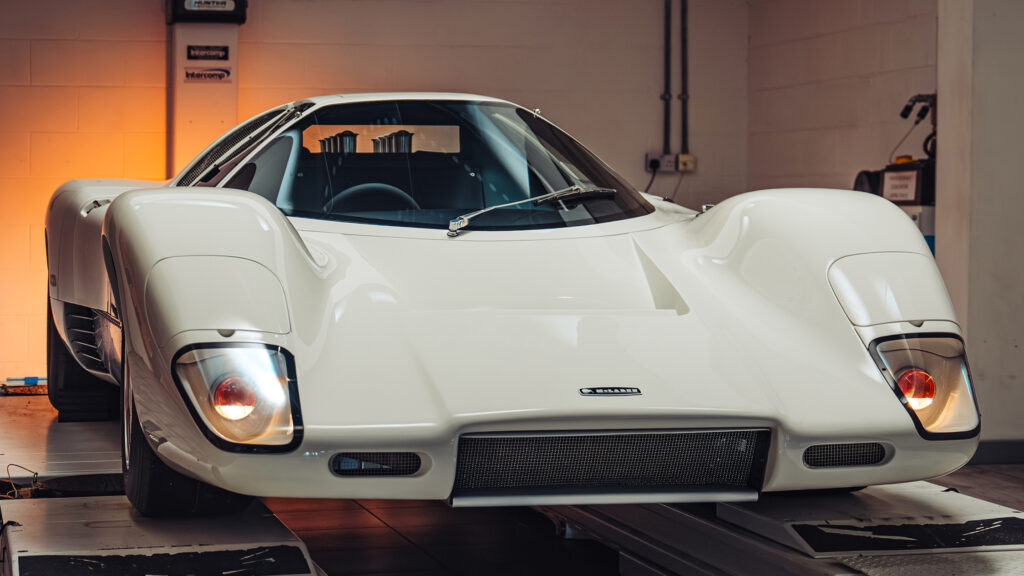
Now the McLaren Special Operations (MSO) division has completed what the founder started. The company meticulously recreated the M6GT using original body shapes, historical drawings, and archival photographs. The car is equipped with an authentic Chevrolet V8 engine from that period and a corresponding gearbox. Instead of modernization, the task was to reproduce Bruce’s original vision as accurately as possible. Mechanics who worked on the first prototypes even assisted in the work.
Details that Matter
Attention to detail is impressive. The chassis is taken from an M6A race car of the same period, the suspension uses restored original components, and the aluminum rivets were installed by aviation specialists. Inside the cabin, you can find a walnut gear shift knob, a fashionable green carpet from the 1970s, custom vinyl upholstery, and a cream-white exterior named Colnbrook after the factory where Bruce developed his ideas for road cars.
Return to Goodwood
This unique car will make its public debut at this year’s Goodwood Festival of Speed. This venue holds special significance, as it was at the Goodwood track in 1970 that Bruce McLaren died while testing the M8D Can Am racing car. He was only 32 years old. Today, the same track hosts the Goodwood Revival, making the return of the M6GT particularly poignant.
MSO Director John Simmons called the project “a labor of craftsmanship and care,” adding that it serves as “a living reminder of Bruce’s ambition to take McLaren beyond the racetracks.”
Looking at the finished result, it’s hard not to wonder what the company’s path might have been if the M6GT had reached series production. Perhaps the F1 would still have become an icon, but it likely would not have carried such a heavy burden of responsibility for starting McLaren’s road car history.
This MSO project is not merely a restoration of an old car. It is a kind of bridge between eras, reminding us that Bruce McLaren’s ambitions extended far beyond the racing circuits. The recreation of the M6GT demonstrates how forward-thinking the brand’s founder was, and how his ideas were ahead of their time. Although series production never happened, this car remains an important testament that McLaren could have become a manufacturer of road-going supercars much earlier than commonly believed. Today’s reconstruction not only honors Bruce’s memory but also adds a new, previously unknown chapter to the company’s history, showing that its road heritage began not with the F1, but with a bold dream that has finally come true.