 by
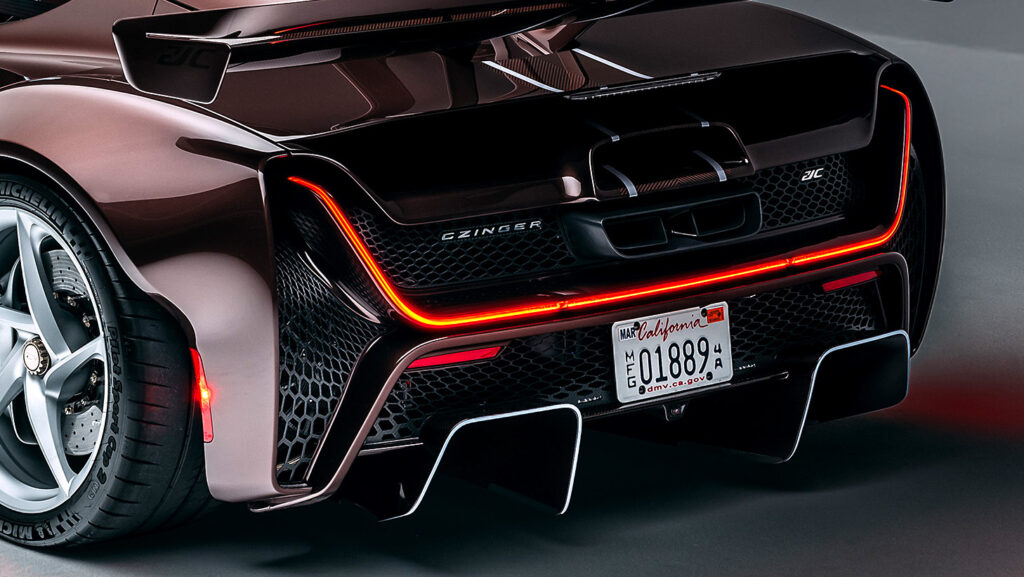
by Eighty examples of the Czinger 21C might seem like a whole crowd, at least in circles where such exotic cars are bought. For those bothered by that, Czinger has a solution. During Monterey Car Week, the company pulled the cover off the 21C Spyder — an open-top version limited to 30 examples worldwide. That is a significantly rarer variant compared with the 80 coupes that have already found their owners.
As one might expect, the 21C Spyder largely repeats the coupe that preceded it, but some things have changed. The most important new component is Czinger’s BrakeNode system.
Innovative BrakeNode braking system
BrakeNode is a part made of aluminum alloy, produced by additive manufacturing, i.e. via 3D printing. It combines the brake caliper, suspension upright, and all necessary hydraulic channels in a single structure. This innovative solution reduces unsprung mass by 1.5 pounds (0.7 kg) per wheel while being 30 percent stiffer.
The brakes themselves are huge front discs measuring 16.1 inches (410 mm) in diameter and rear discs measuring 15.3 inches (390 mm). The 21C Spyder became the first Czinger vehicle with BrakeNode technology, but these components will be available as an option for the regular coupe in the High Downforce and Vmax configurations.
Power and dynamics
Under the body sits the company’s own 2.88-liter twin-turbocharged V8 with a flat-plane crankshaft. It works together with three permanent-magnet synchronous electric motors. Total output reaches an impressive 1,250 hp, of which 750 hp comes from the V8 engine itself. Torque is stated at 691 lb-ft (938 Nm).
Thanks to the all-wheel-drive system, the 21C Spyder needs only 1.9 seconds to reach 60 mph (96 km/h), and it covers the quarter mile (402 meters) in 8.7 seconds. Acceleration continues all the way to 205 mph (330 km/h).
Roof, downforce, and aerodynamics
The removable roof panel is made of carbon fiber and weighs only 22 pounds (10 kg). Unlike some other open-top exotic models, there is no storage compartment for the roof, so after removal the panel will have to be left at home.
According to Czinger, the 21C Spyder generates the most downforce of any road car — a phenomenal 3,267 pounds (1,482 kg). With the roof closed, this figure rises to 3,307 pounds (1,500 kg). These values almost match the car’s dry weight, which is 3,571 pounds (1,620 kg).
Interior: the NeuralNode system
The 21C Spyder also became the company’s first model with an important change inside. It uses the so-called NeuralNode system. It replaces the multi-component construction of a conventional instrument panel with a single system that unites the dashboard, air vents, and essential controls located near the driver’s hands.
Although the hypercar is primarily focused on insane performance, it has wireless Apple CarPlay and an eight-speaker audio system with 650 watts of power, which uses carbon fiber diffusers. If that doesn’t prove Czinger’s commitment to weight reduction, it’s unclear what would.
Price and production run
As already mentioned, only 30 examples of the 21C Spyder will be built, each priced at $2.75 million.
Such a limited production run makes the open-top version even more desirable for collectors. Furthermore, Czinger shows that even in the hypercar segment, future manufacturing technologies can be introduced: integrating brakes with suspension via 3D printing and the minimalist NeuralNode panel could also appear on other brand models. This makes the 21C Spyder not just an open-top supercar, but a kind of technological showcase.