 by
by Retro Charm and New Interpretations
The new generation Renault Twingo is winning fans with its retro charm, which harks back to the original 1992 model. However, Hatano Automobile is not yet ready to say goodbye to it. Instead, the Japanese tuner has returned to the third-generation model, which is out of production, and transformed it into a rugged safari version that pays homage to the wild R5 Turbo of the 1980s.
From Auto Salon to Series Production
The C’eLavie Cross model and the asphalt-oriented C’eLavie 1985 develop the ideas of earlier Hatano projects presented at the Tokyo Auto Salon 2024. They reappeared at the Automobile Council 2026 in Japan, but now with plans for series production, not just as show exhibits.
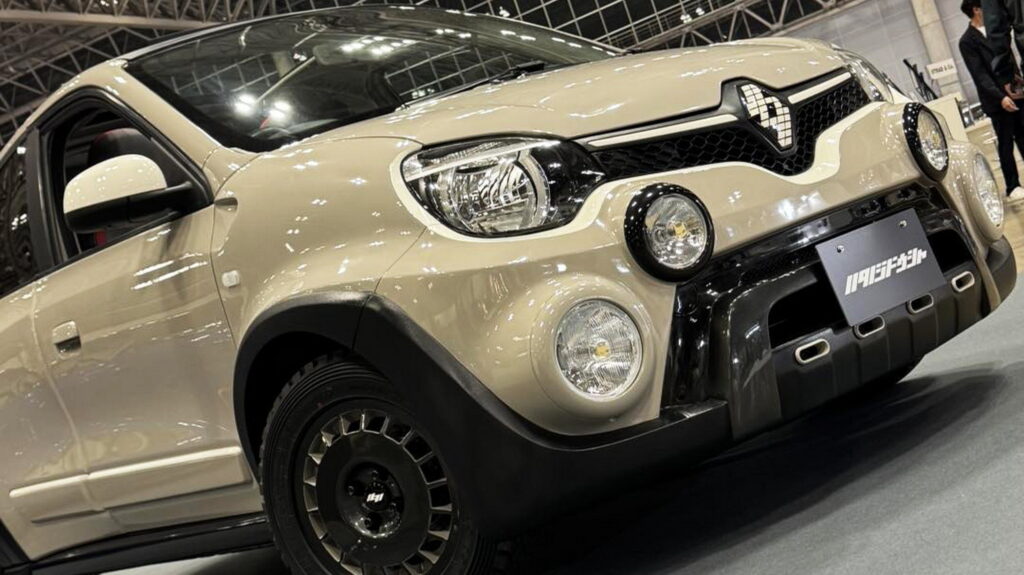
Both Twingo versions received a characteristic wide body kit, including redesigned bumpers, custom front and rear fenders, and a significantly larger rear spoiler. In addition, they are fitted with round rally-inspired headlights integrated into the front bumper.
Features of the Safari Version
The Cross variant is distinguished by more plastic cladding and unique inserts in the bumpers reminiscent of a sump guard. Furthermore, it is mounted on black “turbofan”-style alloy wheels with all-terrain tires and received a raised suspension. All these modifications turn the beige hatchback into a kind of urban alternative to the Porsche 911 Dakar.
The Road Version and Technical Details
The 1985 model moves in the opposite direction. It stays on asphalt, receiving larger wheels, carbon fiber trim, and orange graphic elements on the blue paintwork. The work is completed by dual exhaust pipes at the rear.
Reportedly, the C’eLavie Cross is based on a humble 2018 Renault Twingo Intens with a fabric roof and a 90-horsepower turbocharged three-cylinder engine. On the other hand, the C’eLavie 1985 is built on the sportier Twingo GT. The latter was the top version of the French city car with a more powerful turbocharged 900cc engine producing 109 hp and a sharper suspension.
Hatano offers an optional power increase, thanks to which the output of the tiny engine grows to 138 horsepower. Another option is a Bilstein sport shock absorber kit, which makes the city car more fun in the corners.
Ambitious Plans and Limited Series
At one point, Hatano considered a much more ambitious project. The idea was to install a 3.5-liter V6 engine from Nissan, similar to the one used in the 2013 Renault Twin’Run concept car. For now, this remains just an idea.
Production is expected to be limited to approximately 20 units. To date, five orders have been received and two cars delivered. The conversion kit reportedly costs from 1,350,000 yen (approximately $8,500), with mechanical upgrades paid for separately.
The power increase costs about 1,540 euros, and the sport shock absorbers another 1,350 euros. A V6 engine conversion, if it ever happens, would undoubtedly fall into a completely different price range.
Model Evolution and Future
The third-generation Renault Twingo was a technical “sibling” model to the already discontinued Smart ForFour, sharing the same platform, a rear-mounted three-cylinder engine, and rear-wheel drive with it, which distinguished it from its front-wheel-drive predecessors.
The new Twingo E-Tech has switched to the R5 platform and become fully electric, now driving the front wheels. This is a completely different approach, although it may still open the door for future wide-body projects. Small hatchbacks with character have always had their audience, as once proven by cars like the R5 Turbo and Clio V6.
The latest embodiment of this idea from Renault takes the form of the extremely expensive R5 Turbo 3E. It combines a unique exterior with an aluminum chassis and a dual-motor electric setup, and its production will be limited to 1,980 units.
Transforming an ordinary city car into an expressive special demonstrates that even in the era of electrification, there is still room for creativity and individuality. The limited-series nature of projects like Hatano’s makes them unique artifacts of car culture that combine nostalgia for the past with modern tuning solutions. It also serves as a reminder that the popularity of compact cars with a bright character does not fade; it only transforms.