 by
by Return to Classics
Lancia is expanding the Ypsilon model range by adding a new base version that forgoes electrification in favor of a traditional internal combustion engine paired with a manual transmission. The new Ypsilon Turbo 100 debuted in Italy as the brand’s most accessible offering.
Despite growing demand for hybrids, Lancia claims the new version is a response to direct customer feedback and analysis of the Italian market. According to the company, many drivers derive pleasure from the control offered by a manual transmission, similar to those who “choose to listen to music on vinyl, write by hand, or brew coffee in a moka pot.”
The new Lancia Ypsilon Turbo 100 responds to customer requests who appreciate the control of a manual gearbox.
Technical Features
The Ypsilon Turbo 100 is built on the same platform as other Stellantis hatchbacks, such as the Peugeot 208, Opel Corsa, and Fiat Grande Panda. Under the hood lies the familiar 1.2-liter turbocharged three-cylinder engine without a mild-hybrid system, generating 99 hp (74 kW) and 205 Nm of torque.
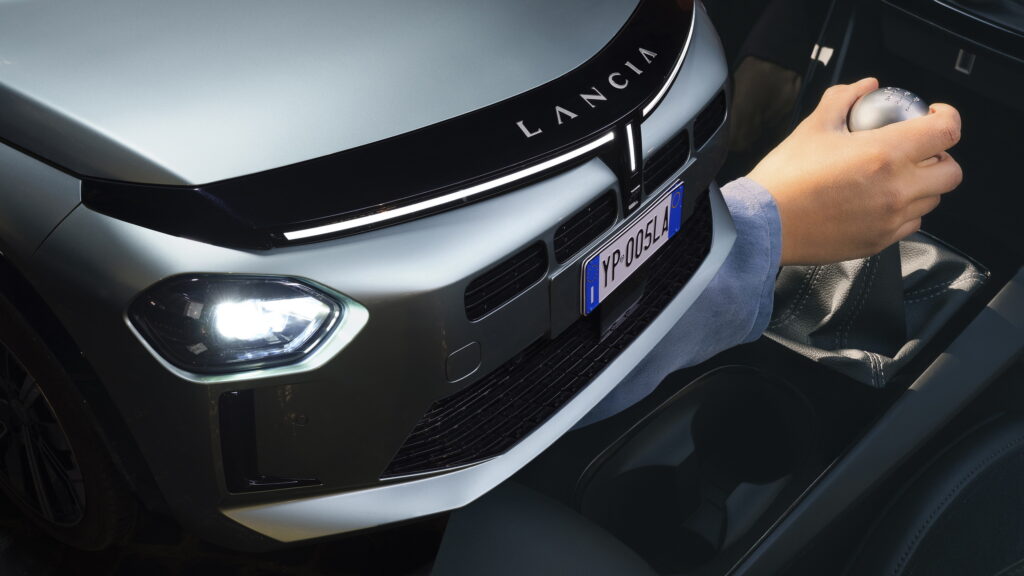
Power is delivered to the front axle via a six-speed manual gearbox, which is the first for Lancia since the start of its new era. In terms of performance, acceleration from 0 to 100 km/h takes 10.2 seconds, and the top speed is 194 km/h.
Exterior and Interior
The exterior of the Turbo 100 is identical to the mild-hybrid version, but there are noticeable changes inside. Besides the presence of three pedals, the inclusion of a gear lever means the signature “multifunctional coffee table console” has been removed.
Trims and Equipment
The Turbo 100 is available in three trim levels – the base Ypsilon, the top LX, and the sporty HF Line, which receives unique body kit. The equipment is quite good; even the cheapest model comes standard with dual 10.25-inch displays, automatic climate control, a USB-C port, fully LED headlights, rear parking sensors, and a basic suite of driver assistance systems (ADAS).
Pricing Policy
The main advantage of the manual version is its price. All Turbo 100 trims are 3,000 euros cheaper than equivalent mild-hybrid cars with an automatic transmission. The starting price is 22,200 euros for the base Ypsilon, and 25,200 euros for the LX and HF Line versions.
However, Stellantis states that if all financial options are utilized, the starting price could drop to 15,950 euros, with monthly payments from 99 euros. This matches the price of the last iteration of the previous generation from 2023, despite having a more powerful engine and significantly more modern technology.
The launch of such a version in Italy may indicate that even in the rapidly electrifying European auto industry, there remains a niche for classic technologies. It also demonstrates the flexibility of the Stellantis platform, which allows offering different powertrains to meet diverse customer preferences. The success of this model could be an indicator of whether there is sufficient demand for non-automated cars in the premium small car segment for other manufacturers to consider similar steps.