 by
by BMW Deploys Humanoid Robots at Leipzig Plant
Automaker BMW has joined the ranks of companies implementing humanoid robots in production. The initiative began last year with a pilot project at the Spartanburg plant in South Carolina, and now the company has announced a new pilot launch at its German facility in Leipzig.
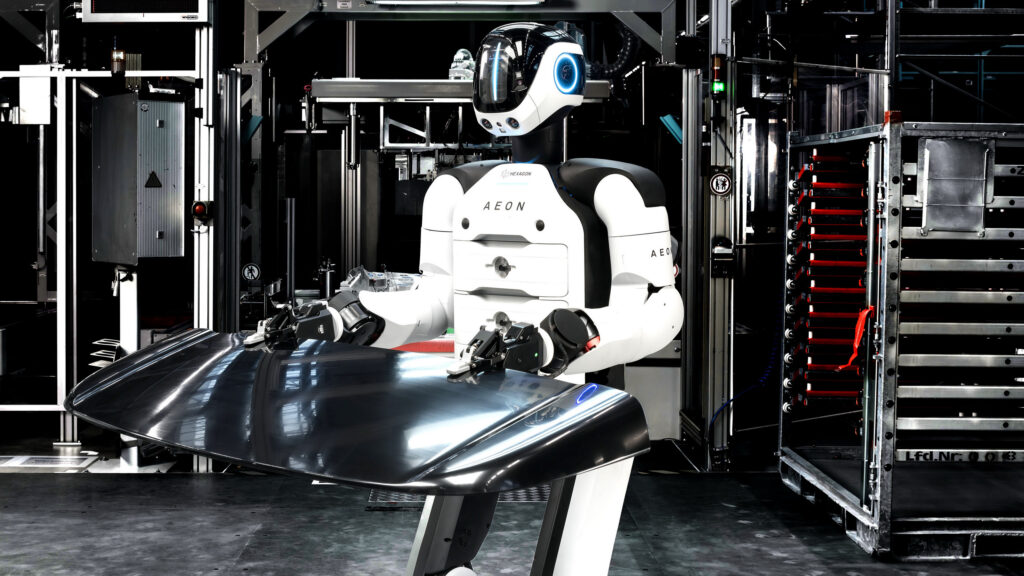
The robots, presented as “Physical Artificial Intelligence,” will be deployed in collaboration with the company Hexagon. This company introduced its AEON robot back in June of last year.
Following the presentation, BMW and Hexagon jointly conducted an initial theoretical assessment and laboratory tests. In December of last year, the companies already tested the AEON robots at the Leipzig plant as part of the first implementation. This laid the groundwork for further tests in April and the direct pilot phase, which will begin this summer.
Tasks for Robots in Production
BMW states that the pilot project focuses on “testing the robot’s multifunctional application.” This is a fairly general formulation, but the automaker clarified that AEON will be used for assembling components and high-voltage battery packs.
This latest pilot project builds on previous testing, during which the company used the Figure 02 robot from Figure AI. It worked ten-hour shifts five days a week for ten months, contributing to the production of over 30,000 X3 crossovers.
The robot performed precise extraction and positioning of metal parts for the welding process – a task that is particularly demanding in terms of speed and accuracy, as well as physically exhausting.
During its operation, Figure 02 moved over 90,000 components and accumulated about 1250 working hours.
Value and Potential of Humanoid Robots
BMW stated that the pilot project showed that robots can “provide tangible added value in real-world conditions.” The company also noted that humanoids “demonstrate potential in performing monotonous, ergonomically demanding, or safety-critical tasks.”
Despite concerns that robot workers might replace humans, BMW asserts that the goal is to “make employees’ work easier and further improve working conditions.” At the same time, the company acknowledges that robots enhance the competitiveness of their manufacturing.
Humanoid Robots in the Automotive Industry
Besides BMW, several other major automakers are exploring similar technologies. Mercedes-Benz is testing humanoid robots at its Berlin plant, where the Apollo robot from Apptronik is being trialed for logistics, quality inspection, and assisting with repetitive tasks on the line.
Hyundai, in turn, plans to expand the use of humanoid robots at its US facilities by 2028 as part of a broader push towards advanced manufacturing systems. And, of course, Tesla, which continues to position its Optimus robot as something far more than just a factory experiment.
The shift towards automation using humanoid robots appears to be becoming a clear trend in the automotive industry. This is not only a matter of technological progress but also of strategic adaptation to challenges related to skilled labor shortages in some regions and constant pressure to reduce production costs. Successful pilot projects, like those conducted by BMW, demonstrate that these robots are already capable of performing specific, complex tasks with high accuracy. The future likely lies in the gradual integration of such systems, where robots and humans will work in close interaction, each performing the work where their advantages are greatest.