 by
by Hyundai Ioniq 6 N: An Electric Sports Car That Changes the Game
Hyundai made a real breakthrough in the world of electric cars when it introduced the Ioniq 5 N a few years ago. It wasn’t just the South Korean brand’s first high-performance EV, but also, perhaps, the first electric car designed primarily for the driver, rather than for impressive technical specifications.
Now it’s time for the sequel. The Korean manufacturer has launched its second high-performance EV — the Ioniq 6 N. Built on the same philosophy as the Ioniq 5 N, and sharing many of its components, the Ioniq 6 N promises even higher performance, significantly more customization options, a slightly higher price, and faster lap times, aided by a lower center of gravity.
Review: Hyundai Ioniq 5 N is a ballistic missile that redefines EVs
Did Hyundai manage to make the already excellent Ioniq 5 N even better? We headed to Sydney Motorsport Park to find out, putting the Ioniq 6 N to the test. It turned out to be so exhilarating to drive that it’s almost unrecognizable as an electric car.
Fast Facts
What Makes It Special?
Significant improvements have been made to the Ioniq 6 to make it worthy of the N badge. It uses an 84 kWh battery pack and a pair of electric motors that produce 448 kW (601 hp) and 740 Nm of torque in standard mode and 478 kW (650 hp) with the N Grin Boost function activated and launch control engaged. The batteries support charging from 350 kW fast chargers, with a peak charging speed of around 250 kW, enough to charge the battery from 10 to 80 percent in 18 minutes.
Like any N product, this car is much more than just increased power. Hyundai has adjusted the suspension geometry, lowered the roll center, and installed new dual-layer bushings. It also uses an advanced, new electronically controlled suspension system with a stroke sensor that adjusts damping based on road conditions and suspension travel. There’s also an electronic limited-slip differential on the rear axle, a damper bushing for the steering rack mount to improve response, and Hyundai’s integrated drive axle.
Hyundai also added 44 additional weld points and an extra 340 mm of structural adhesive to the body, and fitted new brakes with 400-millimeter discs and four-piston calipers at the front. There are also two brake feel modes, numerous regenerative braking settings, and several aerodynamic improvements, including a rear wing that generates 100 kg of downforce.
As with the Ioniq 5 N, the number of features to enhance the driving experience is impressive. There’s N Drift Optimizer, N Launch Control, and N Torque Distribution, which allows for 11 different power distribution settings, from 95:5 front to 5:95 front to rear. Hyundai has also included its N Pedal system to enhance regenerative braking on the track and improve turn-in response, N Grin Boost for 10-second bursts of increased power, and N Battery to optimize battery temperature for drag, sprint, and endurance modes.
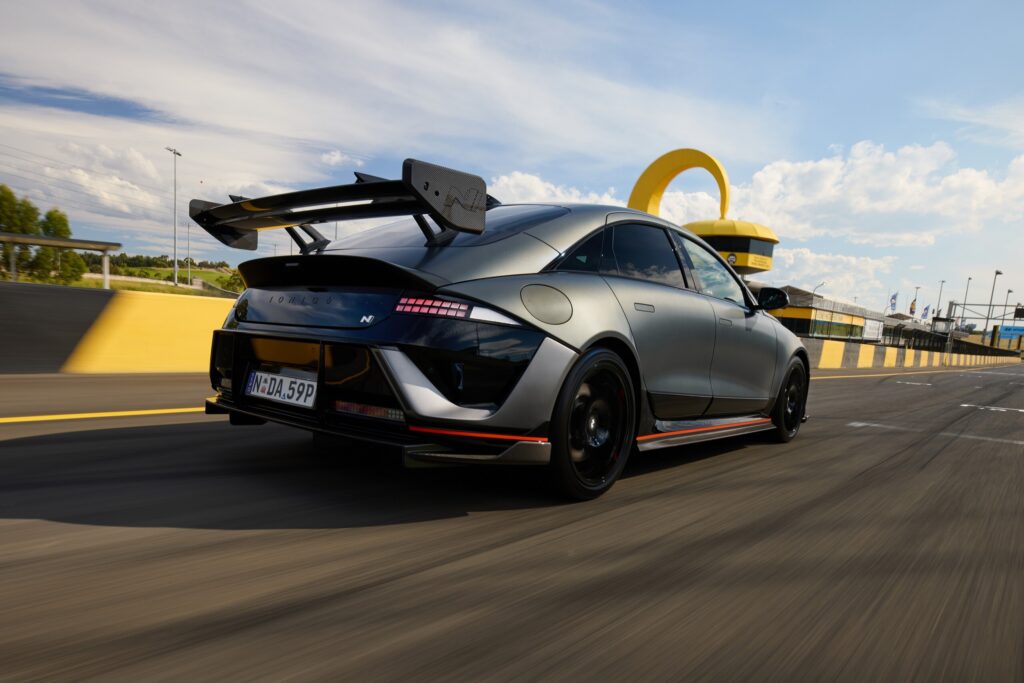
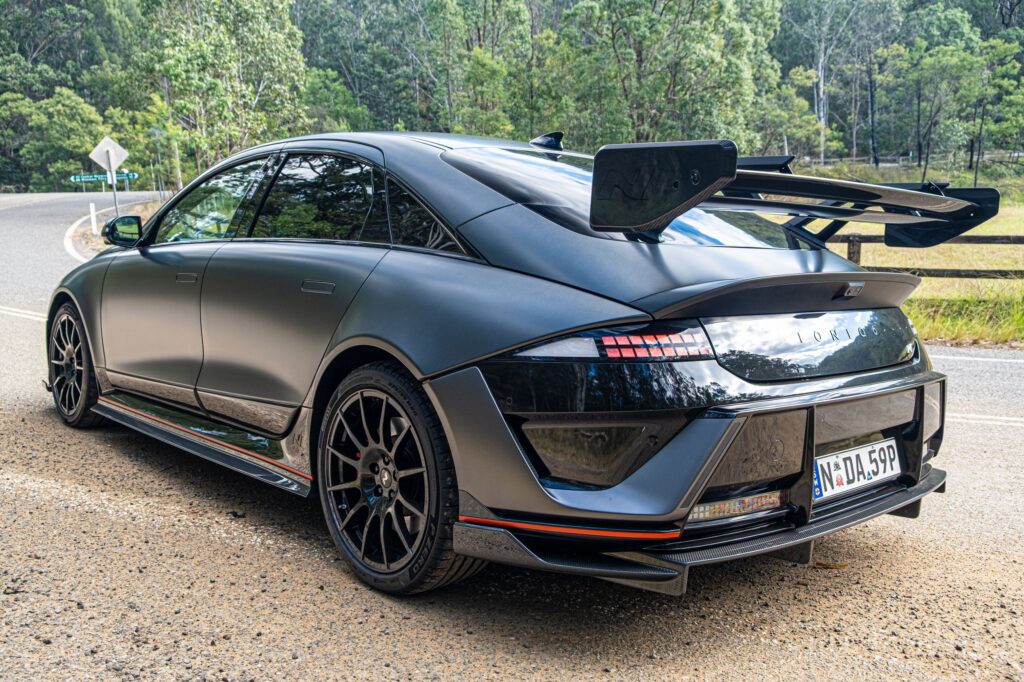
In Australia, prices start from AU$115,000 (US$82,800). In the US, the starting price is expected to be around US$70,000. The matte gray model you see in some photos includes several carbon fiber accessories, including a massive rear wing for AU$7,289 (US$5,245), a carbon splitter for AU$2,484 (US$1,787), side skirts for AU$4,810 (US$3,461), and a rear diffuser for AU$4,090 (US$2,943).
Sporty Changes Inside
The interior has also been revised, although it’s not radically different from the regular Ioniq 6. Key details include a new N steering wheel, new head-up display graphics, sporty bucket seats, and new surfaces with leather and Alcantara.
Since the N is based on the updated Ioniq 6, it has all the same features. These include a configurable 12.3-inch digital instrument cluster, a 12.3-inch infotainment display, and, importantly, plenty of tactile physical buttons — something that is becoming increasingly rare in the EV world. It’s a pleasant space to spend time in, and the updates made for the N ensure it feels special.
Like the Ioniq 5 N, the Ioniq 6 N is a very niche product. It’s not the type of car Hyundai expects to sell in large volumes. In Australia, around 500 expressions of interest have been received, although order books aren’t open yet, so it’s unclear how many will actually convert into buyers.
Driving
A quick look at the Ioniq 6 N’s specifications is enough to understand that this is a seriously focused car. However, unlike some straight-line heroes that dominate the so-called ‘performance’ EV class, Hyundai’s latest creation is much more than just a fast launch from a standstill.
Of course, that doesn’t mean this car isn’t insanely fast off the line. It is. According to Hyundai, the Ioniq 6 N can accelerate to 100 km/h in just 3.2 seconds with the N Grin Boost function activated, which raises peak power to 478 kW (650 hp) and 740 Nm of torque for 10-second bursts. During our testing, we recorded repeated 0-100 km/h runs of 3.2 seconds, while 60-120 km/h takes just 2.45 seconds.
While it would be easy to dismiss these figures given how many quick EVs are on the market now, it’s worth remembering that such performance was once the exclusive preserve of high-end supercars costing half a million dollars, not a practical four-door sedan that costs only a fraction of that and roughly a third of what a Porsche Taycan Turbo costs.
Fitted with standard Pirelli P Zero Elect tires, but with P Zero Corsa rubber for our track sessions, the car just digs into the asphalt, delivering relentless, unstoppable acceleration.
No Electric Sedan Should Drive Like This
However, more than the acceleration, it’s the handling and overall driving dynamics that stand out in the Ioniq 6 N.
Like the Ioniq 5 N, the 6 N uses a pair of powerful electric motors on the front and rear axles. It includes the N Torque Distribution function, which allows drivers to shift from 95 percent power bias to the front axle to 95 percent bias to the rear. However, to get maximum power from both motors, it’s best to keep the power distribution in 50-50 mode.
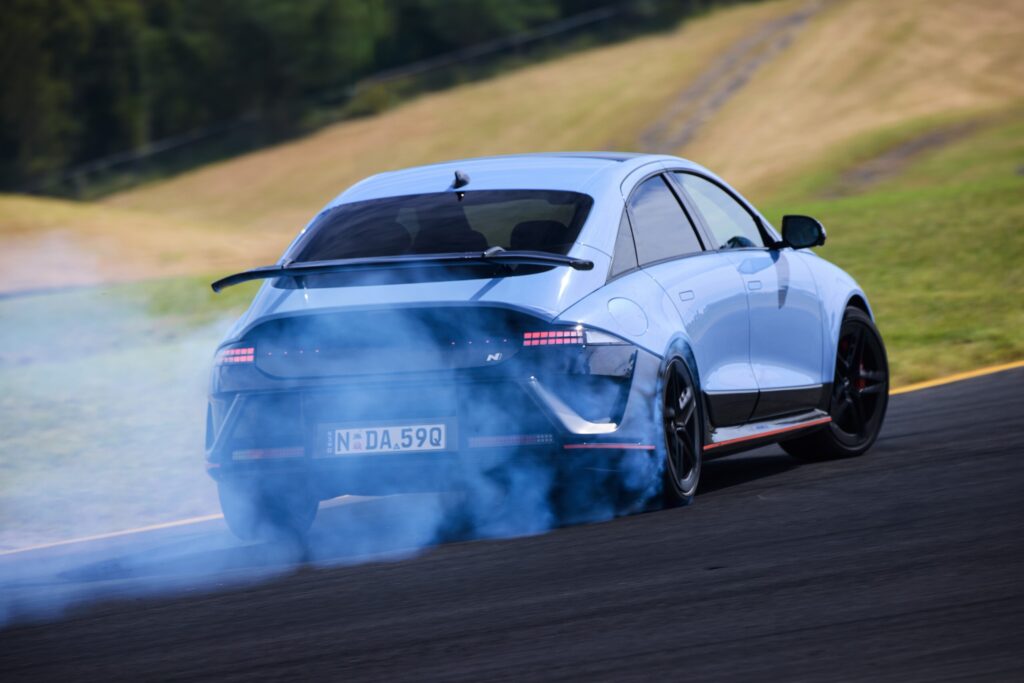
Even in this mode, with a 60-40 power distribution favoring the front axle, the Ioniq 6 N feels rear-wheel drive and is even more playful than its crossover sibling. For several laps, I kept the car’s power distribution in 50-50 mode with ESC in sport mode and was delighted by how gracefully the rear end starts to slide under power. When this happens, the stability system allows an astonishing slip angle before intervening, making the EV extremely easy to control at and beyond the limit.
Absolute grip is exceptional and combines perfectly with excellent steering feel, despite it being an electric power steering system. What’s particularly impressive is that the steering provides as much feedback as Hyundai’s internal combustion N models. There are no issues with determining the grip limits, whether through the front or rear axle.
Admittedly, the overall size of the Ioniq 6 N and its weight mean that both the road-going P Zero Elect and P Zero Corsa tires start to overheat after three or four fast laps. This wasn’t helped by the fact that the tires on the cars we tested dated from 2023, making them a bit old.
Improvements have been made to the N e-Shift function. This system aims to replicate the feel of Hyundai N’s eight-speed dual-clutch automated transmission, providing a satisfying jolt in the back and torque changes like an internal combustion car. Whereas the Ioniq 5 N had seven of these fake gears, the Ioniq 6 N has eight. With shorter gear ratios, even if they aren’t real, you can enjoy even more shifts.
Those who haven’t encountered this system might be quick to dismiss it. After all, how can EV software simulate real gear changes? However, the team of Hyundai engineers who developed the eight-speed dual-clutch transmission for the N also developed this system, and it’s almost indistinguishable from a conventional transmission. It’s confusing at first but quickly becomes familiar.
Changes were also made to the N Active Sound+ system. As in the Ioniq 5 N, the Ioniq 6 N’s system includes three modes: Ignition, Evolution, and Supersonic, although changes were made to all three. Whereas the Ioniq 5 N’s system uses two channels, the Ioniq 6 uses six, providing a richer, louder, and more authentic sound, especially in Ignition mode, which sounds exactly like the i30 N’s exhaust. However, the Active Sound+ system doesn’t replicate the sound of a turbocharged four-cylinder as well as e-Shift mimics a real automated gearbox.
Road Characteristics
On the road, the Ioniq 6 N proved to be a surprisingly good cruiser that can, however, transform into a beast at the press of the N button.
Given the performance, it’s no surprise that the Ioniq 6 N isn’t as efficient as the regular model. On the track, it will average around 19 kWh/100 km, which is acceptable. However, start driving in a more sporty style, and this figure will quickly climb into the 20s. On the track, while driving at the limit without regenerative braking, it depletes the battery by about 8 percent over a 105-second lap. Using regeneration can reduce this to around 5 percent.
A key achievement for the Ioniq 6 N’s road characteristics is how well it rides. The new and improved suspension works wonders, absorbing bumps perfectly in its softest mode while still providing a sporty feel. Increase the setting to one of the more aggressive modes, and it is much less stiff than the i30 N, remaining perfectly suitable for daily driving.
While road tires may overheat on the track, you’d need to find a very long stretch of asphalt to get them to overheat on the road. They provide immense grip and excellent feedback about the grip limits. As on the track, there is no other EV that feels the same on the road. Dynamically, the car is almost flawless, and it is certainly more capable than the Ioniq 5 N.
Perhaps the brake feel isn’t as nice as in some other sports cars, but that’s nitpicking. One thing is certain: there is no noticeable transition from regenerative to friction braking, a signature trait of other Hyundai Group EVs.
Verdict
Automakers have struggled to develop and build EVs that touch the hearts of driving enthusiasts. Overall, these cars lack soul and passion, often devoid of any character. This is not the case for Hyundai, and there’s a good reason why Ferrari, Lamborghini, Porsche, and others used the Ioniq 5 N as a benchmark.
The Ioniq 6 N is the culmination of everything the N division has been developing since its founding over ten years ago. It is expensive for a Hyundai, but cheap compared to a Porsche Taycan or Audi RS e-tron GT, and delivers emotions that neither of those two can offer. As we enter a world where high-performance EVs are becoming increasingly common, it’s good to know that Hyundai keeps the preferences of car enthusiasts at the top of its agenda.
It’s worth noting that the Ioniq 6 N is not just another fast EV. It is an attempt to rethink the very concept of a ‘driver’s car’ in the electric age. Hyundai’s engineers consciously made compromises in efficiency and range to create the most exhilarating driving experience possible. The sound and gear shift simulation systems, while perhaps seeming artificial, actually solve a key problem of many EVs — the lack of feedback and emotional engagement for the driver. Thus, the Ioniq 6 N becomes a sort of bridge between the familiar world of gasoline-powered sports cars and the new electric future, offering drivers familiar sensations in a completely new technological package.