 by
by Skoda Elroq 60: Europe’s Answer to the Challenges of the EV Market
European brands have watched over the past few years as the affordable electric crossover segment filled up around them. Most of the continent’s biggest names arrived late to this battle, hastily creating competitive models capable of standing up to new players from China and established Asian manufacturers.
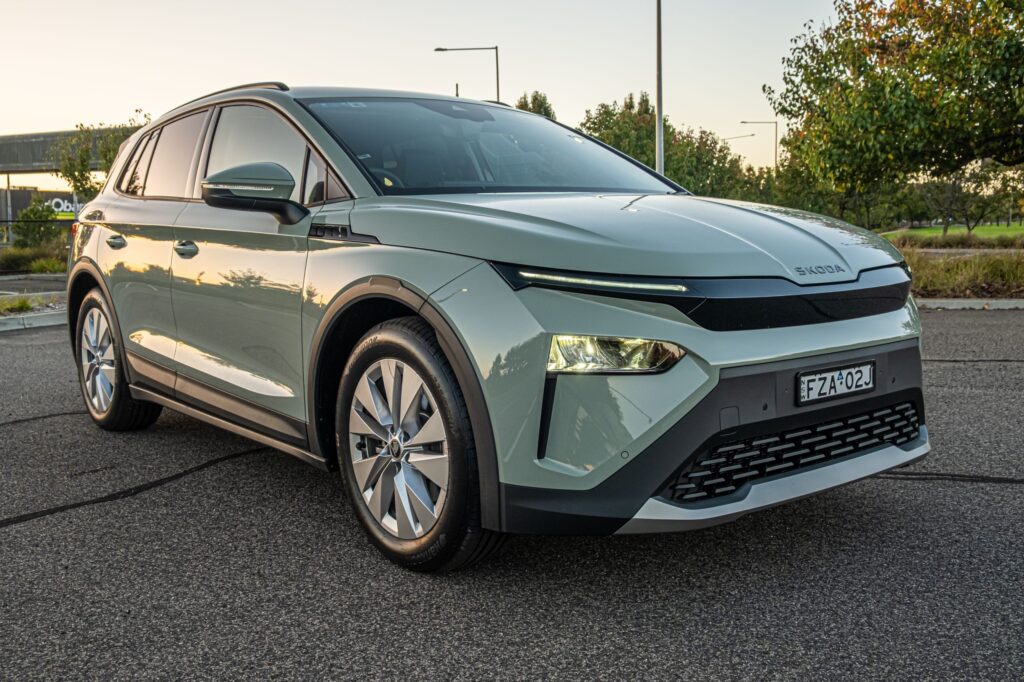
The new Skoda Elroq from the VW Group is one of the answers to this problem. It won’t be sold in the US, but it’s available in Europe and several other markets, including Australia, where we recently tested it in the base Elroq 60 trim. The list of competitors reads like a who’s who of segment leaders: Kia EV3, Nissan Ariya, Tesla Model Y, Geely EX5, and many others. To survive this competition, this car needs to be more than just competent.
Positioned between the larger Enyaq and the smaller Epiq, the Skoda Elroq doesn’t initially announce itself as anything outstanding in this crowded segment. However, after spending some time behind the wheel, it reveals itself as a rather attractive proposition.
Price, Competitors, and Specifications
In Australia, three versions of the Elroq are available. The base model is the Select 60, priced from AU$49,990 ($36,300), including all fees. Next is the Select 85 from AU$59,990 ($43,500), and the top-tier version is the 130 Years Edition at AU$69,990 ($50,800).
Under the bodywork sits a 59 kWh (NMC) battery pack, with power provided by a single electric motor producing 150 kW (201 hp) and 310 Nm of torque. Importantly, the Elroq is rear-wheel drive, unlike competitors such as the Kia EV3 and Geely EX5, which are front-wheel drive. Theoretically, this should eliminate any torque steer issues at the steering wheel and provide more engaging driving dynamics.
The price of the Elroq 60 is competitive, though not class-leading. The better-equipped Geely EX5 Inspire is available for AU$50,061 ($36,300), while the base Kia EV3 Air – Standard Range starts at AU$46,990 ($34,100), and the Air – Long Range is $52,990 ($38,500). Nevertheless, it’s nice to see a European car that largely matches its Asian competitors.
Interior: Fresh, Modern, and Spacious
Getting into the Elroq for the first time, I was pleasantly surprised by its spaciousness and overall build quality. Modern EV interiors are becoming increasingly homogenous, and while the Elroq’s cabin is far from revolutionary, it has some intriguing elements that make it special.
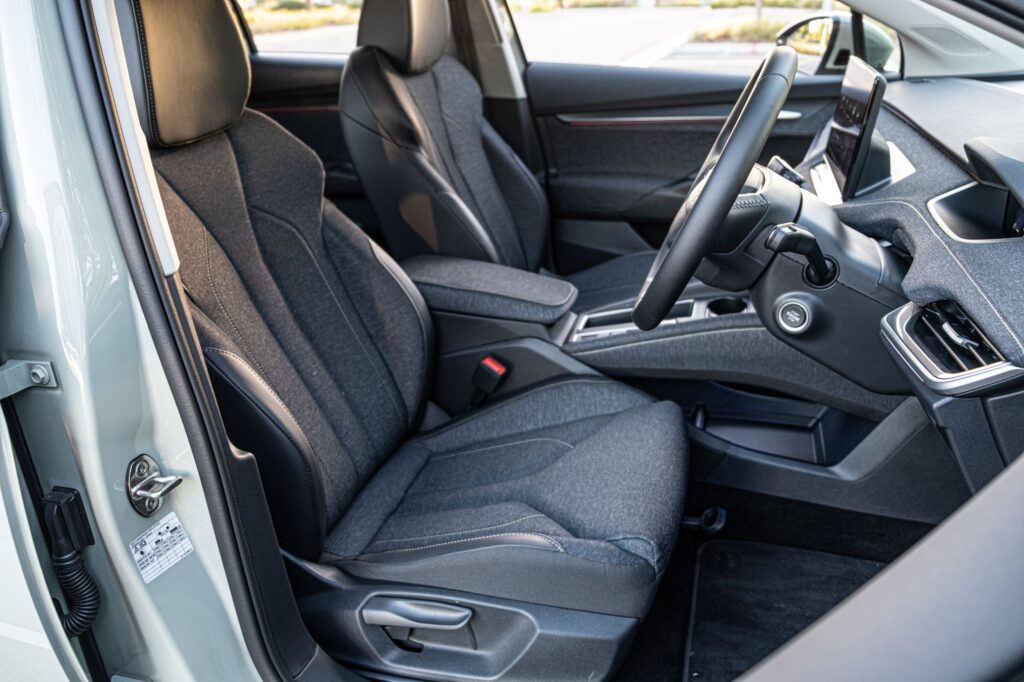
The highlight of this base model is the fabric upholstery adorning the dashboard, armrests, seats, and center console. It’s a nice departure from most competitors, which rely solely on hard black plastic or soft leatherette. While this might not translate in photos, the fabric looks like dark grey denim, though it is much softer than any jeans. Alongside the upholstery, the two-spoke black steering wheel is quite interesting.
As for technology, Skoda includes a 13-inch infotainment screen with wireless Apple CarPlay and Android Auto, as well as a small 5.0-inch instrument cluster display. The instrument screen isn’t anything special, but it’s better than some competitors that don’t have one at all.
The central touchscreen contains all the essential car controls, including climate control. Some controls like temperature and media are pinned to the bottom of the menu as shortcut keys, but it would be great to have shortcut keys for fan speed as well. Below the central vents are physical buttons for a few driving settings and front and rear windshield defogging functions.
The overall build quality in the cabin is top-notch, but it’s genuinely a shame that this base model only has manual seat adjustment without adjustable lumbar support. This will likely turn off some potential buyers, especially considering that some Chinese competitors have these features. As in other Skoda models, an umbrella is neatly installed in the driver’s door, a la Rolls-Royce.
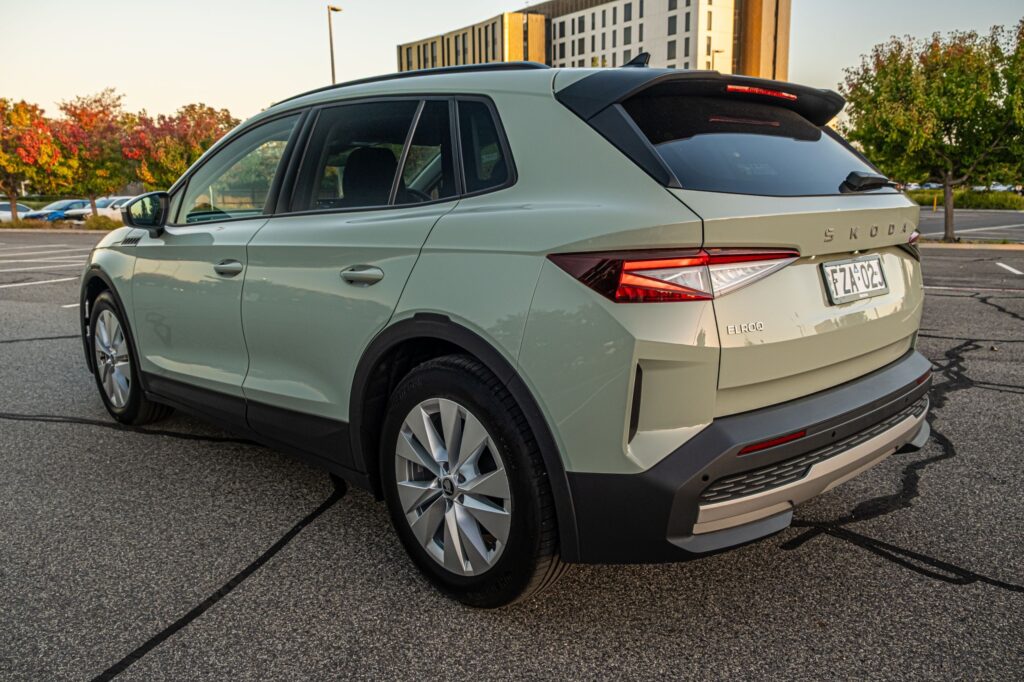
Because Skoda’s designers avoided the trap of trying to make the Elroq too sporty with a fastback roofline, there is plenty of headroom and legroom for adult passengers in the second row.
Dynamics, Efficiency, and Charging
Most cars in this segment aren’t designed to excite enthusiasts. If you step back and look at the Elroq 60 as a transportation device for everyday buyers looking for something premium, the Skoda ticks many boxes.
First, there’s efficiency. Skoda claims the Elroq 60 can average 15.9 kWh/100 km on the combined cycle, which should provide a theoretical range of 395 km. During my week-long test, I achieved an average of 16.0 kWh/100 km, very close to the claimed figure, while driving in mixed city and suburban conditions.
In a world where more expensive EVs promise over 800 km of range, the sub-400 km range of the Elroq 60 might seem unimpressive. However, it’s important to note that this is more than enough for the daily commutes of the vast majority of people looking for such a crossover, especially one large enough to carry kids.
As for charging, the Elroq 60 supports DC fast charging at up to 165 kW. This is far from a class-leading figure, and topping up the battery from 10 to 80 percent takes 24 minutes. However, this is better than the popular Kia EV3, which takes about 29 minutes to charge its 58.3 kWh battery from 10 to 80 percent. When plugged into an 11 kW AC home charger, the battery can be fully charged in about 6.5 hours, so overnight charging will suffice for most owners.
Performance is also solid. Thanks to the rear-wheel-drive layout, there is no torque steer, which is present in some competitors. All owners will experience smooth, unobstructed power delivery. Admittedly, the Elroq 60 isn’t particularly quick, accelerating from 0 to 100 km/h in about 8 seconds.
Dynamically, the Skoda feels excellent. Body roll is minimized thanks to excellent suspension tuning, yet it remains comfortable enough for daily use even on the worst roads. The Hankook tires provide more than enough grip to tackle corners energetically, and even at the limit of adhesion, the car remains easy to control.
Very few EVs on the market have particularly responsive or informative steering, but this isn’t an issue for most drivers. The good thing is the steering is light and direct, working equally well on the highway as it does in a tight mall parking lot.
Braking and Safety
Braking is one area where the Elroq 60 could be improved. In Drive mode, there is no regenerative braking, so the crossover simply coasts — seemingly forever. If you want regen, you have to drive in B mode, which provides decent braking force, but importantly, it does not include a one-pedal driving mode, which is a shame. It’s also unfortunate that there aren’t more ways to adjust the regen level. It could be worse, as some competitors require diving into numerous menus on the central display to adjust regen levels.
Key safety features included as standard on the Elroq 60 include autonomous emergency braking, adaptive cruise control, blind-spot warning, lane keep assist and lane centering, front and rear parking sensors, and an optional 360-degree camera.
I found the adaptive cruise control and lane centering to work flawlessly on well-marked highways, and they are easy to activate and deactivate using the steering wheel controls if you prefer to stay more actively in control.
Verdict
The Skoda Elroq 60 helps prove that established European brands can compete with their Chinese, Japanese, and South Korean rivals in the world of affordable EVs.
This isn’t the type of car that will ignite a burning passion in owners to go for a nighttime drive just for the fun of it, but it does exactly what it should, and at a good price. Skoda has never been a volume seller in Australia, selling only about 5,000 units last year. If local buyers can look past some of the flashy tech features that competitors offer, they will find a very adequate EV in the Elroq 60.
Overall, the Skoda Elroq 60 demonstrates a mature approach to building an affordable electric vehicle. It doesn’t try to impress with the longest range or fastest charging, but instead offers a balanced package with a spacious interior, quality materials, and pleasant dynamics thanks to rear-wheel drive. The lack of some modern ‘features’ like power-adjustable seats or a one-pedal driving mode may disappoint, but for a pragmatic buyer who values space, comfort, and reliability, this could be the ideal choice. It shows that European manufacturers can still offer competitive products, even if they aren’t always the leaders in specifications.