 by
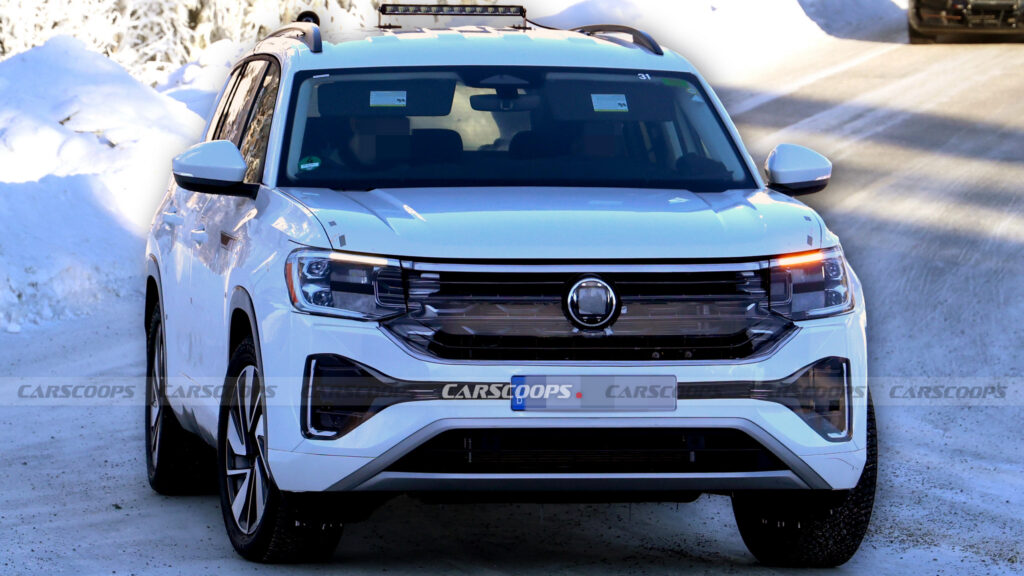
by The 2027 Volkswagen Atlas sheds camo before its debut. Three-row crossover adopts a cleaner evolutionary look. Turbocharged 2.0-liter four likely makes about 268 hp.
Revealing the New Design
Just days after Volkswagen showed the updated Atlas in colorful wrap, spy photographers captured the three-row crossover almost without camouflage. Thanks to their shots, it is clearly visible that this will be a case of evolution, not revolution.
Exterior Details
The car has decals inspired by the current model, and a familiar front end with a new split radiator grille can be seen. It is flanked by larger headlights that look slightly more traditional than the C-shaped units on today’s Atlas.
The lower bumper is clearly disguised as the current crossover, but the central black strip is an imitation. Instead, there will be a restrained bumper with vertical air curtains. A familiar trapezoidal grille is also visible, which differs from the diamond pattern shown in the teasers.
Changes in Profile and Rear
The changes in profile look more striking, as a sculpted body with subtle creases and smooth surfaces is visible. Designers have also given the Atlas a more expansive glass area and substantial body-colored cladding.
They are complemented by traditional door handles and an interesting shoulder line. It is also worth noting that the decoration on the front doors is just a sticker, as the surface accent has been removed.
The tailgate looks quite evolutionary, but the sticker imitating an LED light bar can be ignored. However, the bumper design is much more expressive, as it has a recessed central section with a full-size area for a reflector or LED strip. They are accompanied by imitation exhaust outlets, as well as a trapezoidal accent surrounding the trailer hitch receiver.
Platform and Powertrain
Although Volkswagen has not yet shared many details, the debut will take place at the New York Auto Show in April, and the model will be very similar to the Teramont Pro sold in China. Sources suggest the crossover will retain its 117.3-inch (2980 mm) wheelbase and the same roofline as the current model.
The Atlas will be built on the MQB Evo platform and will receive the new EA888 evo5 engine. In the Tiguan model, it develops up to 268 hp (200 kW) and 258 lb-ft (349 Nm) of torque. However, for the Atlas, the power might be increased, as the Teramont Pro develops the same amount of horsepower but 295 lb-ft (400 Nm) of torque.
Price Expectations
As for prices, we will have to wait a few months for official figures, but they are unlikely to deviate much from the current 2026 model. It starts at $39,310 for the base front-wheel-drive SE and goes up to $56,105 for the all-wheel-drive SEL Premium R-Line. All figures, of course, do not include the mandatory $1,475 destination charge.
The presentation of the updated Atlas comes at a key moment for the SUV market, as buyers increasingly seek more efficient and technologically advanced models. Retaining familiar dimensions along with updated styling and expected interior improvements could be a successful strategy for maintaining customer loyalty in the family crossover segment. The model’s success will also largely depend on how well Volkswagen can position it against the backdrop of intensifying competitors who are also preparing updates to their lineups.