 by
by Update for the Japanese kei van Suzuki Every
The Suzuki Every rarely makes headlines outside of Japan, which is a shame, as it is a cheap and incredibly useful city van that simply doesn’t exist in most Western markets. For the new model year, Suzuki has updated its popular kei van, giving it light cosmetic and technical changes sufficient to make this “box on wheels” comply with local safety requirements.
Exterior changes and versions
Visual changes are concentrated at the front. An updated bumper and a thicker radiator grille soften the purely utilitarian look of the base model, while the Join version adds a chrome insert above the grille for buyers who want a more presentable look on the road.
The Every Wagon version is more concerned with appearance. Tinted headlights, a more aggressive body kit, a larger grille, sharper air intakes in the bumper, deeper side skirts, and a roof spoiler distinguish it from its simpler brethren. Alloy wheels replace stamped steel ones, retractable running boards are available as an option, and the color Majestic Deep Gray Pearl Metallic has been added to the palette.
Suzuki Every J Limited
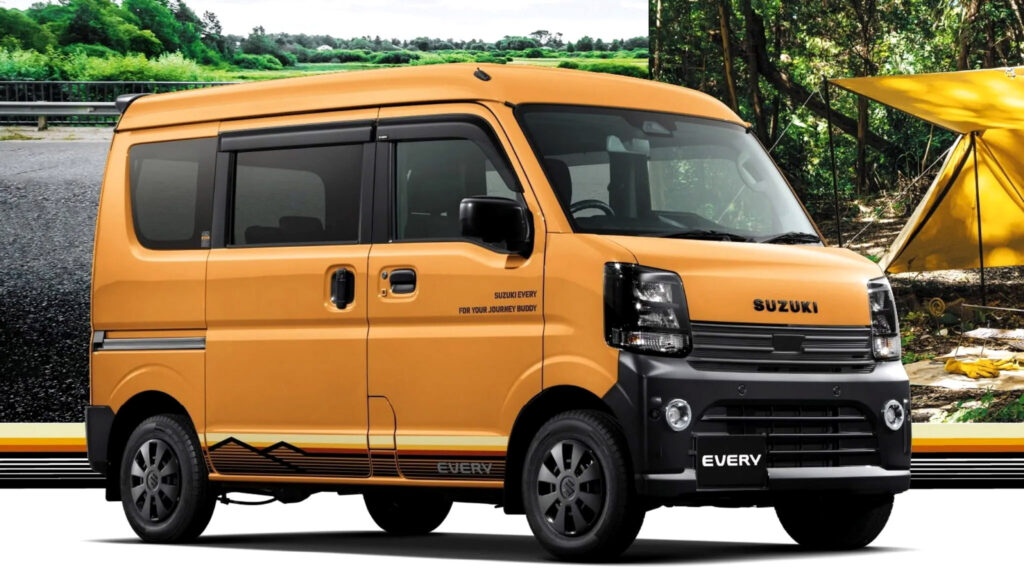
The flagship Every J Limited version, aimed at adventures, also received an updated front bumper finished in glossy black, which combines with wheel caps, mirrors, pillars, door handles, and Suzuki badges marking the special series.
The J Limited retains its off-road decals, exclusive paint options, and an accessory catalog that transforms the interior into a reliable base for camping and weekend trips.
Digital instrument cluster and improved safety
Inside, Suzuki used an all-black theme, which is supposed to hide stains better than lighter alternatives. Analog gauges have given way to a digital instrument cluster, which is now standard across the model range. Buyers can also order a 9-inch infotainment display with built-in navigation, a new 360-degree camera, and a heated steering wheel.
The safety suite has been improved thanks to the Dual Sensor Brake Support II system with updated radar and a monocular camera. The ADAS package also includes adaptive cruise control, active lane departure prevention, and front and rear parking sensors.
Another hidden update is the addition of a special damping mastic sealant between the roof panels to actively suppress rumbling and vibrations in the cabin. Like its predecessor, the kei van remains available in two-seat and four-seat versions with folding rear seats.
The cargo area now has standard LED lighting for working at night. Suzuki claims the 3,395 mm long van can fit 40 standard Japanese beer crates or two child seats along with a pair of strollers. The base PA trim retains manual window regulators, partly to keep the price low, and partly because fewer moving parts means fewer things needing repair over the van’s long service life in a fleet.
Mechanics: Manual transmission, 4WD, and turbo
Suzuki Every and Every Wagon
The Every is based on a mid-engine layout, closely related to the recently updated Carry and Super Carry kei trucks. It is also mechanically identical to the Nissan Clipper Van, Mitsubishi Minicab Van, and Mazda Scrum Van, which received the same set of updates.
Power comes from a 660cc three-cylinder engine, available in two states of tune without electrification. The naturally aspirated version produces 48 hp (36 kW) and is paired with a five-speed manual or a CVT. The turbocharged variant boosts power to 63 hp (47 kW) and is available only with the CVT. Both can be ordered with either rear-wheel drive or part-time all-wheel drive.
Suzuki also sells a fully electric version called the e-Every, but it is a completely different machine. The EV is a rebadged Daihatsu e-Hijet Cargo and Toyota Pixis Van BEV, which is based on its own platform rather than sharing the chassis with the gasoline Every.
Prices and competitors
Adventure versions often attract attention, but the real story lies at the bottom of the Every’s price range. The PA trim with rear-wheel drive and a manual transmission opens the lineup at ¥1,343,100 ($8,400) in Japan, which is roughly the maximum amount of van one can buy for that money.
Moving up, the cheapest all-wheel drive option costs ¥1,475,100 ($9,300), while the most accessible turbocharged version starts at ¥1,775,400 ($11,200). The adventure-oriented J Limited with a turbo and all-wheel drive costs ¥2,132,900 ($13,400), and the top-of-the-line Every Wagon PZ Turbo Special with a high roof tops the lineup at ¥2,264,900 ($14,200).
The unrelated and fully electric Suzuki e-Every starts at ¥3,146,000 ($19,800), which is more than double the price of the base gasoline model.
In its domestic market, the Every competes with its rebadged brethren from Nissan, Mitsubishi, and Mazda, as well as the Daihatsu Hijet Cargo and Attrai, the Toyota Pixis Van, and the trio of Subaru Sambar Vans.
The price of the base Every makes it one of the most affordable new cars in the world, highlighting the uniqueness of the Japanese kei car market. While such cars are rarely officially exported, they remain an interesting example of how strict local regulations and tax incentives can create niche but incredibly practical vehicles that have no direct analogues in the West.