 by
by New Electric Heavy Truck from Ford
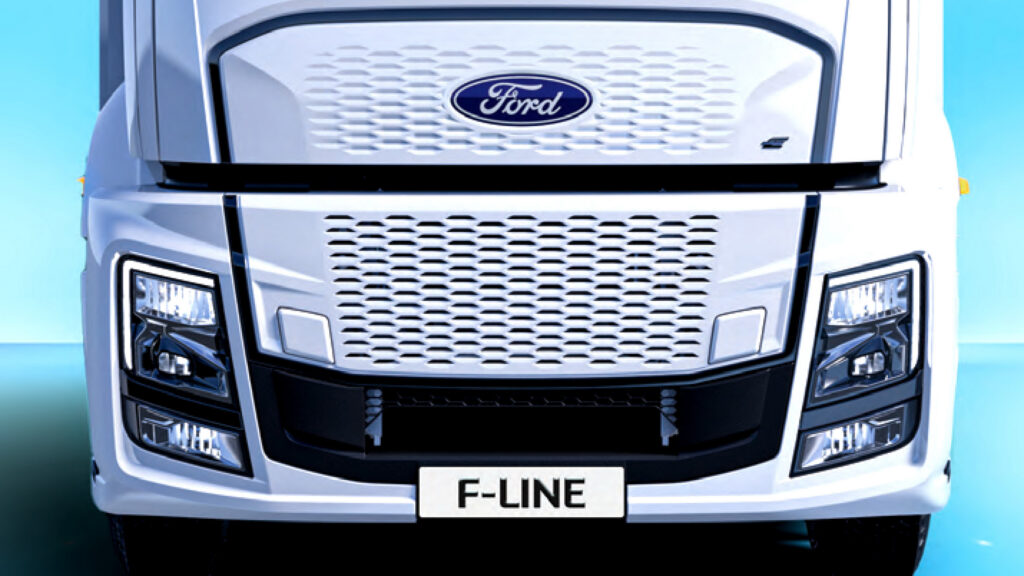
Ford has introduced its first serial heavy-duty electric truck F-Line E, designed for the European market. This model is available in two main configurations: the more powerful 6×2 and the more compact 4×2.
Ford’s Strategy in Electric Vehicle Development
Despite some slowdown in ambitious plans for electric vehicles, Ford continues to invest in new developments. The first serial battery product from the Ford Truck division was not a passenger car, but a specialized electric truck F-Line E.
Ford Trucks operates as the heavy commercial division of Ford Otosan, a joint venture between Ford and the Turkish Koç Holding. The partnership is responsible for the design, engineering, and production of tractors, construction equipment, and heavy trucks for the markets of Europe, the Middle East, and Asia.
Production and Specifications
Production of the F-Line E will be carried out under the auspices of Ford Otosan, and the model will be first presented at the Solutrans exhibition in France in 4×2 and 6×2 configurations.
The largest model is equipped with four 98 kWh nickel-manganese-cobalt type batteries, providing a total capacity of 392 kWh or 314 kWh of usable capacity. According to Ford, this is enough for a range of up to 300 km.
Power is provided by a single electric motor on the rear wheels: 415 hp and 1370 Nm of torque in normal mode, with the possibility of increasing to 523 hp and 2470 Nm. The 6×2 model also supports a peak charging speed of up to 285 kW.

Smaller 4×2 Version
The smaller 4×2 version has three battery packs with a total capacity of 294 kWh or 235 kWh of usable capacity. It is also equipped with a less powerful 315 hp engine with a peak value of up to 389 hp. The range of this version is up to 250 km, and the peak charging speed is limited to 213 kW. Both models are limited to a maximum speed of 90 km/h.
Purpose and Capabilities
Ford Trucks positions the F-Line E as a flexible platform suitable for cargo transportation, municipal operations, and various professional applications, including garbage collection. The truck’s modular design allows operators to adapt it for specific tasks without major modifications.
Updated Diesel Model
Alongside the F-Line E, Ford also introduced the updated F-Max at the same event. This significantly larger model is equipped with a modernized 12.7-liter engine for 2025, which promises to reduce fuel consumption by 11%, indicating that Ford’s commercial lineup has not yet fully transitioned to electrification.
The appearance of the F-Line E demonstrates that heavy equipment manufacturers are gradually adapting to emission reduction requirements by offering solutions for urban and regional transport. The ability to choose between electric and diesel versions allows companies to flexibly approach fleet renewal, taking into account infrastructure limitations and economic factors.