 by
by Tesla Sales Drop in Norway
Tesla’s dominance in Europe has been under pressure for some time, but a sharp decline in one of its most loyal markets has proven unexpected. Despite controversial behavior by Elon Musk and the emergence of competitive alternatives undermining the brand’s popularity on the continent, one country had remained faithful. But now the situation has changed even there.
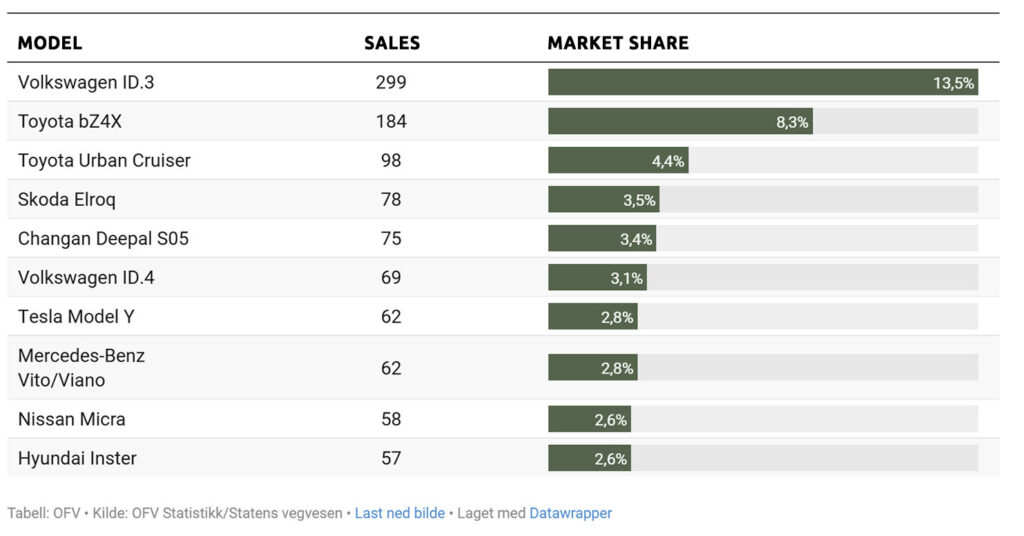
Norway, long considered Tesla’s European stronghold, may also be losing interest. New registration data for January 2026 shows that only 62 Tesla Model Y units were delivered in Norway last month, accounting for just 2.8% of new car sales.
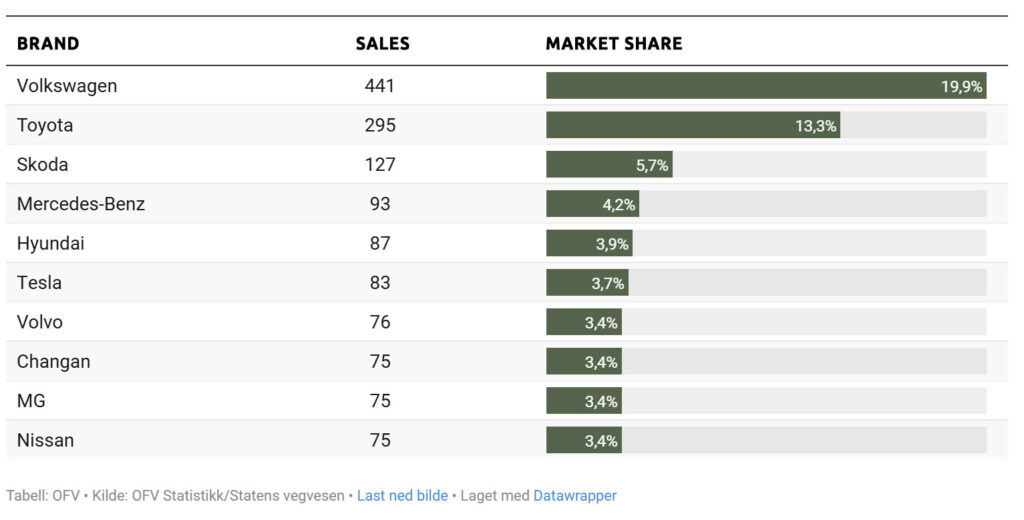
Across the entire model range, Tesla sold only 83 vehicles, representing an 88% drop compared to the same period last year.
Change of Leaders
Several other electric vehicles now significantly outsell the Model Y in Norway. The leader in January was the Volkswagen ID.3 with 299 registered units, nearly five times more than Tesla.
It was followed by the Toyota bZ4X with 184 sales, ahead of the Toyota Urban Cruiser with 98 and the Skoda Elroq with 78. Even the relatively unknown Deepal S05 surpassed the Model Y with 75 new registrations, while the Volkswagen ID.4 performed slightly better than Tesla with 69 units.
Electric Cars Still Dominate
Despite Tesla’s failure, the Norwegian car market remains predominantly electric. A staggering 94% of all new vehicles sold in Norway last month were electric cars. Diesel cars accounted for only 98 sales, while just 7 gasoline cars were registered nationwide, the lowest figure on record.
Although Tesla had a difficult month in Norway, it actually recorded sales growth in some European markets. For example, sales in Spain increased by 70% to 456 units. Furthermore, sales in Italy grew by 75% to 713 units, in Sweden by 26% to 512, and in Denmark by 3% to 458.
This growth was likely driven by new, more affordable and simplified versions of the Model 3 and Model Y. These standard variants were introduced to revitalize Tesla’s aging lineup, which is increasingly criticized for lagging behind newer, more dynamic competitors.
Nevertheless, the overall picture for Tesla in Europe remains mixed. A Reuters report points to significant losses in key markets: sales in France fell by 42%, in Belgium by 31%, and the Netherlands saw a sharp drop of 67%. The decline in Portugal was moderate but noticeable at just over 3%.
New Threats on the Horizon
It will be interesting to observe how Tesla’s situation in Europe develops throughout the rest of 2026. An increasing number of Chinese brands are launching several new models in Europe, and in the second quarter, BYD will begin mass production at its plant in Szeged, Hungary, allowing it to sell electric cars in the region duty-free.
The Norwegian market has always been a kind of barometer for electric vehicle adoption in Europe, and a sharp shift in consumer preferences may signal deeper structural changes. The success of models like the Volkswagen ID.3 and Toyota bZ4X suggests that buyers increasingly value diversity and, perhaps, a more conservative approach to design and reliability. The arrival of Chinese manufacturers capable of offering competitive technology at affordable prices could further intensify the competition, forcing even an innovator like Tesla to find new ways to retain market share. The future will show whether the Norwegian experience becomes an exception or a precedent for other European countries.