 by
by Future Strategy
Renault has decided that the best way to prepare for the future is to literally name its strategy after it. The company’s new plan, called futuREady, promises dozens of new models, cheaper electric cars, and sharply accelerated development cycles. The French automaker is trying to protect its business from Chinese competition and become Europe’s “benchmark” car manufacturer.
This strategy builds on the Renaulution recovery plan launched in 2021, which helped stabilize the company after several turbulent years. Now Renault wants to turn this recovery into long-term growth with a roadmap that stretches to the end of the decade.
Electrification and Hybrids
The main figure is quite simple. The Renault Group plans to launch 36 new models over the next five years, including 22 in Europe and 14 for international markets. Electrification will be a key element, with 16 of these European launches being fully electric.
Hybrids will still have their role. Renault states that hybrid technology will remain in its European lineup even after 2030, continuing to expand globally where charging infrastructure is not yet ready for a full switch to electric vehicles.
Brand Roles in the Plan
Each brand has its role in the plan. Renault aims to strengthen its position in Europe while expanding internationally, with the goal of selling over 2 million cars per year by 2030, half of which will be delivered outside Europe.
Dacia will stick to its familiar value formula but will add more electrification. By the end of the decade, about two-thirds of its sales are expected to be electrified, and the brand will continue to expand into the larger C-segment.
Alpine will carry the performance torch. A new generation of the A110 is expected, this time as an electric vehicle, along with newer models like the electric A290 and A390. Brand head Philippe Krief confirmed that the A110 electric platform will also be able to use internal combustion engines. However, Renault’s latest strategy rules out North American adventures for any of its brands.
Compact Model Updates
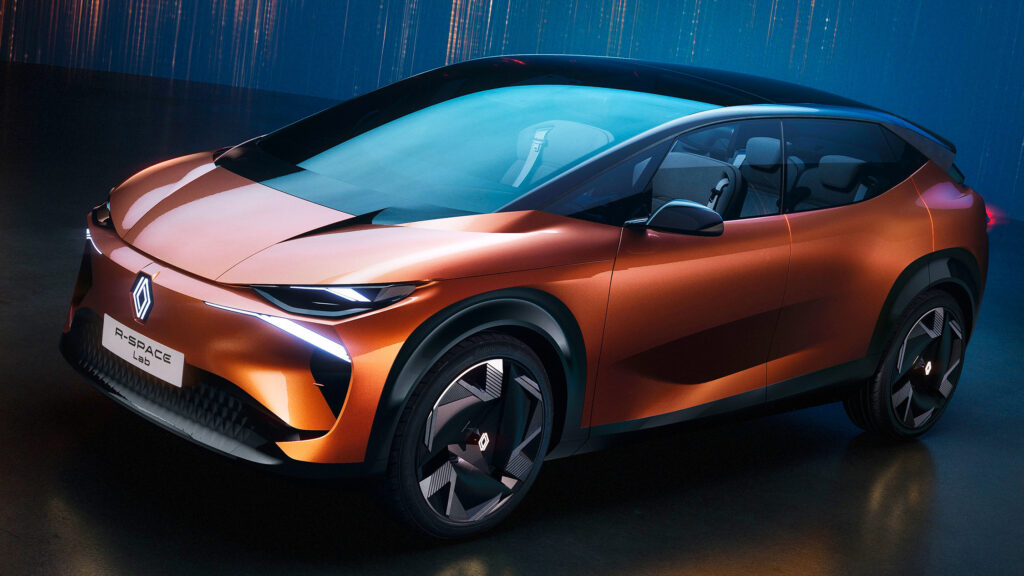
One of the most important parts of the plan is the future Renault RGEV Medium 2.0 electric platform, designed for the next generation of C-segment compact cars. This architecture brings 800-volt charging technology to the company for the first time and promises impressive figures, including a 40 percent reduction in production costs. Renault showed its potential, as well as the design of the next Espace, with the R-Space Lab concept.
Renault states that electric vehicles built on this platform can provide a range of up to 466 miles (750 km), while a version with a range extender can increase this figure to approximately 879 miles (1400 km). There will be plenty of power too. The next-generation electric motor is expected to deliver up to 271 hp (275 PS).
Competition with China
Software is another big part of the puzzle. Future Renault models will transition to a software-defined vehicle architecture, allowing most features to be updated “over the air” and eventually managed by artificial intelligence systems. The company also wants to drastically accelerate processes. Renault aims to shorten new car development cycles to just two years, which will be crucial to keeping up with Chinese automakers.
Renault’s Platform Strategy
The group detailed its platform strategy, which covers different families for different needs:
- Electric Passenger Car Platforms: include RGEV Small for small EV segments A and B, RGEV Medium 1.0 for first-generation C-segment EVs, and RGEV Medium 2.0 for next-generation C and D segment EVs with 800V technology.
- Electric Commercial Vehicle Platforms: RGEV Medium Van for light commercial vans in the C-segment.
- Modular Multi-Energy Platforms: RGMP Small for B and C segment cars with various powertrains, RGMP Medium for C and D segment cars, and RGMP Pick-Up for pickups.
- Entry-Level Platform: RGEP for affordable entry-level cars with different engine types.
- Partner Platform: RGEA, an adapted Geely GEA platform, for some international models.
- Sports Platform: APP for Alpine sports cars.
The planned changes indicate a deep transformation of Renault’s approach to car development. Reducing time-to-market for new models and drastically lowering the cost of electric vehicles are direct responses to the challenges Chinese manufacturers pose to traditional European brands. The success of this strategy will depend not only on technical innovations but also on the company’s ability to effectively scale new technologies and adapt them for different markets, while maintaining a clear identity for each of its brands – from budget Dacia to sporty Alpine.