 by
by Stellantis considers Leapmotor production in Mexico and Canada
Leapmotor’s expansion plan is moving faster than most analysts expected. After confirming that the Chinese brand will produce more of its models at the Stellantis plant in Spain, as well as separate negotiations with China’s Dongfeng regarding the assembly of premium Voyah models at the Citroen plant in France, Stellantis’ CEO has now floated the idea of producing Leapmotor vehicles in North America.
Speaking after an investor day at the company’s North American headquarters near Detroit last Thursday, Stellantis CEO Antonio Filosa stated that the company “certainly” sees opportunities to expand its partnership with Zhejiang Leapmotor Technology Co., including potential production in Mexico and, eventually, Canada. The United States, however, is not being considered for now.
Filosa looks at Mexico first, then Canada
“I think there is space in Mexico… Maybe there is space in Canada too. We’ll see,” he said. “Right now, in the United States, there is no space. We don’t see that.”
Filosa presented the Leapmotor deal as a triple win for Stellantis: a path to increasing sales, an opportunity to study how a Chinese competitor operates, and a way to share the capital burden of large-scale EV production.
The Brampton plant: a prime candidate
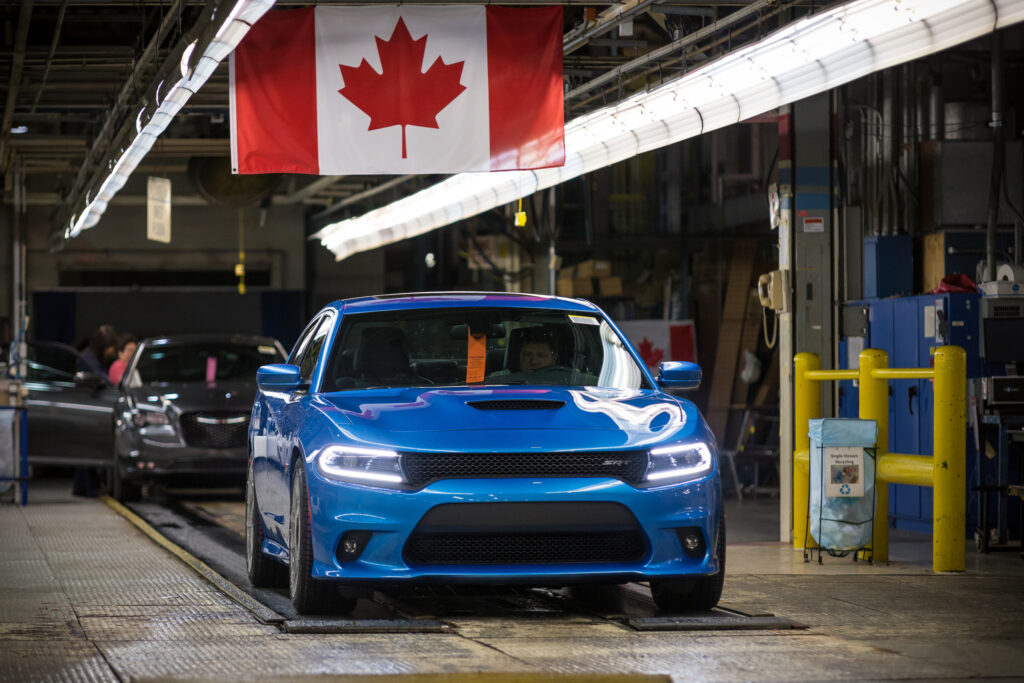
The conglomerate’s plant in Brampton, Ontario, is arguably the most obvious candidate for producing Leapmotor vehicles, according to CNBC. It has been idle since production of the old Dodge Charger and Challenger ended in December 2023, and the facility could be retrofitted to handle multiple Leapmotor models without too much difficulty.
Canada currently allows 49,000 Chinese EVs to be imported per year for retail sale at a reduced tariff rate of 6.1 percent. This quota sets an upper limit for any discussions about local production.
Made in Canada or just assembled in Canada?
Rumors about this potential move emerged in late April. At the time, it was reported that Leapmotor could manufacture its cars in China, partially disassemble them, and then export them to Canada. If this happened, the Brampton plant would be responsible for their reassembly. However, this idea found no support from either Canadian Federal Industry Minister Melanie Joly or Ontario Premier Doug Ford.
Stellantis currently owns 21% of Leapmotor, making it the single largest shareholder of the Chinese firm. Through a 51% stake in a joint venture with Leapmotor, the company also has exclusive rights to sell, distribute, and manufacture the brand’s models outside of China.
Although Leapmotor does not currently sell cars in Canada or the United States, the brand was launched in Mexico in April. Its local launch will include the C10, B10, and the smaller T03 models.
This move by Stellantis signals the company’s ambition not only to gain access to the Chinese manufacturer’s technology but also to leverage its platforms to rapidly scale its own EV production. At the same time, moving assembly to North America could help circumvent trade barriers and tariffs, which is particularly relevant amid rising protectionism in the automotive industry. However, the issue of production localization and job creation remains a sensitive one for Canadian authorities, who insist on full-fledged manufacturing rather than mere “wheel unbolting.”