 by
by Subaru Launches Hands-Free Driving System in America
Subaru has introduced its new hands-free driving system to the American market. This technology, named Highway Hands-Free Assist, debuts on the top trim levels of the 2026 model year Outback SUV. The system allows the driver to travel on highways without the need to keep their hands on the steering wheel at speeds up to 85 miles per hour.
Competition with Giants and Availability
Subaru’s new offering enters direct competition with similar developments from major automakers, such as Ford’s BlueCruise and General Motors’ Super Cruise. The system will be available on the Outback Touring and Touring XT versions, starting from the 2026 model year. Importantly, owners of existing vehicles of these models will be able to receive the update free of charge.
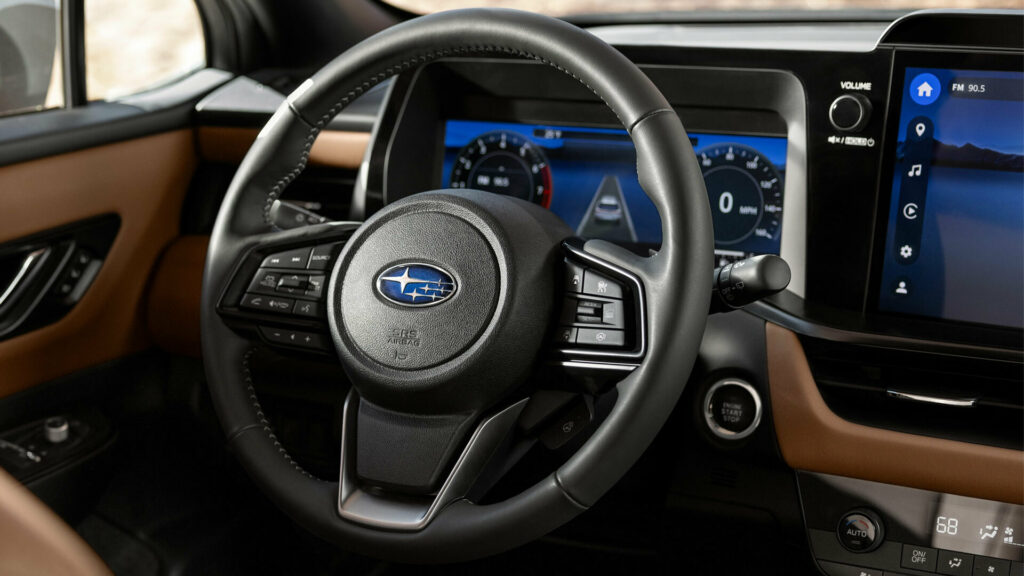
As reported by the manufacturer, the system automatically activates on compatible roads – with two or more lanes – when adaptive cruise control is enabled. An icon on the instrument panel changes color from green to blue when the hands-free driving mode is activated, informing the driver of the system’s status.
Functionality and Safety Measures
Subaru does not disclose all the details about its semi-autonomous driving technology but notes that it provides “limited hands-free assistance” and includes a range of auxiliary functions. Among them: assistance with active lane changes on the highway, speed control before a turn, automatic resumption of movement after a stop, and an emergency stop function with safe lane selection.
If the driver becomes distracted, the system will deactivate and ask them to place their hands on the steering wheel and regain control of the vehicle.
To ensure safety, a cabin camera is installed to monitor the driver’s condition and attention. This is standard practice for such systems, aimed at preventing dangerous situations where the driver relies too heavily on the autopilot.
Technological Basis and Testing
Subaru’s Highway Hands-Free Assist system combines GPS data, three-dimensional high-definition maps, as well as information from a camera and a millimeter-wave radar. The company’s engineers conducted extensive testing, covering over 100,000 miles in hands-free mode, to refine the system’s performance, driver attention monitoring, and the control handover procedure in real-world conditions.
Trims and Technical Specifications
The base Outback Touring version with the new system starts at a price of $45,395, while the more powerful Touring XT starts at $47,995. In addition to the advanced driver assistance system, these vehicles received luxurious equipment: a 12.3-inch digital instrument cluster, a 12.1-inch multimedia system, and a premium Harman Kardon audio system. Options also include heated and ventilated front seats with Nappa leather, heated rear seats, wireless smartphone charging, and an auto-dimming rearview mirror with HomeLink.
The standard Outback is equipped with a 2.5-liter four-cylinder engine producing 180 horsepower, while the XT modifications receive a turbocharged 2.4-liter engine that delivers 260 horsepower. This provides the vehicle with sufficient power for both city driving and highway travel.
The appearance of such a system from Subaru, traditionally known for its focus on safety, is a logical step in the overall evolution of the automotive industry. The introduction of hands-free driving on affordably priced models, unlike premium brands, makes these technologies more mainstream. The success of this initiative will depend not only on the technical perfection of the system but also on how quickly drivers learn to interact with it correctly, understanding that it is precisely an “assistant,” not a full-fledged autopilot that relieves them of the need to monitor the road situation.