 by
by Unique transmission selector with two personalities
Modern automakers like Porsche are trying to make electric cars more exciting with software that simulates gear shifting. This is a modern solution to an old problem: how to give the driver more engagement without sacrificing convenience. Over half a century ago, Oldsmobile and Hurst took a completely different approach. Instead of programming artificial shifts, they created a transmission selector with two personalities: one mode for everyday driving, another when the driver wanted to take control.
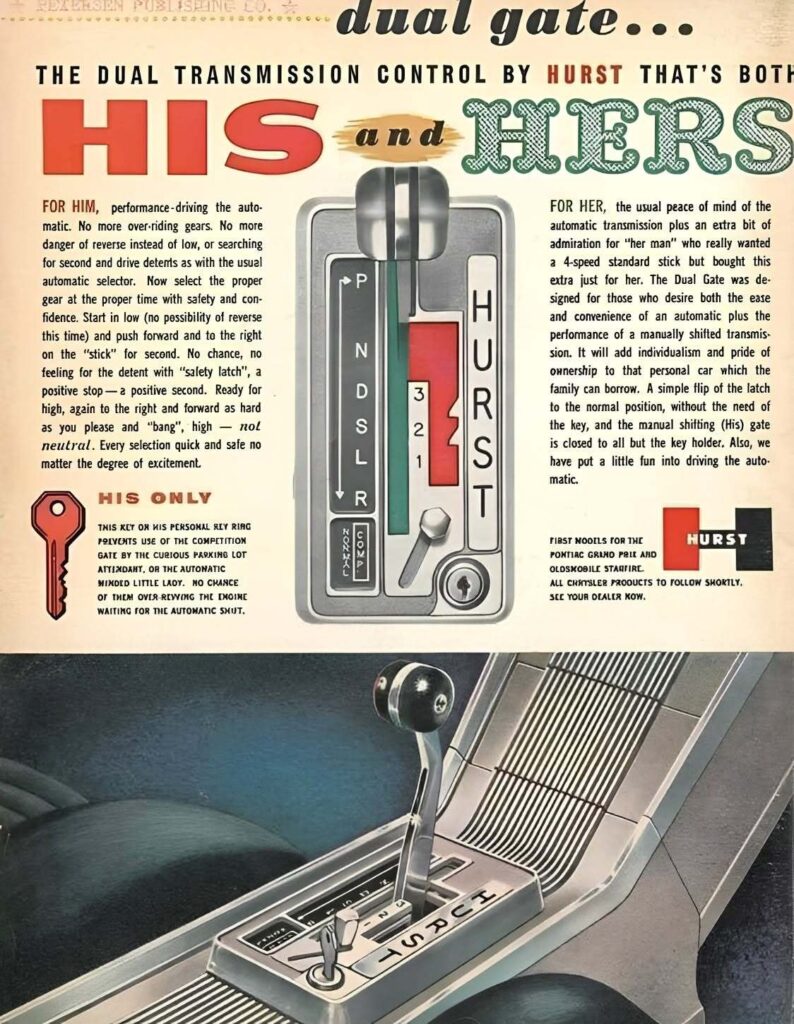
What is the “His and Hers” shifter?
The result was the Hurst Dual Gate, better known as the “His and Hers” shifter. Of course, today such branding seems outdated. The advertising campaigns of that time actively used gender stereotypes, although the real innovation of the Dual Gate was to give any driver a choice between automatic convenience and manual control. If this technology were advertised today, it would undoubtedly use more neutral terminology.
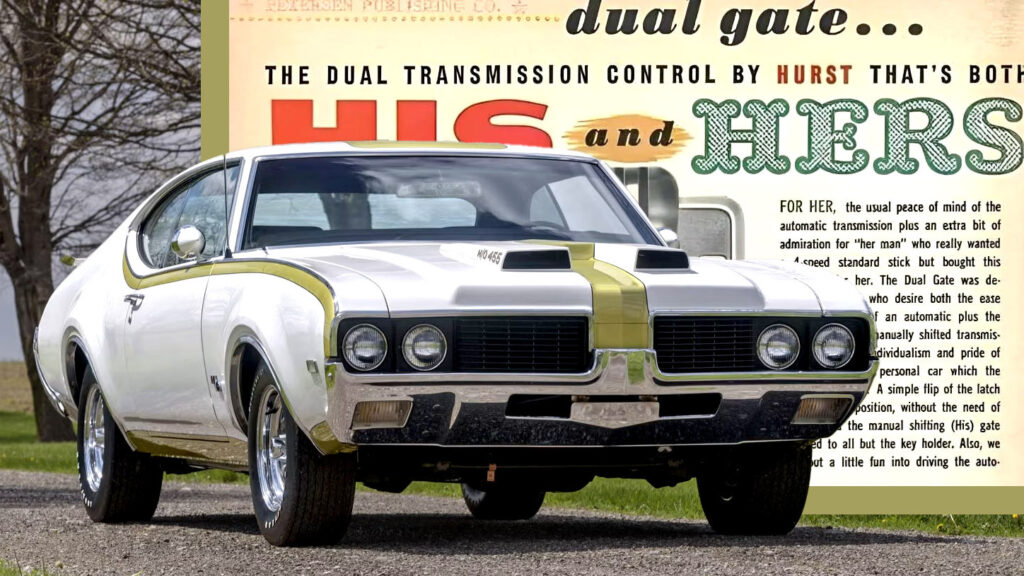
This shifter appeared in several GM sports cars from the muscle car era, but today its most sought-after application is in the 1969 Hurst/Olds. One particularly striking example recently sold at Mecum’s Indy auction for $187,000.
Elegance instead of aggression
Unlike the later Lightning Rod system, which looked like it belonged in a dragster, the Dual Gate was surprisingly elegant. The shifter had two separate channels. One side worked like a regular automatic: the driver selected Drive and went. Moving the lever to the adjacent channel allowed manual gear changes without the risk of accidentally skipping the desired speed.
Rare car with a legendary engine
The car itself is notable even without its unusual shifter. It is one of only 906 Hurst/Olds models produced in 1969. This particular example, number 176, underwent a concours-level restoration using original NOS parts. Under the hood is the legendary Oldsmobile Rocket V8 engine with a displacement of 455 cubic inches (7.5 liters), producing 380 hp (283 kW), paired with a Turbo 400 automatic transmission.
History of creative rule-bending
More importantly, the Hurst/Olds represents a fascinating moment in Detroit’s history. GM officially limited intermediate cars to engines no larger than 400 cubic inches, but this 455-cubic-inch coupe somehow slipped through those restrictions. The Dual Gate shifter reflected the same spirit of creative rule-breaking. Today, Porsche uses software to make a single-speed electric car more interactive. But in 1969, Hurst achieved nearly the same goal with just a clever mechanical device and a questionable marketing campaign.
Interestingly, this car became a symbol of an era when engineers found unconventional solutions within strict corporate constraints. Today, as electric cars face their own technological challenges, the story of the Hurst/Olds reminds us that true innovation often arises from the need to bypass rules, not just follow them. The $187,000 sale confirms that collectors value not only rarity but also a history of creative automotive engineering.