 by
by At first glance, electric powertrains seem ideal for ultra-luxury brands like Rolls-Royce. However, wealthy buyers don’t seem to be in a hurry to fully embrace these electric vehicles. A striking example is two certified Spectre cars that a dealer is offering with significant six-figure discounts.
The Theoretical Perfect Match
Electric propulsion should be the perfect partner for an ultra-luxury car. On paper, nothing suits Rolls-Royce, Bentley, or Maybach better than smooth, silent motion and torque-rich acceleration. These brands are built on silence, presence, and seamless power delivery—precisely the qualities that electric cars seem to provide better than any V12. Theoretically, this should be a golden era for the top of the market.
Wealthy owners don’t worry about range, rarely road-trip their cars across states, and often have multiple vehicles (and dedicated home charging) to rotate through.
So why is the first wave of ultra-luxury electric cars failing so loudly on the used market?
The Depreciation of the Rolls-Royce Spectre
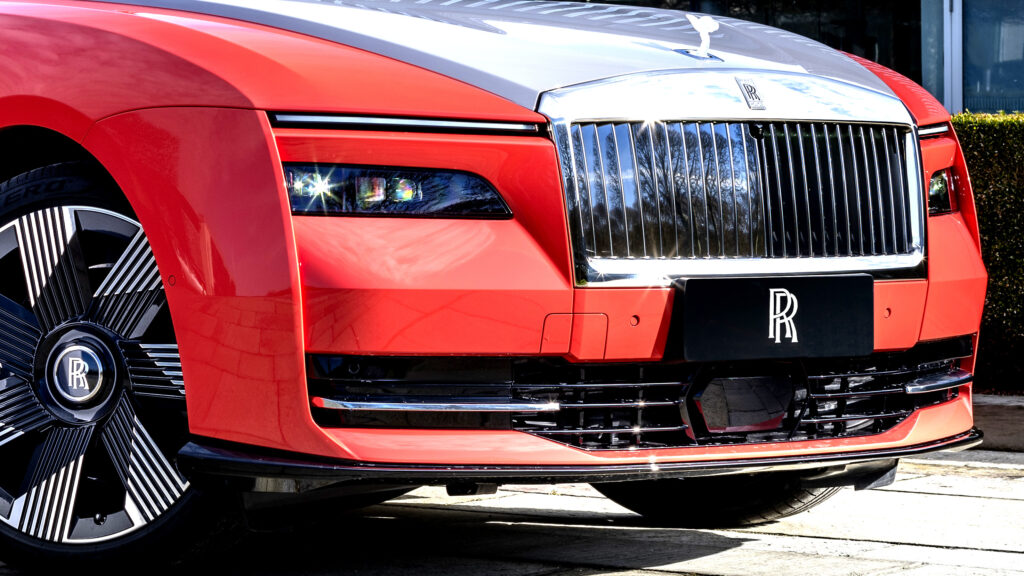
The most vivid example of this is the Rolls-Royce Spectre. It is elegant, impeccably crafted, and quieter than practically anything else in their lineup. Despite this, its resale value is falling faster than it accelerates from 0 to 60 mph.
For example, a Spectre listed on Bring a Trailer auction earlier last year. With only 99 miles on the odometer and the added appeal of being a “Launch Package” edition, it failed to meet the reserve price with a maximum bid of just $451,000. That may sound like a large sum, but its MSRP was $521,650.
Six-Figure Dealer Discounts
This week we also spotted two low-mileage, certified examples at the Rolls-Royce Boston dealership, each offered with a six-figure discount off the original MSRP! Make no mistake, no luxury car (except hypercars) retains perfect value.
Together, these two Spectres from Herb Chambers originally had a combined price of $1,064,725. The lower-mileage example, showing just over 2100 miles, is offered for $385,575, which is $136,000 below its original MSRP of $521,575.
The other Spectre, with only 3822 miles, is priced at $385,150, reflecting a colossal drop of $158,000 from its MSRP of about a year ago at $543,150. That’s enough to buy a new Porsche 911 Carrera T ($143,700) and still have money left for something else.
A Question Without a Clear Answer
Which brings us back to the broader question. Why are wealthy buyers avoiding ultra-luxury electric cars like the Spectre? Does it all come down to tradition and the desire for a classic internal combustion powertrain like a mighty V12?
Or is range anxiety still a factor even at the top of the market? Or perhaps some buyers simply haven’t driven them enough (or at all) to realize how exciting they actually are.
This Spectre situation might not just be a matter of technology, but also psychology and status. For many buyers in this segment, a car is not just transportation, but a tangible asset and a symbol. Rapid depreciation, even if not critical to the owner’s budget, can be perceived as a loss of prestige or a poor investment. Traditional engines, especially iconic ones like the V12, have decades of history, sound, and emotion that the electric setup has yet to develop. Furthermore, the market for collectible and used luxury cars hasn’t yet established clear rules for EVs, creating additional uncertainty. Perhaps the initial enthusiasm of manufacturers has met with a more conservative and wait-and-see stance from their clients, who are in no hurry to become early adopters in such a conservative category of goods.