 by
by A Lifestyle Tool Instead of an Ordinary Van
In Europe, the Renault Kangoo is known primarily as a reliable delivery van or a practical family car. However, in Japan, this model is viewed differently — as a tool for a certain lifestyle. The best proof of this is the special Kangoo Couleur version, which combines a Spartan exterior with bright colors and a spirit of adventure.
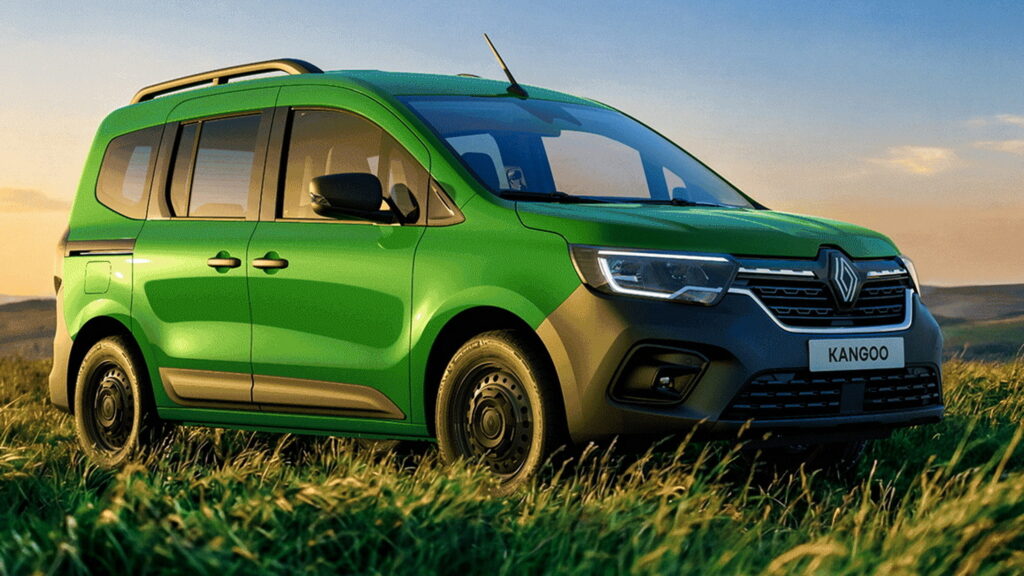
At first glance, the Couleur resembles the basic commercial version of the Kangoo. This is due to the unpainted plastic bumpers and black steel wheels, which are usually associated with the most affordable trims. However, LED headlights and optional roof rails indicate that this is not an ordinary workhorse.
Bright Colors and Features
The main highlight of the new special version is the bright Vert Foret (green) shade, inspired by the colors of French forests in early summer. In a similar vein, the extended Grand Kangoo Couleur version is offered in Vert Paris (dark green) and Jaune La Poste (yellow) colors.
Although the Renault Kangoo in Japan is only front-wheel drive, the company tried to make it a bit more capable off paved roads. The black 16-inch steel wheels are shod with Michelin CrossClimate all-season tires, and an “Extended Grip” switch on the center console helps improve traction on slippery surfaces.
Dimensions and Layout
The standard Kangoo is 4490 mm long and offers a five-seat layout. The Grand Kangoo is extended to 4910 mm, providing enough space for seven passenger seats or a massive luggage compartment of up to 3750 liters after their removal. Japanese models are equipped with rear “barn doors” instead of a conventional trunk, facilitating loading and unloading in limited urban space.
Engines and Transmissions
Under the hood, Japanese buyers have two options. The non-electrified 1.3-liter turbocharged gasoline engine develops 129 horsepower and is paired with a seven-speed dual-clutch robotic transmission. The second option is a 1.5-liter turbo-diesel with 114 horsepower, which is exclusively combined with a six-speed manual transmission.
In any case, power is sent to the front wheels, as the second and third generations of the Kangoo never received the all-wheel-drive option that was available in the original model.
Limited Availability
The Renault Kangoo Couleur will be produced in only 100 units, including 40 copies with the gasoline engine and 60 with the diesel engine and manual transmission. Both variants are priced at 4,390,000 yen, which is 200,000 yen higher than the starting price of a regular Kangoo in Japan. However, buying it is not so simple, as owners will be determined through a lottery system.
The Grand Kangoo Couleur will appear next month, also through a lottery application system. Production of the long seven-seat version will also be limited to 100 units, evenly distributed between the two available colors.
A Longstanding Tradition
The Kangoo Couleur is a longstanding tradition for Renault Japon, first introduced in 2010 as a way to add color to what the company describes as “Japan’s often bland streets.” Over the years, the series has seen dozens of limited editions with various shades inspired by French culture and nature.
Similar special editions have contributed to the minivan’s popularity in Japan. The French model has created a cult following in the Land of the Rising Sun, which peaks annually at the Kangoo Jamboree — the world’s largest gathering of Kangoo owners, held at the foot of Mount Fuji.
This approach to creating limited series for a specific market demonstrates how deeply automakers can study and consider local characteristics and cultural tastes. The success of the Kangoo in Japan, despite its European origin, is a vivid example of how a car can cease to be just a means of transportation and become part of a subculture, uniting people around shared values and lifestyle. Such initiatives often become much more significant than just a marketing move, forming long-term loyalty and an emotional connection with the brand.