 by
Not only software: what is holding back the electric A4
Software problems are not the only reason Audi is forced to delay the launch of the electric version of the A4. The German brand finds itself in a situation where competitors already have modern electric vehicles on the market, while its own model for this segment remains a thing of the future.
The new BMW i3 and the electric Mercedes-Benz C-Class have already proven that European manufacturers are capable of creating electric sedans that can compete with the best offerings from Asia. At the same time, Audi is still watching this rivalry from the sidelines: according to current estimates, it may need about three more years to present its own answer to the i3 and the electric C-Class.
The electric A4 is expected to use Volkswagen Group’s new platform called Scalable Systems Platform, or SSP. This architecture has already faced delays several times. It was announced back in 2021 as an advanced 800-volt system that was supposed to be ready for series application this year. However, some of the problems arose due to difficulties in the Volkswagen Cariad unit responsible for software. Because of this, the group was forced to involve Rivian in the development of the new electronic architecture.
The SSP platform and Volkswagen’s difficulties
Previously, the launch of the electric A4 was planned for 2028. However, according to Autocar, this timeline has now shifted to at least 2029. The reason is not limited to Volkswagen’s software problems. According to reports, Audi decided that the electric A4 should have separate footwells for front- and rear-seat passengers instead of a completely flat floor. This forced engineers to return to design solutions and revise the placement of the battery and other key components.
In addition, Audi reportedly switched from a 12-volt system to a more advanced 48-volt system. This change also affected the work of Volkswagen and Rivian, as they had to rework parts of the electronic architecture they are developing jointly. As a result, the electric A4 became a more complex project than envisaged at the initial stage.
Design and electrical architecture
All these factors mean that the delay of the Audi A4 e-tron is complex in nature. It combines software challenges, changes in interior packaging, and the transition to a new electrical architecture. For a model that is supposed to become an important part of Audi’s electric lineup, this creates additional pressure: the brand needs not only to catch up with competitors but also to offer solutions that will be relevant at the time of launch.
How will Audi compete?
By the time the electric A4 finally reaches the market, the BMW i3 and the electric Mercedes-Benz C-Class will already be approaching mid-cycle updates. Such updates may include design changes and, most importantly, improvements to batteries and electric motors. This means that Audi will have to compete not with the initial versions of its rivals but with their improved variants.
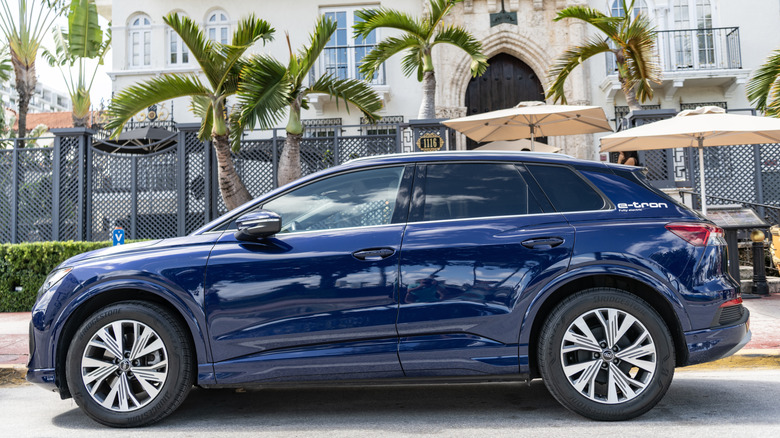
Some of Audi’s current electric vehicles, in particular the Q4 E-Tron and Q6 E-Tron, are already perceived as somewhat outdated against the backdrop of rapid market development. Therefore, the German brand will have to work hard if it wants to compete worthily with its German competitors. Moreover, it is unknown what solutions Chinese manufacturers will offer by the end of the decade. Based on current schedules, some of them may begin mass production of electric vehicles with solid-state batteries even before the Audi A4 e-tron launches.
Design and technological pressure
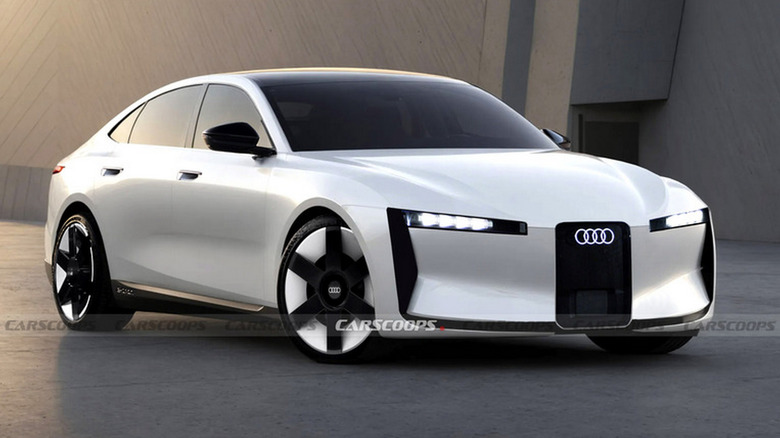
Audi will be under pressure not only in terms of powertrain and technology. Carscoops’ render of the A4 E-Tron demonstrates how radically the model may differ from all current Audi sedans. The car is expected to use the brand’s new design philosophy, which was previewed last year on the Concept C and later revealed more fully on the Nuvolari supercar.
Among the most noticeable changes may be a redesigned front end with a small vertical darkened grille and thin LED headlights. Similar solutions may continue at the rear, with narrow taillights. All of this should help Audi make the A4 e-tron visually fresher and more modern than the brand’s current models.
The SSP platform for the entire group
The SSP platform will be used not only by Audi. This scalable architecture is due to debut in the fully electric Volkswagen T-Roc, as well as in the new electric Golf. Skoda will also use this platform for its next-generation electric SUV, which is intended to replace the current Enyaq.
Thus, the electric A4 is part of a much broader Volkswagen Group strategy. Not only the fate of the Audi A4 e-tron but also the launch schedule of several important electric vehicles of the group will depend on how quickly SSP can be brought to series readiness.
What this means for the market
For Audi, the delay of the electric A4 creates a risk of losing ground in the premium electric vehicle segment. While BMW and Mercedes-Benz are developing their electric sedans, and Chinese brands are increasingly entering the European market, Audi must not only catch up with competitors but also offer a convincing answer in terms of range, charging speed, software, and design.
At the same time, postponing the launch may be justified if the company truly wants to avoid repeating problems with software and electronic architecture. But in a rapidly developing market, every year of delay means that competitors manage to update their models, increase battery efficiency, and offer new technologies. Therefore, it is important for Audi that the A4 e-tron arrive not simply later, but as a truly modern model capable of competing with the strongest players in the segment.