 by
by Radical Changes for the Velar
Spy photos recently captured the updated Range Rover, and now they have managed to see the second-generation Velar as well. The model will undergo radical changes, becoming even more streamlined and fully transitioning to electric propulsion.
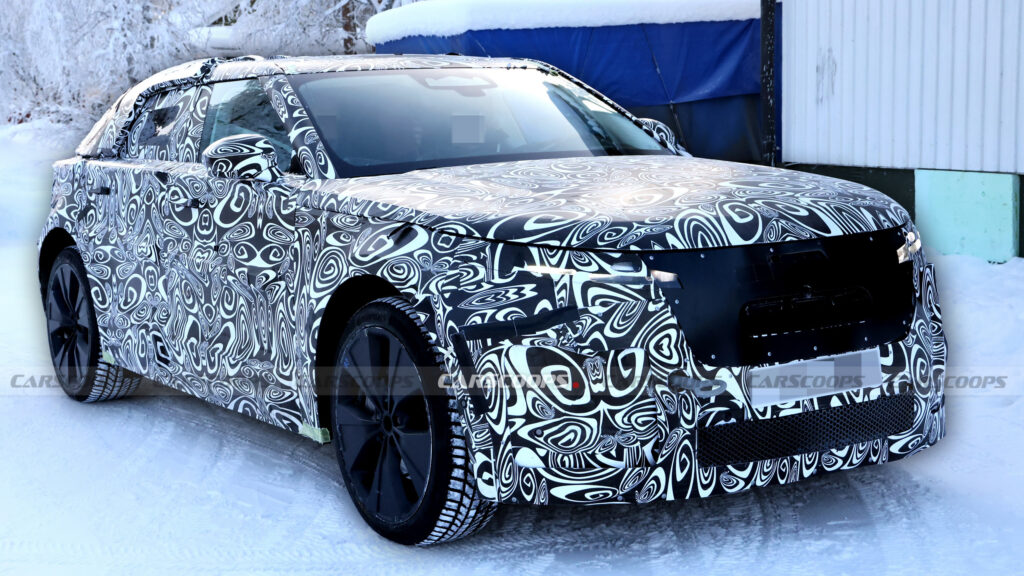
The updated crossover is expected to debut later this year, but it is still heavily camouflaged. This hides many key details, but one can expect a rounded front end with a fully enclosed radiator grille, flanked by narrow headlights. These will be complemented by a clamshell-style hood and a wide lower air intake.
Read more: The new Velar from Land Rover swaps a V8 roar for electric muscle
Dynamic Profile and Possible Compromises
The car’s profile immediately catches the eye: the Velar has a steeply raked windshield that flows smoothly into a sharply sloping roofline. This creates a much more dynamic design, however, it seems this may come at the expense of trunk volume and rear passenger headroom.
A closer look reveals a charging port located at the rear, as well as pop-out door handles. These are complemented by streamlined body panels, whose camouflage gives away barely noticeable protrusions.
Interesting Rear View and Technologies
The rear is the most interesting angle: one can see a characteristic tailgate with a vertical cut-off. A roof-mounted camera is also visible, which may indicate the Velar’s abandonment of a rear window. This remains to be seen, but such a path has already been paved by Polestar, followed by Jaguar.
Despite hopes that a rear window will still be present, the model will get a spoiler and wraparound rear lights. They are accompanied by a minimalist bumper with horizontal reflectors.
What will power the new Velar?
Common Features with the Range Rover Electric
Land Rover is primarily focused on promoting the Range Rover Electric, so not much is known about the Velar yet. However, these two models may have much in common.
If so, the Velar could receive a 117 kWh battery pack, as well as an all-wheel-drive system with two electric motors producing around 542 hp (404 kW) and 627 lb-ft (849 Nm) of torque. However, we wouldn’t be surprised if several configurations are offered for the Velar.
New Platform and the Brand’s Future
While there may be similarities between the models, it’s important to note that the Velar will be built on the brand’s new modular architecture adapted for electric vehicles (EMA). It will be produced at the company’s Halewood plant, and this model will be an important test to understand if Land Rover’s loyal followers are ready for the transition to electric.
The arrival of a fully electric Velar marks an important strategic step for Land Rover in light of the overall trend towards electrification. The success of this model among the brand’s traditional audience, which values off-road capability and status, could be indicative for the entire segment of premium SUVs. To a large extent, the pace of further transition of major luxury automakers to battery technologies, especially in segments where off-road capability and range are critical factors, will depend on the market’s reaction to models like the Velar EV.