 by
by Impressive Results on the Drag Strip
Not long ago, running a quarter-mile in eight seconds required a seriously prepared car. This often meant a tube-frame chassis, slicks, and an experienced driver with years of practice. Today, all it takes is some experience behind the wheel of a production Corvette costing around $250,000.
Capability Demonstration by DragTimes
A new video from Brooks Weisblat of the DragTimes channel clearly demonstrates how simple it can be. Weisblat and the ZR1X’s owner are not professional drag racers. Of course, they have extensive experience with powerful cars, but compared to professionals who have been doing this for decades, they are more like spectators.
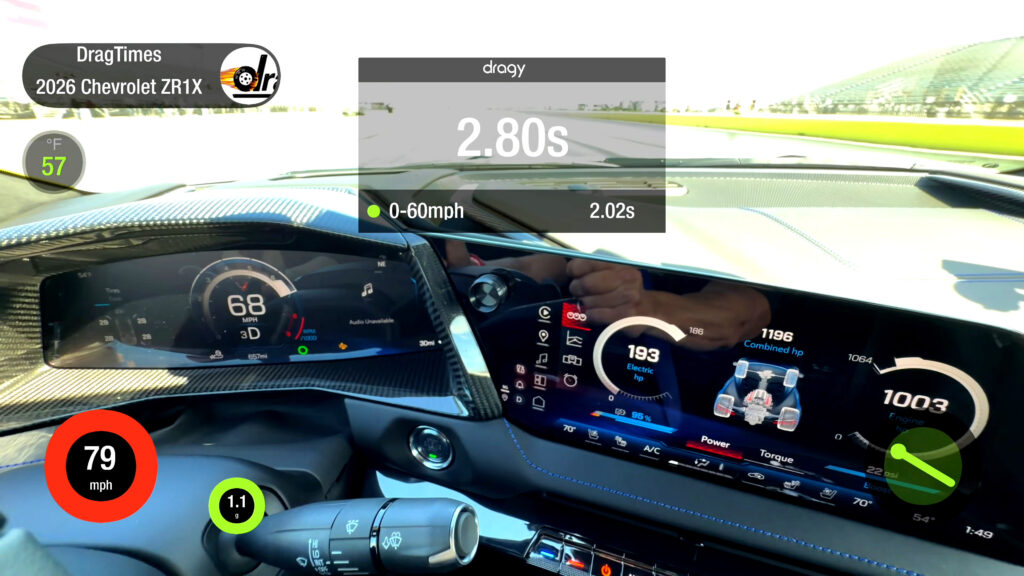
Despite this, the Corvette ZR1X in this video makes them look like superheroes. The car is equipped with carbon-ceramic brakes, the ZTK package, and a full carbon fiber aerodynamic body kit. The rear wing was removed for the runs, although Chevrolet does not recommend this, while the front dive planes were left in place.
On the very first run of the day, the car posted an 8.742-second quarter-mile time, reaching a speed of 159 miles per hour. This run also recorded a 0-60 mph time of 1.96 seconds.
Sequence of Runs
The second run took place without additional engine cooling, yet the car still accelerated from 0 to 60 mph in 1.95 seconds, covered the eighth-mile in 5.663 seconds, and completed the quarter-mile in 8.784 seconds with a top speed of 157 mph.
On the third run, performance only slightly dropped: 0-60 mph in 2.02 seconds, 0-130 mph in 5.91 seconds, and a quarter-mile in 8.83 seconds with the same top speed of 157 mph.
Technical Behavioral Features
One interesting detail noticed during the runs is that the car seems to lose approximately 100 horsepower from the front electric motor after reaching a speed of around 130 mph. This indicates that the hybrid system reduces assistance at high speeds. Despite this, a terminal speed in the high 150 mph range firmly places the ZR1X among modern hypercars.
Historical Context of the Achievement
It’s important to understand the context. No one at the track was chasing a single unique “hero” run. There was no professional driver, no factory test team, or endless tuning between attempts. Just experienced enthusiasts making run after run in a production Corvette that consistently posted eight-second quarter-mile times.
Ten years ago, this would have sounded ridiculous. Twenty years ago, it would have seemed impossible. Today, it is a reality that demonstrates an incredible technological leap in automotive engineering. Such performance from a production car, achieved without extreme preparation, changes the perception of accessible performance. It also raises new questions about the future of drag racing and how manufacturers will compete in this new reality, where electronically managed power becomes available to a wide range of drivers.