 by
by A Legend Without Modern Technological Embellishments
While modern sports cars love to boast about software, huge screens, and electrified power, this specimen manages without such theatrical effects. The Mercedes-Benz Museum houses something much more classic—the last assembled Mercedes W124 E 500, which needs no special embellishments to make a statement.
Created as a competitor to the BMW M5 E34 series, the most powerful version of the W124 appeared in 1990 as the 500 E, and after the 1993 facelift, it was renamed the E 500. The development was a joint effort with Porsche, which was responsible for tuning the chassis and suspension, as well as final assembly.
Porsche’s role went beyond engineering consultancy, as Mercedes could not justify retooling its line in Sindelfingen to install a body that was 56 mm wider and 23 mm lower. The project was handed over to Zuffenhausen, where the bodies were built and then shuttled back and forth between Mercedes and Porsche plants during production.
Limited Run and Museum Exhibit
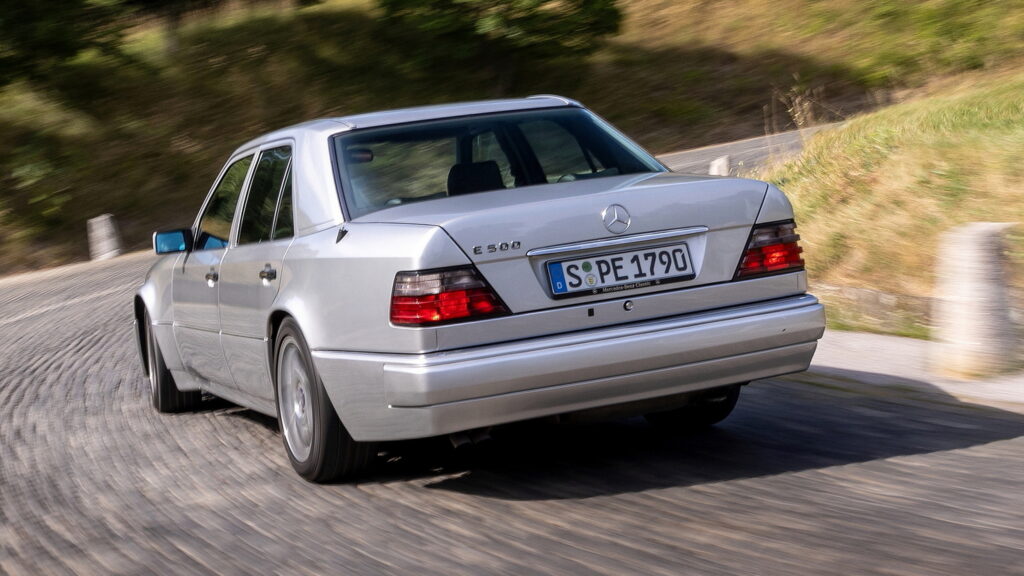
By April 1995, production had ended, with 10,479 cars built. Each was a four-seater not by choice but by necessity, as the massive differential left no room for a full-fledged middle seat in the rear.
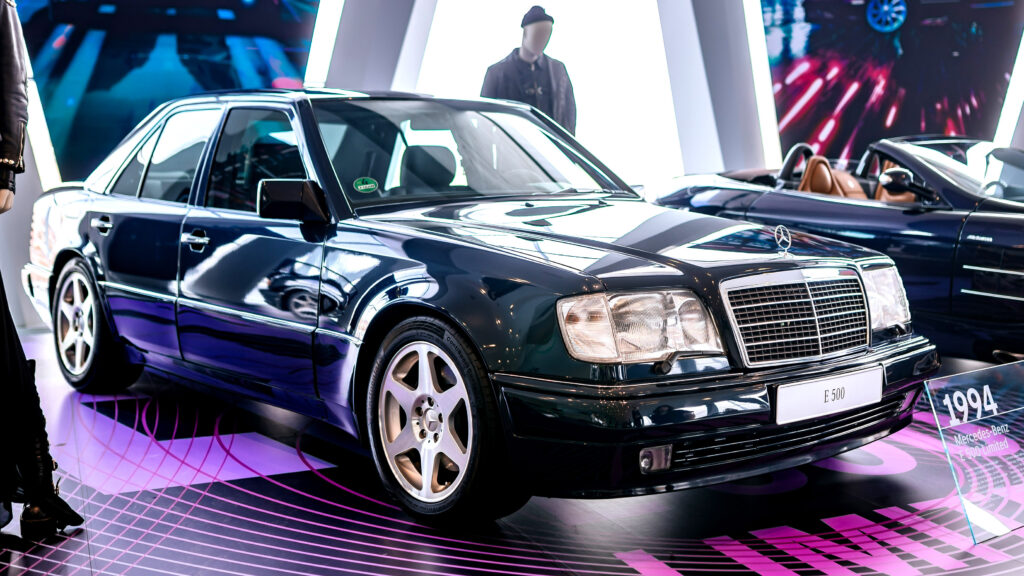
This particular specimen, the last to leave the Zuffenhausen plant, is one of only 500 cars built in the exclusive Limited edition. It effectively marks the end of an era before the appearance of the W210 and remains in exceptional condition, having covered only 422 km (262 miles) after a life carefully preserved as a museum exhibit.
Restrained Design
Visually, the E 500 retains the restrained look that continues to appeal to purists, sitting just below the ultra-rare E 60 AMG in the W124 hierarchy. The exterior is defined by a wider track and flared front fenders that distinguish it from less powerful variants, along with a lowered suspension and model-specific alloy wheels. Post-facelift cars received a more modern radiator grille, body-colored bumpers, and clear turn signal indicators.
The last specimen is finished in Sapphire Black, one of the two colors available for the Limited trim alongside Brilliant Silver. A distinctive detail is the set of 17-inch alloy wheels with a six-spoke design, borrowed from the homologation special race car, the 190 E 2.5-16 Evolution II W201.
The interior features Recaro sports seats upholstered in soft leather with a techno-pattern, combined with black-stained “peacock eye” maple on the dashboard and door panels. Buyers could choose between grey, red, or green interiors, although this example adheres to the more restrained black-grey combination.
V8 Power and Porsche-Tuned Chassis
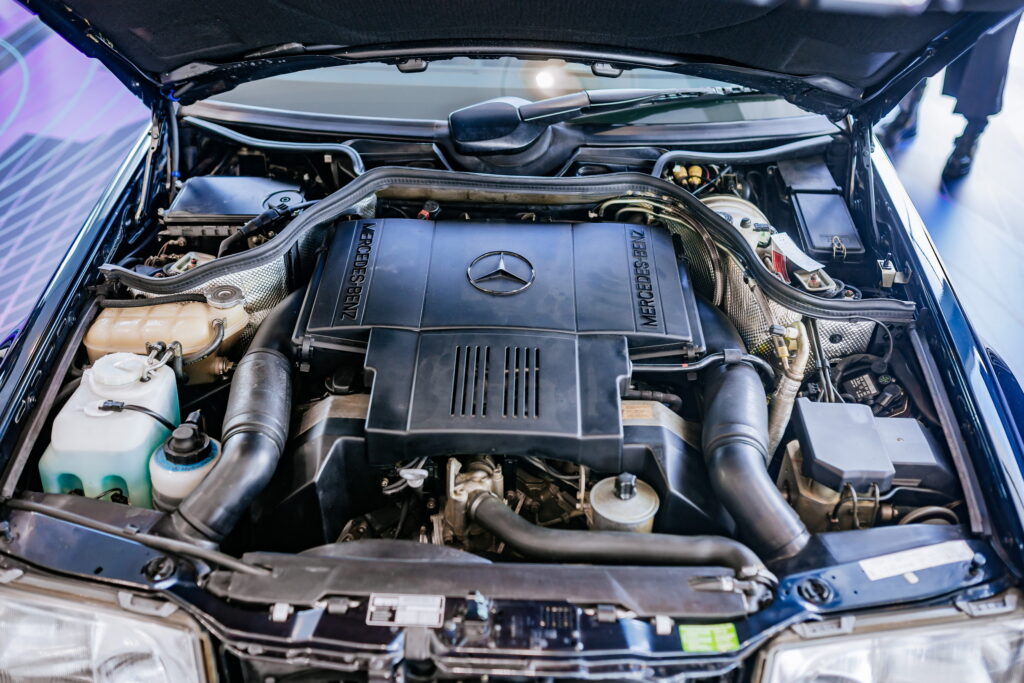
Under the hood lies a naturally aspirated 5.0-liter V8, borrowed from the 500 SL, which in these later versions produces 315 hp (235 kW / 320 PS) and 470 Nm of torque. Power is sent to the rear wheels via a four-speed automatic transmission, allowing acceleration from 0 to 100 km/h in 6.1 seconds and featuring a top speed electronically limited to 250 km/h.
The Porsche-tuned suspension and chassis are combined with larger 320 mm brake discs at the front.
Where to See It
The E 500 Limited is currently on display alongside its “brother,” the EVO II, at the Mercedes-Benz Museum. Both are part of a selection of ten special cars from the 90s and 2000s presented at the “Youngtimers” exhibition, which will run until May 31st.
This car is a vivid example of an era when engineering mastery and collaboration between legendary brands created products that became iconic. Its museum status and minimal mileage only emphasize its significance as a heritage object, not merely a vehicle. Such specimens remind us that true value often lies not in the quantity of technology but in the purity of the concept and the quality of execution, which stand the test of time. The “Youngtimers” exhibition offers a unique opportunity to appreciate these cars in the context of their time and see how they influenced the further development of the automotive industry.