 by
by Returning to the Roots
In a world where modern sports cars are becoming heavier and more complex, the desire to drive something simple and light remains strong. The British company Dutton, still led by its founder Tim Dutton, is returning to its roots—manufacturing kit cars—after a 37-year hiatus and decades of building amphibious vehicles. Their new model, the Dutton Phaeton 5, is a lightweight roadster designed to satisfy this appetite for uncomplicated driving pleasure.
Technical Basis and Purchase Options
The new model continues the lineage where the Phaeton 4 left off in 1989, but with a significantly more modern technical base. Instead of parts from an old Ford Escort, the car is built on the basis of the third-generation (NC) Mazda MX-5. This means using a familiar chassis and a naturally aspirated 2.0-liter four-cylinder engine, promising honest and predictable dynamics.
Various purchase options are offered to customers. Someone who already owns a Mazda MX-5 can purchase a conversion kit starting from £9,990. For those who want to avoid the assembly process, a factory-built version is available, with its price starting from approximately £14,300, including VAT.
Original Design
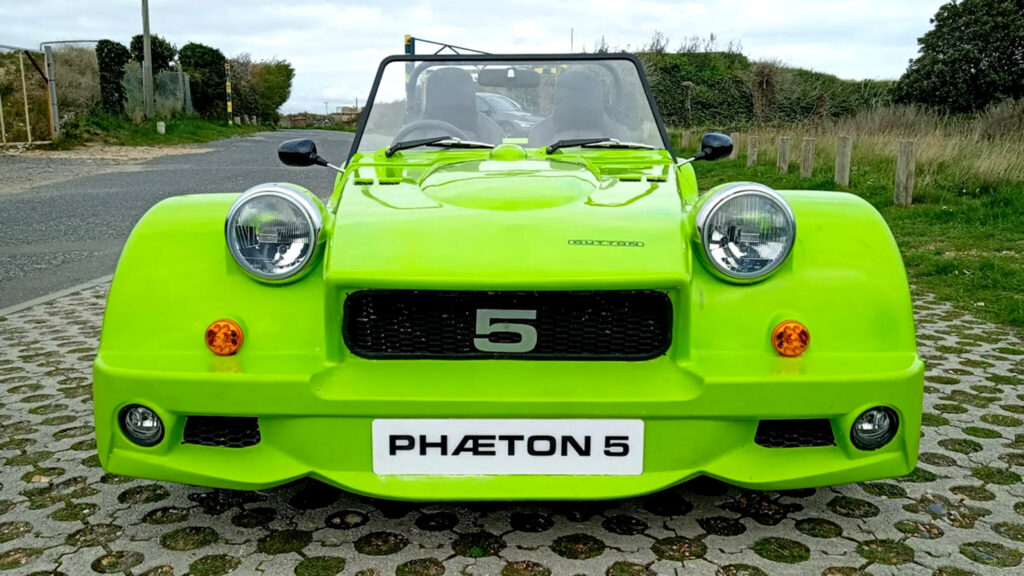
Unlike other Mazda MX-5-based projects, which often retain visual cues from the donor car, the Phaeton 5 has a completely independent look. The car does not share any external panels with the Mazda, instead following its predecessor with slightly larger dimensions and a retro vibe. It features round headlights integrated into wide fenders, open door apertures, side-mounted exhaust pipes, and a massive radiator grille on a “shark-like” nose.
Overall, this kit car looks like a heavily modified Caterham 7—something you might build in Minecraft and then decide to drive in real life. The example shown is finished in a bright lime green color paired with black alloy wheels and bright red brake calipers.
Dutton’s return to the kit car market comes at an interesting time when part of the automotive enthusiast community increasingly values simplicity and straightforwardness over technological overload. Using the proven and accessible Mazda MX-5 platform makes the project not only reliable but also relatively easy to maintain. It could become a real find for enthusiasts seeking a way to get a feeling close to that of a classic sports car without astronomical costs. The success of the Phaeton 5 may depend not only on nostalgia but also on how well the company manages to convey the same joy of driving that their models offered decades ago, adapting it to modern standards and expectations.