 by
by Nissan plans to sell cheap Chinese electric cars in Canada
Nissan is in a difficult position and is looking for ways to recover its business. One option may be to sell affordable Chinese-made electric vehicles in the Canadian market. This decision, although small, is important for the company’s overall rescue strategy. However, this initiative will not help American drivers.
According to Bloomberg, Nissan Americas chairman Christian Meunier said the company is exploring the possibility of supplying vehicles produced through a joint venture with Dongfeng in China to Canadian dealerships. Meunier did not name specific models but confirmed that Nissan is actively evaluating this idea after Canada eased restrictions on the import of Chinese cars.
New trade conditions and their consequences
Earlier this year, Canada allowed the annual import of up to 49,000 Chinese-made vehicles. This decision has already begun to change the market. For example, Tesla recently began advertising the Canadian version of the Model 3, produced in Shanghai, at a price significantly lower than previous versions. However, due to US tariff policy on Chinese cars, none of these models will enter the American market, even via Canada.
For Nissan, the advantages are obvious. Chinese factories can produce electric cars faster and cheaper than many other plants. The company urgently needs competitive products. New CEO Ivan Espinosa inherited a company burdened with outdated models, falling sales, and financial instability. More efficient use of assets in China could give Nissan much-needed room to maneuver.
Nissan’s global plan for China
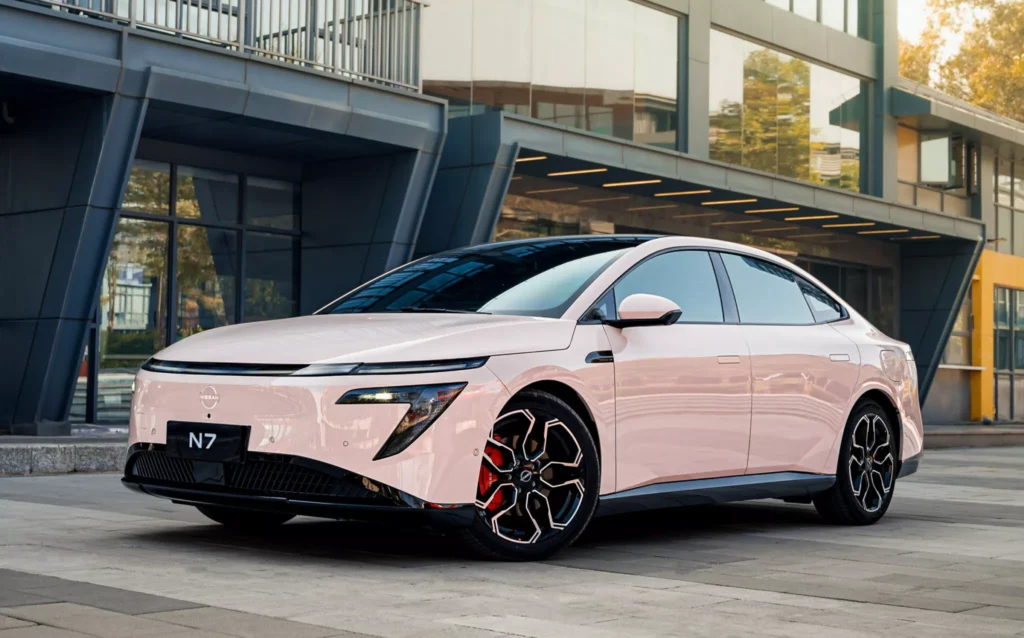
Exports have already become a key part of the company’s recovery plans. According to Bloomberg, Espinosa plans to initially export 100,000 Chinese-made vehicles annually around the world, and later triple that figure to 300,000 units. The first markets will be Latin American countries. The electric sedan N7 and the Frontier Pro pickup with a hybrid powertrain will be supplied there. In China, these models cost from $17,000 and $26,000 respectively, although these prices are likely to change upon export.
The N7 electric vehicle could appear in Canada alongside the Frontier and the NX8 SUV (price in China from $22,000). Importantly, Canada’s new trade rules allow the import of not only fully electric vehicles but also hybrids and plug-in hybrids. This aspect is often overlooked.
Chinese brands are interested in Nissan’s Western plants

At the same time, Nissan is aggressively cutting costs in Europe, notably reducing production capacity at its plant in Sunderland, UK. This story also has a Chinese dimension. According to reports, Nissan has held talks with several Chinese automakers, including Chery, regarding the possibility of producing cars at the idling facilities of the Sunderland plant.
There is no information yet about Dongfeng’s plans to build factories in Canada, but the country’s liberal rules make this possible. Nissan’s competitor, Stellantis, is already considering the possibility of producing Chinese Leapmotor electric vehicles at the idled Jeep plant in Brampton, Ontario.
Thus, Nissan’s strategy of using Chinese production capacity for export to Canada and other regions appears to be a logical step in a difficult financial situation. At the same time, it reflects a global trend where Western automakers are increasingly integrating Chinese technology and production into their supply chains, trying to reduce costs and offer competitive prices. Canada, for its part, is becoming a kind of “testing ground” for such cooperation, opening its market to more affordable electric vehicles, which could significantly impact the local automotive market in the coming years.