 by
by Xiaomi YU7 Conquers the Nürburgring Without a Driver
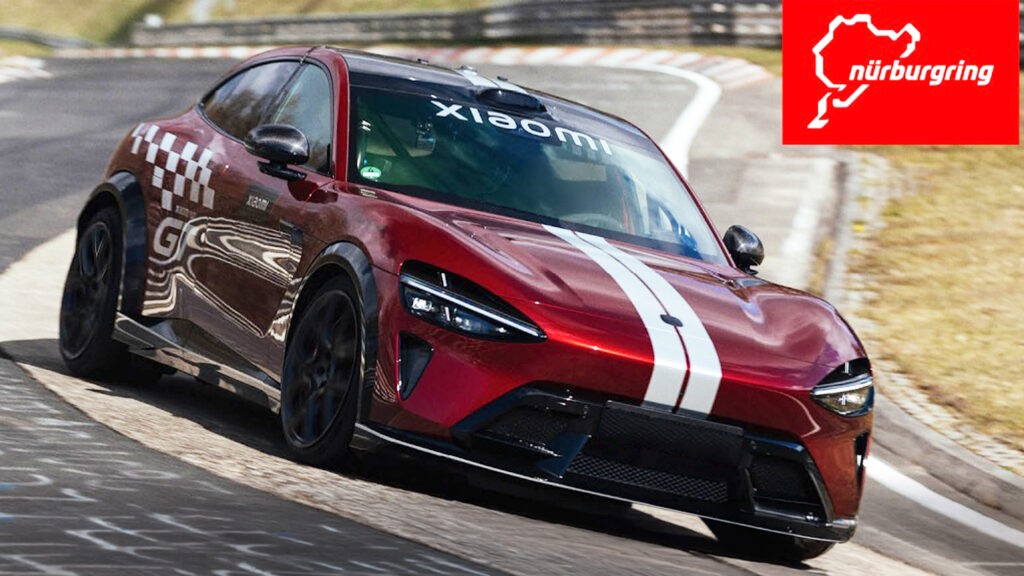
Xiaomi has added another Nürburgring achievement to its growing collection, but this lap time would elicit a routine sigh rather than a cheer. Instead of chasing absolute records with a pro driver behind the wheel, the company sent the YU7 GT to the Nordschleife with an empty driver’s seat.
The result was a lap of 10 minutes and 29.483 seconds, making it the first driverless car to complete a full measured lap of the old North Loop. This is, without a doubt, an impressive technical achievement, even if it is more than 3 minutes slower than the 7:22.76 posted by the YU7 GT with a racer at the wheel last month, which set a new record for SUVs.
A 10-Minute Lap Worth Talking About

It has been quite a while since anyone got excited about a 10-minute lap time at the Nürburgring. Jeremy Clarkson drove a 9:59 in a diesel Jaguar S-type back in 2004, and the late, great Sabine Schmitz almost matched that time in a Ford Transit van nine months later, again on the Top Gear show.
Review: We Are Passengers in the Stellantis Hands-Free Active Driving Assist System
Watching the onboard video of the driverless Xiaomi, it becomes immediately obvious that the YU7 GT is not attacking the track. It enters corners cautiously, leaves comfortable margins, and generally behaves like a driver who is well aware that crashing a prototype into the barrier would make for the wrong headline in the news.
Where it makes up time is on the exits. The instant torque of the 990-hp (1,003 hp / 738 kW) electric powertrain allows the crossover to slingshot itself onto the straights, helping to compensate for the cautious approach on many of the faster and more daunting sections of the Nordschleife.
Man vs. Machine
This cautious behavior raises an interesting question. If you’ve never driven the Nürburgring before, could you lap faster? Many Carscoops readers might rate their chances. 10 minutes 29 seconds is not slow, especially on a track full of blind crests, complex cambers, and over 70 corners. But it is also not a time that suggests the autonomous system is operating anywhere near the car’s limits.
In fact, the YU7 GT appears to leave some time ‘on the table’ for another reason. On the 1.3-mile (2.1 km) long Döttinger Höhe straight, the crossover quickly hits its 131 mph (210 km/h) limiter and just stays there. You can almost see the seconds ticking away as the car continues at full throttle but not going any faster. If the limiter were removed, the final lap time would likely drop by several seconds at least.
Impressive, But It’s Not the Whole Story
Of course, a fast autonomous lap isn’t necessarily proof of anything in everyday traffic, and we have no idea what data the YU7 relied on to know when to accelerate and brake. It clearly wasn’t just using its standard lidar sensor to cruise around like it would on the streets of Shanghai.
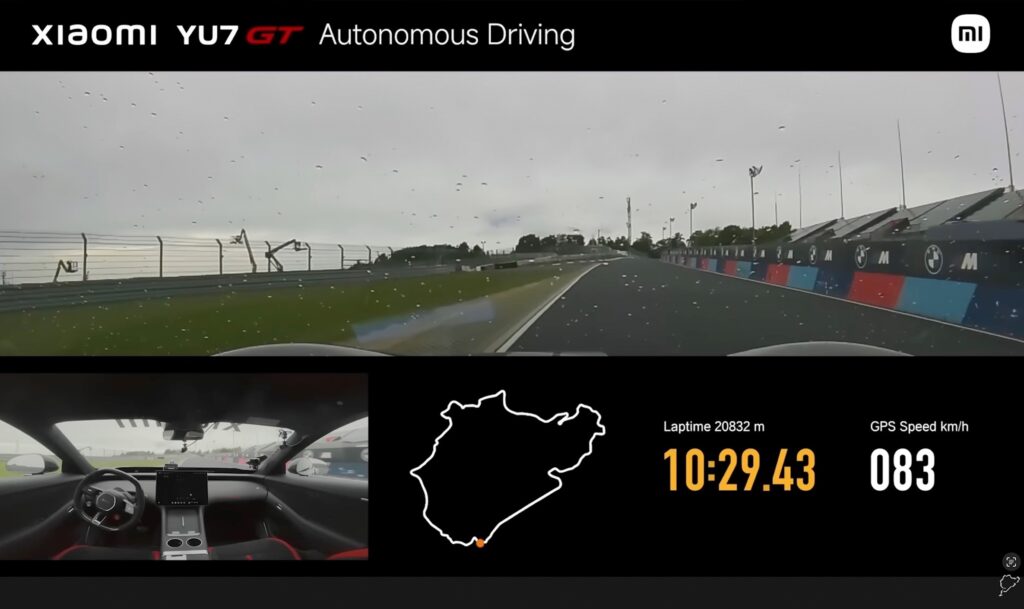
Nevertheless, it is an intriguing demonstration of how far the technology has come. Robots may not yet be ready to challenge the human lap record holders at the Nürburgring, but you know for sure they are coming for it, and possibly sooner rather than later.
This Xiaomi experiment shows that autonomous technology is already capable of complex tasks, like lapping a legendary track. However, the cautious driving style and the presence of a speed limiter suggest the system is tuned for safety, not maximum performance. It serves as a reminder that the path to fully autonomous race cars capable of outperforming humans in extreme conditions still requires refinement, especially in terms of making risky decisions at high speeds.