 by
by The fastest hydrogen car in history
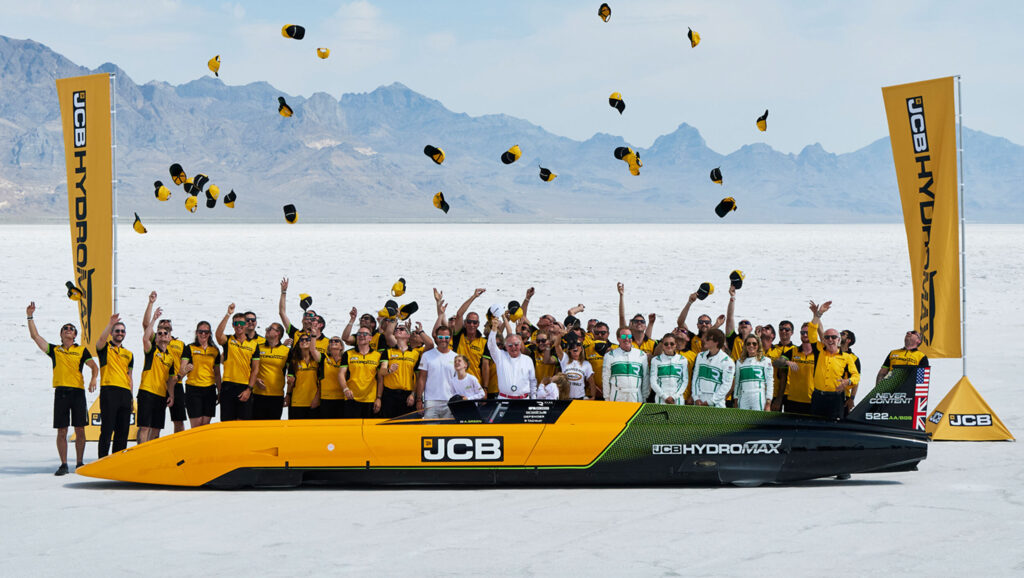
Just a few days after posting 368.347 mph (592.797 km/h), JCB Hydromax set a new FIA world speed record on the Bonneville Salt Flats.
Early in the morning, the hydrogen model recorded an average speed of 400.623 mph (644.740 km/h) on the first run. The car then turned around and headed in the opposite direction, where it reached an average speed of 412.135 mph (663.267 km/h).
Thus, JCB Hydromax’s average figure was 406.320 mph (653.909 km/h). This significantly surpassed the previous record for hydrogen cars — 185.5 mph (298.5 km/h) — as well as the world speed record for diesel vehicles: 350.092 mph (563.418 km/h), set in August 2006 by JCB Dieselmax.
More: a jet car with an engine from a nuclear bomber developed 5,200 pounds of thrust.
The man who etched himself into history twice
Twenty years passed between these events, but behind the wheel of both machines — Hydromax and Dieselmax — was the same pilot, Wing Commander Andy Green.
“The car was fantastic — stable, robust and fast. To set a world land speed record on hydrogen power twenty years after Dieselmax is a huge honor,” said Green. He added: “This record is a tremendous achievement by a world-class team and excellent engineering.”
Green is no stranger to records. The former Royal Air Force pilot is the fastest person on Earth: he reached 763.035 mph (1,227.986 km/h) in ThrustSSC and became the only person in history to break the sound barrier on land.
Hydrogen engines from regular production
The JCB Hydromax is 32 feet (9.75 meters) long. It is powered by two “production” JCB hydrogen engines used in excavators. Total output is 1,600 hp (1,193 kW / 1,622 PS). According to the company, these are the same engines that currently power JCB machines coming off production lines in Great Britain.
That is precisely the point, as JCB chairman Anthony Bamford explained:
“Twenty years ago we came to Bonneville with JCB Dieselmax and showed what British engineering could do with diesel. Today we have done it again — this time with hydrogen engines.” He added that Hydromax “proves hydrogen works, and works today at the highest level with zero emissions.”
Why this matters
This record shows that hydrogen engines can deliver extreme performance without harming the environment. The use of production units, rather than unique prototypes, makes the achievement practically significant: the technology is already available not only for racing cars but also for ordinary construction equipment. This could accelerate the adoption of hydrogen powertrains in commercial transport and make them a real alternative to traditional fuel.