 by
by CONS ›› Very heavy, drives large, drinks fuel
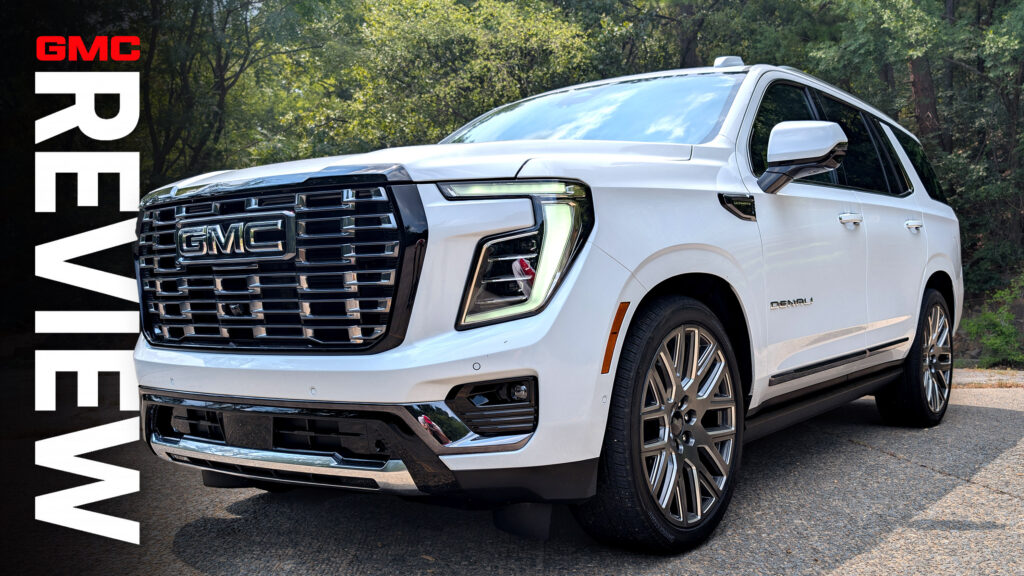
At $111,795, the Denali Ultimate isn’t merely expensive. It’s difficult to imagine how an average American family could comfortably buy one new. Put $20,000 down and finance the rest at 6.5 percent, and you’re still staring at roughly $1,550 a month for six years. That’s before insurance, maintenance, or feeding a 6.2-liter V8 that returned 13.4 mpg in our hands.
And here’s the reality. The 2026 GMC Yukon Denali Ultimate is comfortable, handsome, quiet, powerful, beautifully equipped, and remarkably easy to live with. There’s just one problem: so are plenty of three-row SUVs that don’t cost $111,795.
Quick Facts
| Model | 2026 GMC Yukon Denali Ultimate |
| Engine | 6.2-liter V8 |
| Transmission | 10-Speed Automatic |
| Output | 420 hp (313 kW) and 460 lb-ft (624 Nm) |
| Fuel Economy | 14/18/16 mpg city/highway/combined |
| Dimensions | 210.1 L x 81.0 W x 76.5 H in (5,337 x 2,057 x 1,943 mm) |
| Cargo | 25.5 cu-ft (722 liters); maximum 122.8 cu-ft (3,477 liters) |
| MSRP | $103,900 (base); $111,795 as tested, excluding $2,795 delivery fee |
SWIPE
That’s what makes reviewing the Ultimate a little strange. Asking whether it’s good is almost pointless. Of course it’s good. GMC has spent decades refining the Yukon, and this is supposed to be the fanciest expression of it. The harder question is whether there’s enough here to justify spending nearly $112,000 on one. After living with it, I’m not convinced there is.
Photos: Stephen Rivers for Carscoops
Let’s start with that price, because this isn’t a case of GMC building an $80,000 SUV and then loading our tester with $30,000 of questionable accessories. The Denali Ultimate itself starts at $103,900 for 2026. GMC includes Super Cruise, Air Ride Adaptive Suspension, 24-inch wheels, 16-way adjustable massaging front seats, and an 18-speaker Bose system as part of the Ultimate package.
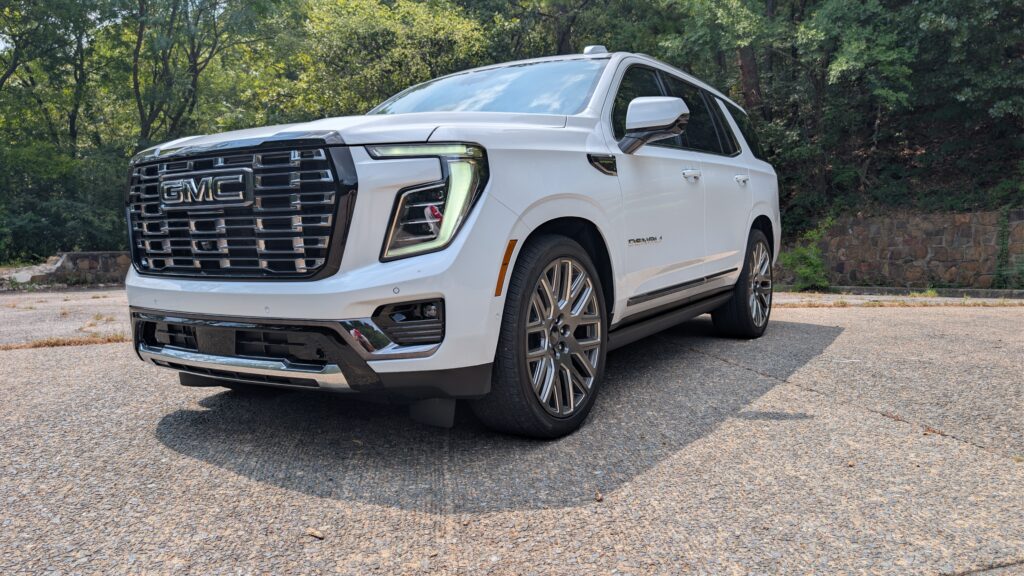
Our Glacier White Tricoat tester added the $3,995 Executive Second Row Seating package, among a few smaller extras, bringing the bottom line to $111,795 including destination. That’s real luxury-car money. Fortunately, the Yukon makes a strong first impression. It’s imposing without becoming cartoonish, and the cabin immediately feels substantially more special than what you’ll find in a basic Yukon.
A Cabin That Earns Its Badge
Photos: Stephen Rivers for Carscoops
Full-grain leather, real wood, comfortable seats, impressive screens and plenty of thoughtful details make this a genuinely nice place to spend time. The front seats are excellent, and their massage function is more than something you’ll turn on once to show your friends. The second-row executive chairs get their own heating, ventilation, and massage functions.
Then there are little details like the Bose speakers integrated into the second-row head restraints, a useful upper storage area in the center console, and the available rear entertainment screens. It certainly feels expensive. The question is whether it feels $112,000 expensive.
GMC has also gone to considerable lengths to remind you that you bought the Ultimate. There’s topographical Denali detailing seemingly everywhere. I know you read that as “a lot,” but I mean everywhere. It’s on the seat fronts, the seat BACKS, and the infotainment system, to mention just a few locations. The leather features elaborate stitching that looks like a baseball stitch. I can’t decide whether I love it or find it faintly ridiculous. Probably both.
Photos: Stephen Rivers for Carscoops
Still, it’s distinctive, and I’d rather see GMC try something interesting than cover everything in piano black plastic and call it luxury. Fit and finish are also excellent throughout most of the cabin, and the major touch points generally live up to the badge. Start moving rearward, though, and things become less convincing.
The Cheap Seats Are Actually Cheap
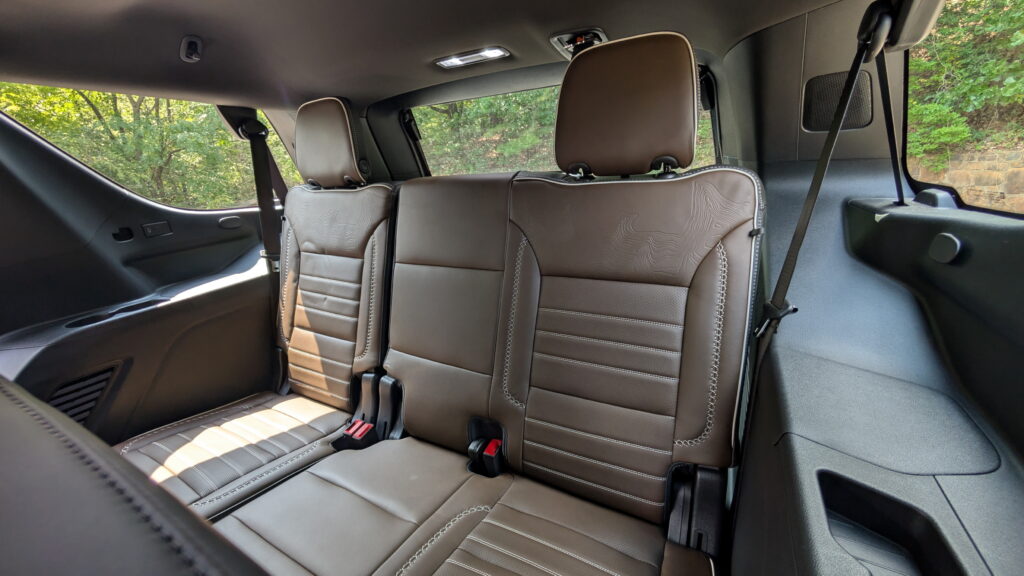
The third row maintains the general upholstery treatment, but the seats aren’t particularly well bolstered, and there’s plenty of hard, cheap-feeling plastic surrounding passengers. Some cost-cutting is understandable in an SUV. It’s harder to overlook when the SUV costs as much as a small house did not all that long ago. In fact, I kinda get it considering the potential damage that a tike can inflict. More troubling is actually getting back there.
Our Yukon’s $3,995 Executive Second Row Seating package might be one of the strangest luxury options I’ve encountered. The chairs themselves are great. They’re big, comfortable, heated, ventilated, and massaging. GMC even gives second-row passengers Bose speakers in their head restraints. There’s only one small problem. They barely get out of the way.
Trying to access the third row is bizarrely difficult because these substantial executive chairs don’t tumble forward enough to create the sort of easy passage you’d expect in a gigantic three-row SUV. Remember… you are paying six figures to drive what is essentially a senses-dulling barge so that you can bring your whole family.
Passengers effectively have to squeeze around them or find another route. That’s annoying in a $40,000 crossover. In a $111,795 Yukon whose entire reason for existing is transporting lots of people in considerable comfort, it’s borderline comical. And it highlights a larger problem with the Yukon.
If your priority is simply carrying people and their stuff, a good minivan makes a compelling case for itself. It’ll offer comparable passenger capacity, dramatically easier ingress and egress, excellent cargo flexibility, better fuel economy and, in many situations, feel more responsive around town.
Of course, nobody accidentally buys a Yukon while shopping for a minivan. The GMC can tow considerably more, offers proper four-wheel-drive capability and has a presence that a sliding-door people mover simply doesn’t. But if you’re not regularly using those capabilities, the practical argument starts getting uncomfortable for good reason.
A Great V8 That Somehow Feels Ordinary
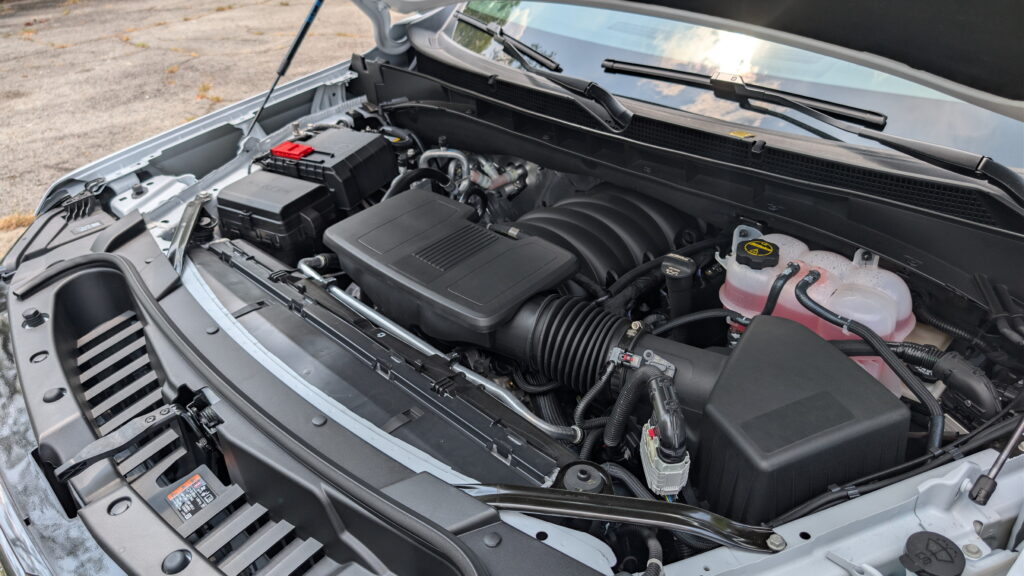
That’s especially true from behind the wheel. Our Yukon uses GM’s naturally aspirated 6.2-liter V8 paired with a 10-speed automatic. And in 2026, a big naturally aspirated V8 should feel special. Here? It doesn’t. There’s nothing wrong with it either! I drove this same V8 years ago in a Suburban, and it felt more lively. Maybe that was a weight change, but the difference was slight.
The Yukon moves along perfectly well, power delivery is smooth, and there’s something satisfying about knowing there’s a 6.2-liter V8 rumbling away up front. But the experience never really rises above adequate. There’s a lot of SUV for that engine to move, and the 10-speed automatic isn’t memorable enough to add much character of its own. The same applies to the chassis.
Ride quality is good. The Yukon is comfortable, smooth, and breezy over long distances. It isolates occupants well, and noise suppression is excellent. It’s not Bentley quiet, but conversation at highway speeds is effortless, and this is exactly the sort of SUV in which you could knock out hundreds of miles without feeling beaten up.
Push harder, and things become less impressive. There’s nothing terrible about the steering or body control, but neither feels particularly sharp. The Grand Wagoneer remains a more satisfying big SUV from the driver’s seat. Ten years ago, something this enormous driving this well would’ve seemed like witchcraft. Today, it’s just okay.
At Least The Technology Is Excellent
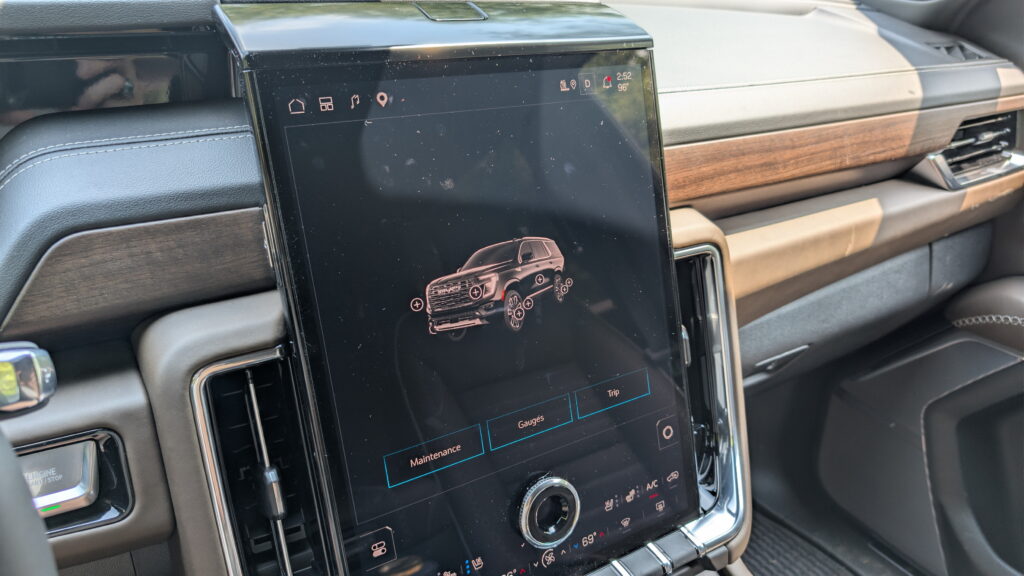
One area where GMC absolutely nailed it is infotainment. The huge portrait-oriented display is fantastic. It’s bright, crisp, responsive, and, most importantly, easy to understand. Basic functions don’t require an expedition through menus, and the Google-based software means useful services such as Google Maps are built directly into the vehicle.
You don’t need to immediately connect your phone just to make the system useful. That’s how modern infotainment should work. The Bose audio system is good, too, and the headrest speakers are an entertaining touch. But again, the Grand Wagoneer creates a problem. Its available McIntosh system remains more impressive to my ears, and at this price, those comparisons matter.
Photos: Stephen Rivers for Carscoops
Super Cruise fares much better. In fact, it might be my favorite part of the Yukon. On compatible roads, GMC’s hands-free system is smooth, confidence-inspiring, and genuinely relaxing to use. It’s less ambitious than Tesla’s Full Self-Driving system in terms of the situations it attempts to handle, but I’m not sure that’s entirely a disadvantage.
Tesla’s broader capabilities can encourage you to become extraordinarily comfortable with the system doing the work. Super Cruise has clearer boundaries. In my experience, that made it easier to maintain an appropriate understanding that, eventually, the human behind the wheel is going to be needed. Whatever your preference, Super Cruise transforms long highway drives and feels like technology worthy of an expensive luxury vehicle.
It Drinks Like A $112,000 Truck, Too
Fuel economy provides another reminder that underneath all this leather and technology is a very large body-on-frame SUV with a 6.2-liter V8. The EPA rates this configuration at 16 mpg combined, 14 city and 18 highway, according to our tester’s window sticker. I averaged 13.4 mpg.
And that wasn’t while hauling seven passengers, towing a boat, or filling the cargo area to its roof. That’s simply what it returned during my time with it. Nobody shopping for a 6.2-liter Yukon should expect Prius numbers, obviously. But 13.4 mpg still stings, especially when combined with a six-figure purchase price and a massive fuel tank.
It’s another compromise that becomes easier to justify if you’re actually taking advantage of the Yukon’s truck-based abilities. If you need serious towing capacity, lots of room and four-wheel drive in one luxurious package, physics is going to collect its fee. If you’re mostly commuting, doing school runs and carrying groceries, however, you’re paying quite a premium for capability you may rarely touch.
The Palisade Problem
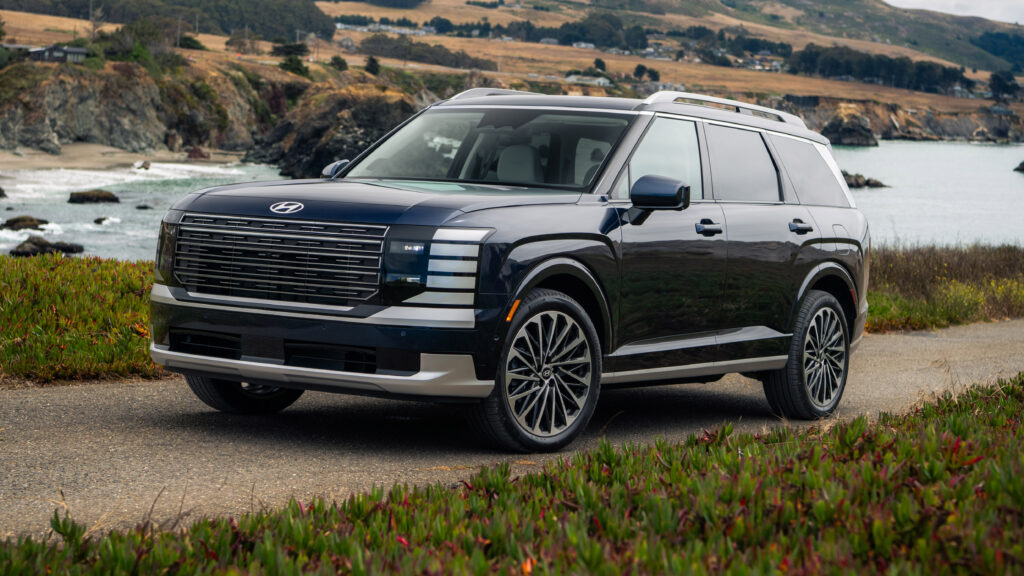
And that’s where something like the Hyundai Palisade enters the conversation. No, a Palisade Calligraphy isn’t a Yukon Denali Ultimate. It doesn’t have a 6.2-liter V8, can’t match the GMC’s towing capability, and Super Cruise alone is a meaningful advantage for the Yukon. But consider what Hyundai will sell you for roughly half the money.
A 2026 Palisade Calligraphy starts at $54,560 and offers Nappa leather, heated and ventilated seating, second-row relaxation seats, a head-up display, surround-view cameras, premium audio and a long list of driver-assistance features. Hyundai also backs it with a 5-year/60,000-mile new-vehicle warranty and a 10-year/100,000-mile powertrain warranty.
The Yukon is nicer. It had better be, right? But is it more than twice the money nicer? That’s where I struggle.
The same question applies when you look upward. Once you’ve committed to spending nearly $112,000, you’re knocking on the doors of some seriously prestigious luxury vehicles. The GMC badge isn’t inherently a problem, but Denali Ultimate has to deliver an experience capable of making you forget how much you’ve spent. Too often, this Yukon simply reminded me.
Verdict
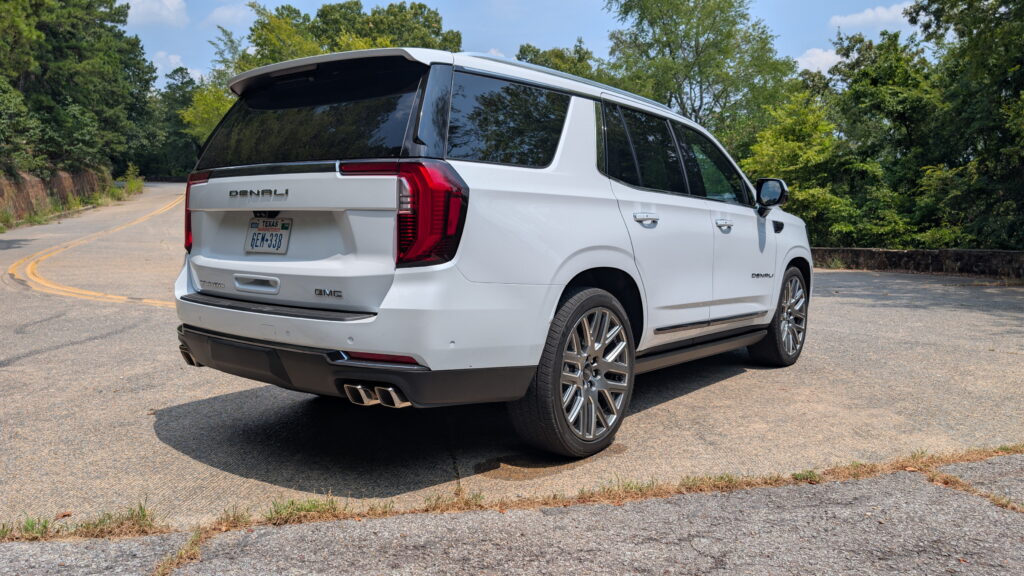
None of this makes the 2026 Yukon Denali Ultimate a bad SUV. Quite the opposite, honestly. It’s extremely comfortable. It’s quiet. The interior is attractive and generally beautifully finished. The seats are lovely. The infotainment system is among the better ones I’ve used recently. Super Cruise is superb. There’s tons of capability underneath it all, and GM’s big naturally aspirated V8 remains something worth celebrating while we can.
The Yukon Denali Ultimate does almost everything well. That’s the problem. At $70,000, “well” is enough. At $111,795, I personally want something extraordinary. Call me a cynical automotive journalist, but I’m a guy who cannot afford this SUV. I could be wrong, but I would guess that most readers can’t either. Even those who could probably would be better off spending half and getting 90 percent as much.
The V8 feels ordinary, the handling is merely competent, the audio system isn’t class-leading, fuel consumption is predictably brutal, the third row has some conspicuously cheap plastics, and somehow those fancy $3,995 second-row seats make accessing row three significantly worse. Meanwhile, vehicles costing roughly half as much have become astonishingly good at doing the everyday luxury-SUV stuff.
The Yukon fights back with towing capacity, truck-based capability, Super Cruise, a V8 and undeniable presence. Buyers who need that particular combination may find the Denali Ultimate makes perfect sense. For everyone else, I’d ask one question before signing the paperwork. Where, exactly, is the extra $50,000? After a week of looking for it, I like the Yukon Denali Ultimate but I’m still not entirely sure.