 by
by Bridgestone launches airless tires: first steps on Japanese roads
Bridgestone has spent 18 years bringing its airless tire from prototype to real-world road use. The first commercial tires are installed on self-driving golf carts that transport elderly residents of the city of Higashiomi. However, the cost and speed limitations currently prevent their use on ordinary passenger cars.
For nearly two decades, Bridgestone searched for the formula for a workable airless tire. After eighteen years of prototypes, the company finally claims to have a road-ready version. But don’t rush to buy a set for your own car, as the first commercial application is far removed from sports cars.
The tire manufacturing giant has launched its new AirFree tires on a fleet of self-driving vehicles in the Japanese city of Higashiomi. These vehicles resemble elongated golf carts. They will transport elderly residents around the city, so the tires will not be subjected to excessive loads. Nevertheless, this is the first time AirFree tires have entered regular commercial service, rather than a limited-time trial period.
Technology and Design
Bridgestone created its first airless tire back in 2008, and presented the current third-generation version in 2023. Thus, the technology on these golf carts is the result of eighteen years of continuous improvement. Instead of relying on a solid material that could fail or spoil the ride quality, AirFree tires use a recyclable material. It is strong enough to withstand daily use without turning every bump into a problem.
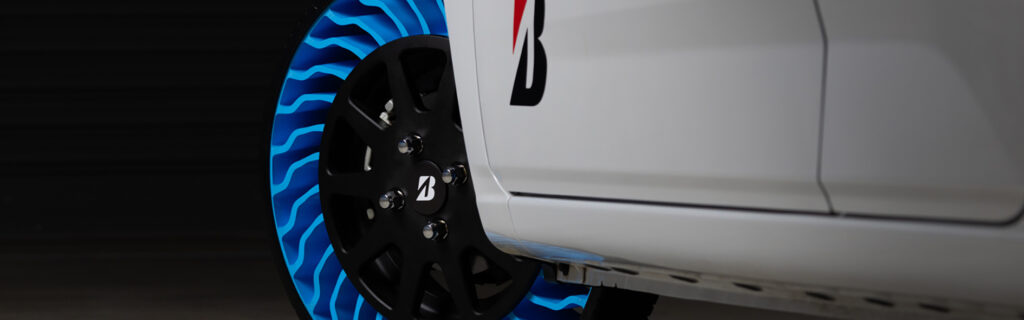
The design is based on thermoplastic resin spokes wrapped in a thin rubber tread that contacts the road. Bridgestone engineer Masaki Ota said the breakthrough came when the team stopped trying to make the material harder and instead turned to flexible resin and a structure that distributes load more evenly across the tire.
Bridgestone engineer Masaki Ota said: “The breakthrough came when the team stopped trying to make the material harder and instead turned to flexible resin and a structure that distributes load more evenly across the tire.”
Limitations and Prospects
The tires were demonstrated on driverless golf carts for selected members of the press earlier this week. These vehicles were limited to a speed of only 12 miles per hour (20 km/h). It is unclear whether they were limited to this speed for the comfort of the journalists present, or if this is simply the maximum safe speed for which they were designed. In any case, Nikkei Asia reports that they are currently only suitable for “relatively slow vehicles.”
As a result, these AirFree tires are not at all ready to replace the conventional rubber that modern production cars rely on. Until the technology makes a significant leap forward, expect to see such tires only on small mobile fleets performing low-speed work in controlled conditions.
As for the color, Bridgestone calls it “Empowering Blue” and says the bright shade was chosen to increase visibility during the day and at dusk.
The Future of the Technology
Bridgestone has not committed to a timeline for mass production and is currently weighing a business model that combines tires with services such as recycling. The company is also developing tires for lunar rovers, built on a metal structure derived from the same AirFree design. This suggests that the company sees a future for this idea far beyond the Japanese pensioner shuttle.
This move by Bridgestone is an important stage in the development of airless tires, which promise to solve the problem of punctures and wear, but currently face limitations in speed and cost. The first commercial application in low-speed vehicles allows the company to collect real-world data on performance and durability, which is critical for further technological improvement. The parallel development of tires for lunar rovers indicates that the company sees the potential of this technology in extreme conditions where conventional tires are unsuitable. However, for widespread adoption on passenger cars, significant technical and economic barriers will need to be overcome, particularly ensuring acceptable cost and safety at high speeds.