 by
by In the early 2000s, the Lancia Thesis was one of the most controversial executive sedans. Its retro-futuristic design, luxurious interior, and aim to compete with the BMW 5 Series made it stand out. However, a car built to transport Italian politicians was not at all intended for camping. An Estonian named Allar thought otherwise: he found an abandoned Thesis and transformed it into a real camper.
From daily commute to unexpected find
The story of this unusual project began with Allar’s daily route. For a year, he drove past a dark green Lancia Thesis that looked abandoned. Eventually, he came across an advertisement selling this very car for parts, with the only alternative being the scrapyard.
Feeling sorry for the Italian sedan, Allar went to inspect it. Unfortunately, the old Lancia was in terrible condition: dents, scratches, mismatched wheels, and rust on the underbody. The car wouldn’t start, the gearshift lever mechanism was broken, several vital electronic modules were missing, and various trim elements were shattered.
3D printing and Italian electrics
Most people would have been discouraged, but Allar bought the car anyway and began the painstaking restoration process. After replacing numerous engine parts, he discovered that the 2.4-liter five-cylinder turbo diesel JTD was in surprisingly good condition. A greater obstacle was the gearshift lever, as spare parts for this rare sedan are almost impossible to find.
Undeterred, Allar used 3D printing to fabricate the necessary gear selector components himself. He then tackled the notoriously complex Italian electrical system, sourcing used modules to troubleshoot the dashboard until every system functioned correctly. He also repaired the body dents as much as possible.
From executive sedan to camper
Once the Lancia was drivable, registered, and passed inspection, Allar realized he had no practical daily use for it due to his existing fleet. His collection includes a BMW 760Li, Volvo 960, Porsche 944, and Opel Corsa OPC, along with two Honda CBR motorcycles.
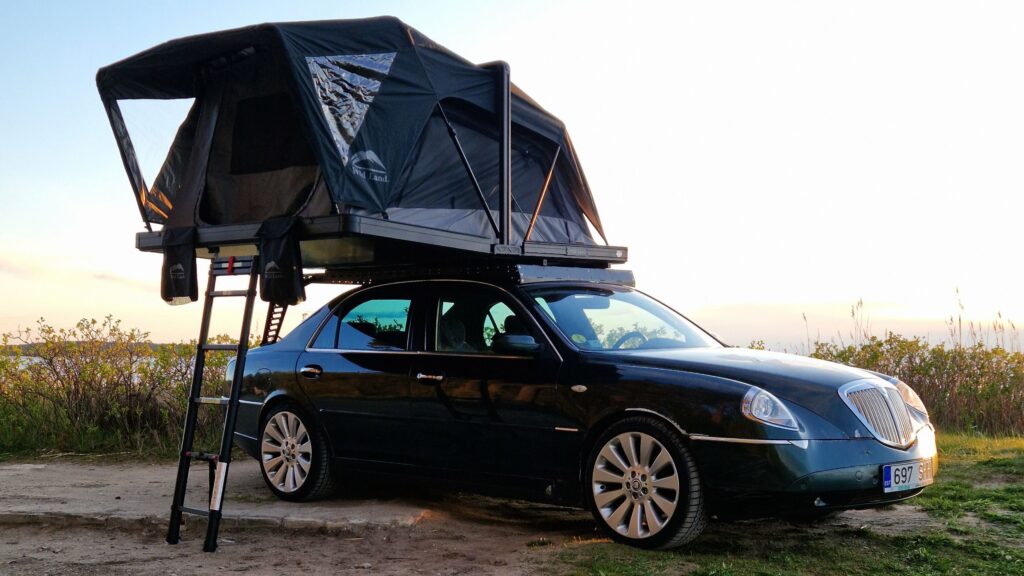
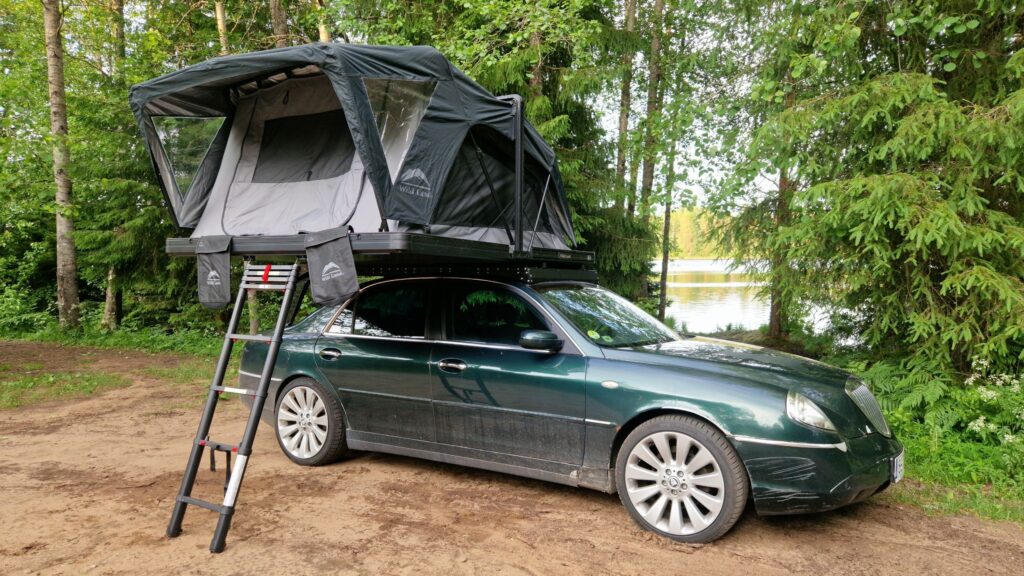
Instead of selling the Thesis, Allar decided to fulfill a long-held dream — to have his own camper. He ordered a hard-shell roof tent that unfolds to 4 square meters. To support its weight, he designed and built a low-profile roof rack that follows the lines of the Thesis’s roof and rear deck.
The sedan also received rear spring height adjusters to handle the extra load. Allar also installed a new set of 19-inch multi-spoke wheels from a Jaguar XF, using spacers and custom-made lug nut adapters. A dual-battery system was installed to power all the auxiliary equipment and electronics inside the roof tent. Inside the cabin, the old ashtray gave way to a custom phone charger.
Enthusiasts understand, others do not
Probably the world’s only Thesis-based camper is not a garage queen, as Allar actively uses it for traveling across Europe. He notes that the flagship remains a surprisingly comfortable cruiser, and despite the roof tent and special roof rack, it holds 140 km/h without wind noise.
There are drawbacks. Allar recounted that the 2.4-liter turbodiesel feels outdated at low RPMs, which he believes is due to sticky turbo geometry and a faulty boost solenoid delaying power delivery.
As for reactions, Allar admits that an untrained eye might perceive his Thesis as a neglected car. Enthusiasts, on the contrary, love this project, and this slightly scruffy car commands respect wherever it appears. It proves that with enough determination and work, even a forgotten Italian flagship can find a second life in the great outdoors.
We thank Allar for sharing his project with us. You can follow his adventures on Instagram and YouTube under the name Sats Motors.
This project demonstrates how a creative approach and perseverance can turn a seemingly hopeless car into a unique and functional vehicle. Allar’s story is not just about restoring an old car, but about realizing a dream and finding unconventional solutions. The use of 3D printing to manufacture rare parts highlights how modern technology can help preserve classic cars. Furthermore, this case shows that even cars that are not very popular can find a new purpose and become an object of admiration for true enthusiasts.