
 by
by Ford Emphasizes Its Leading Role in American Auto Manufacturing
Automaker Ford proudly reports its achievements in manufacturing and exports in the USA, highlighting its commitment to the American economy and jobs.
Leadership in the Domestic Market and Exports
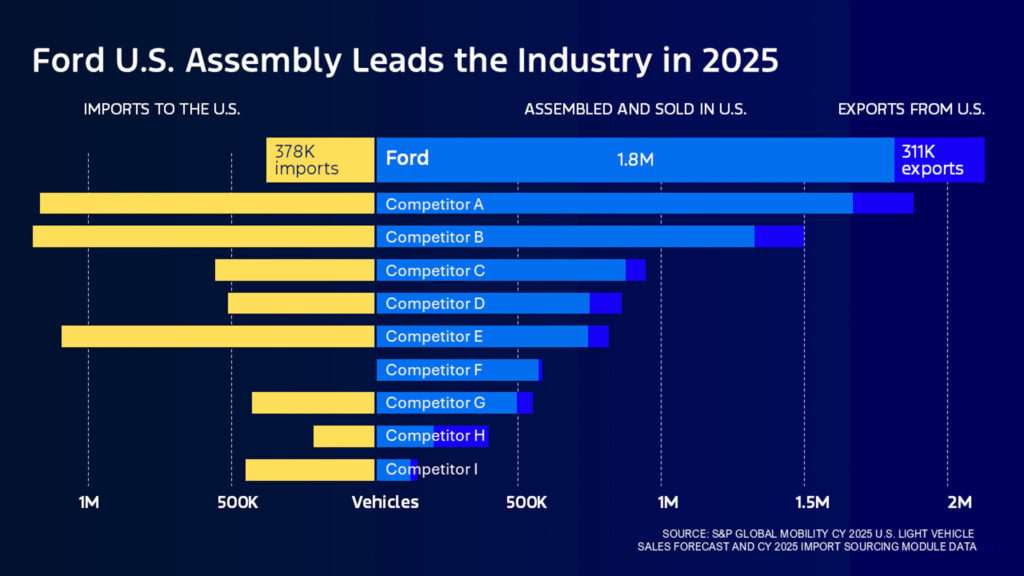
Ford CEO Jim Farley stated that last year the company assembled over 2 million vehicles in the USA, surpassing all other automakers. The gap to the closest competitor, Toyota, was nearly 350,000 vehicles in Ford’s favor.
It is noteworthy that about 83% of the vehicles Ford sells in America are also manufactured there. This level of localization is unattainable for most competitors.
Export also remains an important direction: the company shipped approximately 311,000 American-made vehicles to over 60 global markets. Among the export hits are models such as the F-150, Bronco, and Mustang.
Impact on Employment and the Economy
Ford emphasizes social responsibility, pointing out that the company provides jobs for approximately 56,300 hourly workers in the U.S. manufacturing sector, which is the highest figure among automakers. These jobs have a multiplier effect, supporting not only the auto industry but entire communities.
Jim Farley emphasizes that local production is not just a matter of cost, but also about supporting schools, small businesses, and local economies. Building vehicles at home helps sustain lives far beyond the factory gates.
People ask why we fight so hard to keep assembly lines here when our competitors profited by moving production offshore. It’s because we understand the math of community. When you assemble a car in America, you ignite an entire economic ecosystem.
Future Plans and Investments
Despite the slowdown in the transition to electric vehicles, Ford does not plan to reduce its activity. The company intends to hire thousands of new workers in preparation for the launch of new gasoline, hybrid, and electric models. One of the key future projects is the launch of an affordable pickup truck priced around $30,000.

Ford’s position, while it may seem like self-promotion, is quite compelling. The company is trying to present itself not just as an automaker, but as a key player that does more for America and its citizens. This becomes especially relevant in the context of the potential penetration of affordable and high-tech Chinese electric vehicles into the U.S. market. If Chevrolet was once called the heartbeat of America, Ford now claims to be the new heart of American industry.
Ford’s strategy, focused on keeping production in the USA, looks like a long-term bet on consumer loyalty and political support. In a world where global supply chains often become the subject of political debate, such a position could become a significant competitive advantage. The success of the affordable electric pickup and new models will be a practical test of this strategy, showing whether local production can effectively compete with imports not only on patriotic sentiment but also on real product characteristics and price.