 by
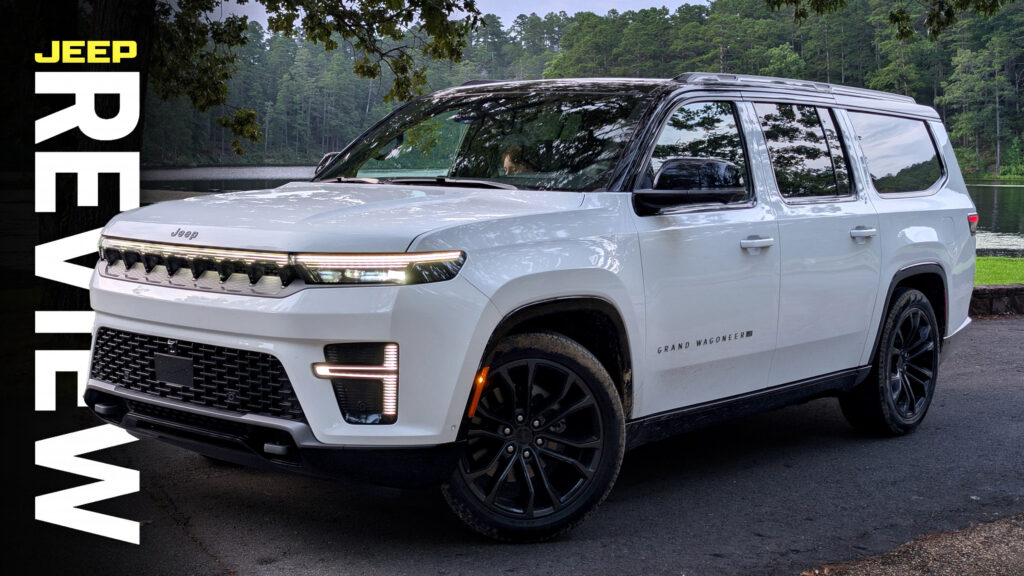
by 2026 Jeep Grand Wagoneer L Review: Is It Worth the Price?
Pros: Excellent on-road and off-road handling, superb interior, comfortable ride.
Cons: Expensive, larger than most need, H.O. engine option is gone.
There aren’t many SUVs left on the market costing over a hundred thousand dollars that try to be all things. Most specialize in one thing. The Cadillac Escalade is about presence. The Lincoln Navigator is about comfort. The Chevrolet Suburban is about utility. The Range Rover tries to blend luxury with genuine off-road capability, albeit at an astronomical price.
The 2026 Jeep Grand Wagoneer takes a different path. It aims to do all of this at once, combining three rows of genuine luxury in a body capable of traversing miles of off-road terrain, then comfortably cruising home on the highway. It’s a bold promise for a vehicle nearly 5.5 meters long and weighing almost three tons.
Significant changes have occurred this year. Jeep simplified the lineup, completely dropping the standard Wagoneer and removing the 540-hp (403 kW) High Output Hurricane inline-six engine. Now, every Grand Wagoneer is equipped with the ‘standard’ 3.0-liter twin-turbo Hurricane producing 420 hp (313 kW) and 634 Nm of torque.
Key Facts
Model: 2026 Jeep Grand Wagoneer L Summit Obsidian
Price: From $97,310 / Tested at $106,890
Dimensions: 5758 × 2123 × 1920 mm
Curb Weight: Approx. 2917 kg
Powertrain: 3.0-liter twin-turbo Hurricane I-6, 8-speed auto, four-wheel drive
Power: 420 hp (313 kW) / 634 Nm
Towing Capacity: 3719 kg (standard) / 4449 kg (Max Tow package)
Fuel Economy: 18 mpg (EPA combined) / 15.4 mpg (tested)
On Sale: Now
On paper, these changes look like cost-cutting. But after a week behind the wheel, including taking this massive SUV where most owners probably never will, I kept returning to one question. What happens when the best full-size SUV isn’t the one you’d recommend?
Design
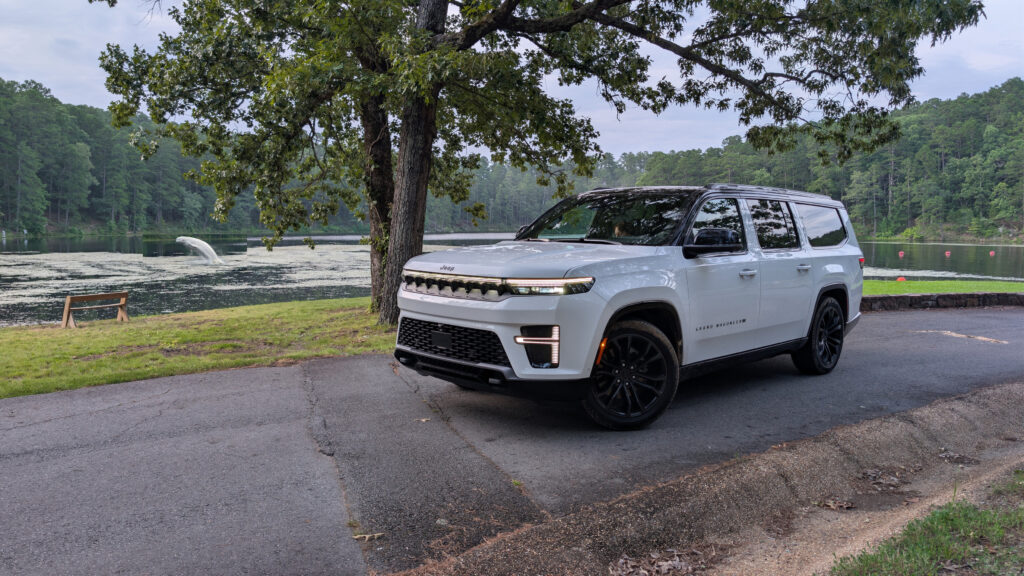
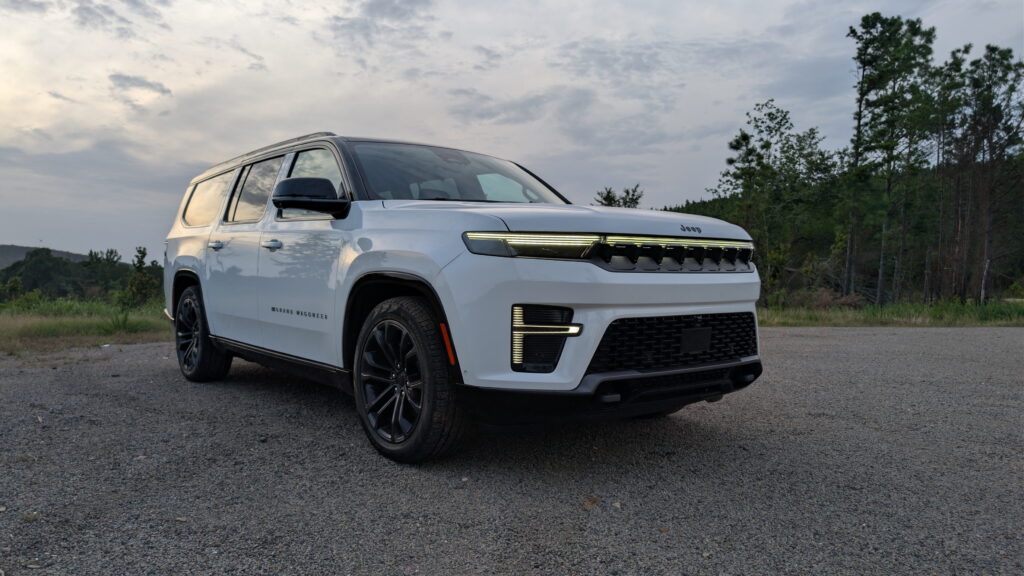
When this generation debuted, it always seemed like Jeep designed the front and rear separately, then introduced them five minutes before production started. The front looked modern, while the rear resembled an oversized suburban appliance. The facelift has improved things.
The front finally looks like it belongs to a Jeep. Slimmer lighting, an updated grille, and cleaner surfaces give it much more personality than before. It’s recognizable from half a mile away, and that’s exactly what a flagship SUV should achieve. Unfortunately, the rear remains its weakest angle.
I still can’t quite explain why it bothers me so much. The proportions just don’t work. Viewed from almost any angle behind the C-pillar, it looks bloated, as if the design kept expanding after everyone else stopped drawing. If the front is athletic, the rear is… a beluga whale. Speaking of whales…
White is probably the worst possible color for this SUV. The Grand Wagoneer is huge anyway. Painting it bright white somehow makes every dimension look a foot longer. It’s hard not to think of marine mammals that are actually smaller than the Jeep.
The average adult beluga whale is about 4.5 meters long. The Grand Wagoneer L is 5.4 meters long. There’s a fact you didn’t know until today. Tell your friends.
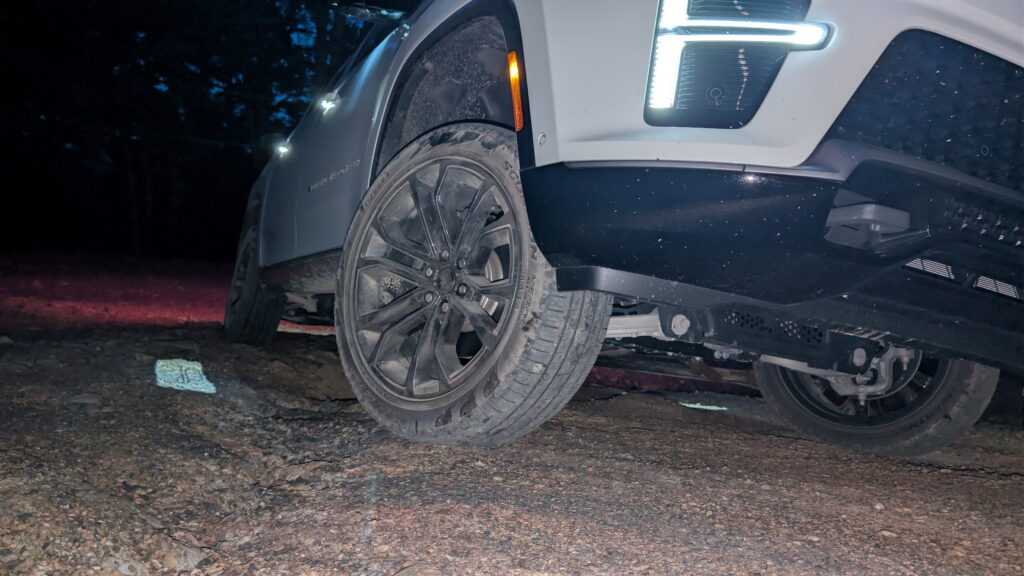
Of course, the size becomes a pleasant surprise when paired with the 22-inch wheels. Usually, such large wheels either disappear under an oversized body or dominate the design. Somehow, Jeep nailed the proportions. They look just right. Overall, this is the best version of the current Grand Wagoneer. It’s progress, but there’s still room for improvement.
Interior and Features
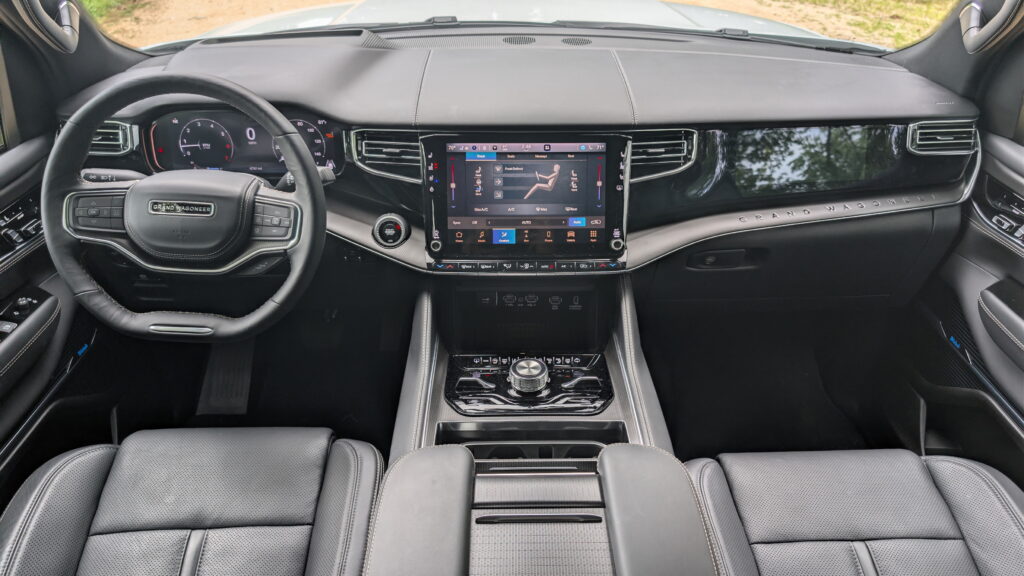
This is where Jeep justifies a significant part of the price. Yes, there are cheap materials if you start looking. The black glossy plastic covering most of the center console and some areas of the dashboard looks and feels out of place in a vehicle costing over $100,000. It will scratch, attract fingerprints, and eventually look terrible.
Fortunately, that’s the exception, not the rule. Almost everything you touch feels genuinely premium. The stitching throughout the cabin looks expensive. Even the leather-wrapped start/stop button shows someone paid attention to detail.
A beautifully textured wood inlay stretches across the entire dashboard. The Grand Wagoneer lettering, elegantly embedded on the passenger side, is the cherry on top. It’s one of the classiest dashboard designs offered by an American manufacturer today.
The seats also deserve special praise. They are heated, ventilated, and have a massage function that doesn’t just vibrate — it actually works. After several hours behind the wheel, they helped reduce fatigue.
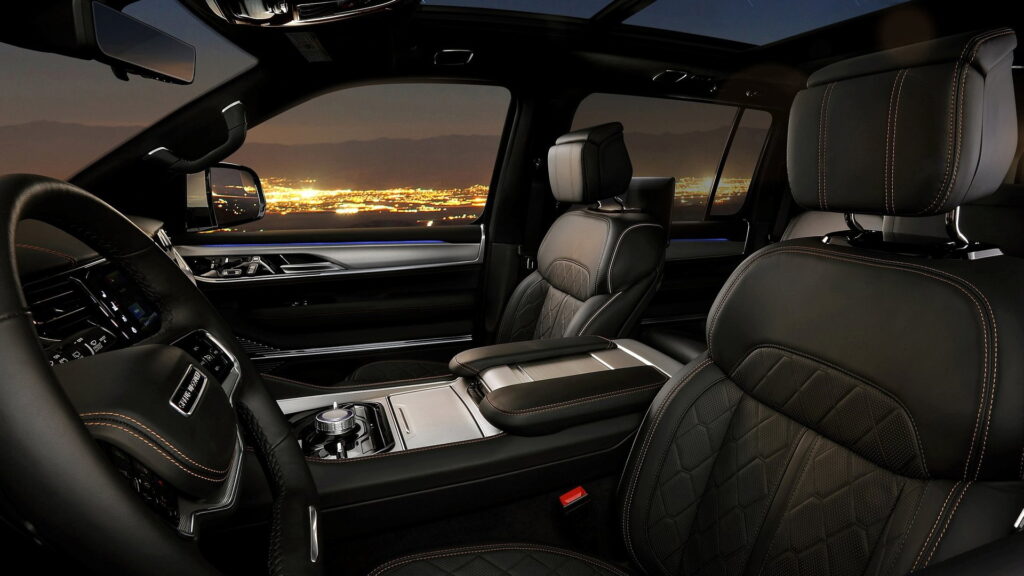
Nevertheless, they are clearly designed for someone shorter than my 6’6″ (198 cm) frame. No adjustment allowed the upper backrest and headrest to fit my shoulders perfectly. Fortunately, the massage system compensated for much of this discomfort.
It’s worth noting that not everything is perfect here. Jeep placed an array of expensive electronic switches directly under the cup holders. Think about that for a second. Do you really expect every owner never to spill coffee, soda, or water over the years?
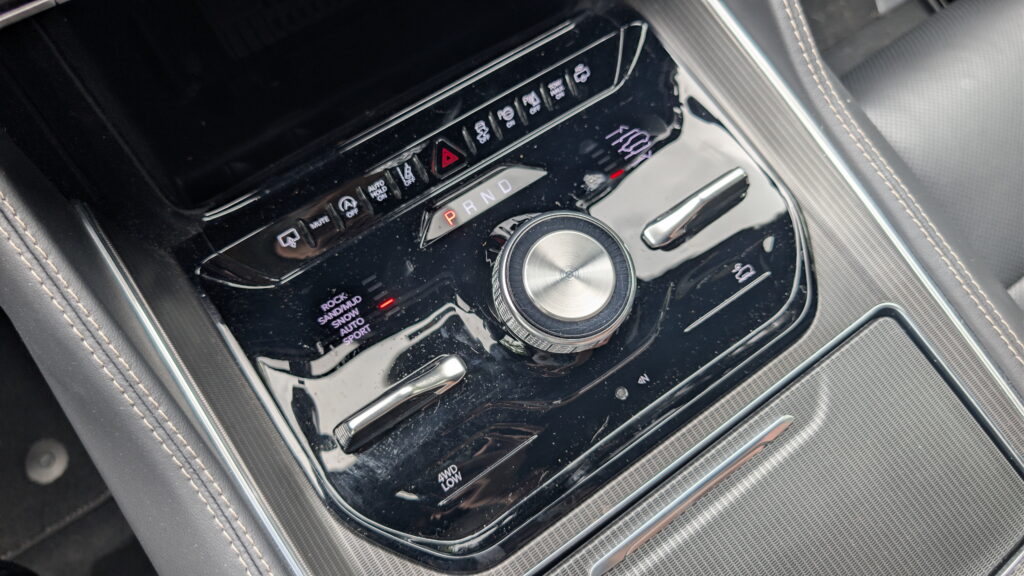
Gravity doesn’t care how much your SUV costs. Eventually, something will spill right onto those controls, and I don’t want to imagine how much replacing that unit costs. Fortunately, most of the controls are excellent.
The main infotainment display is responsive and intuitive, and Jeep wisely kept physical climate control buttons instead of burying everything in menus. A second lower touchscreen manages seat functions and can retract, revealing a hidden storage compartment with wireless charging, USB ports, and HDMI. The optional passenger display… is okay.
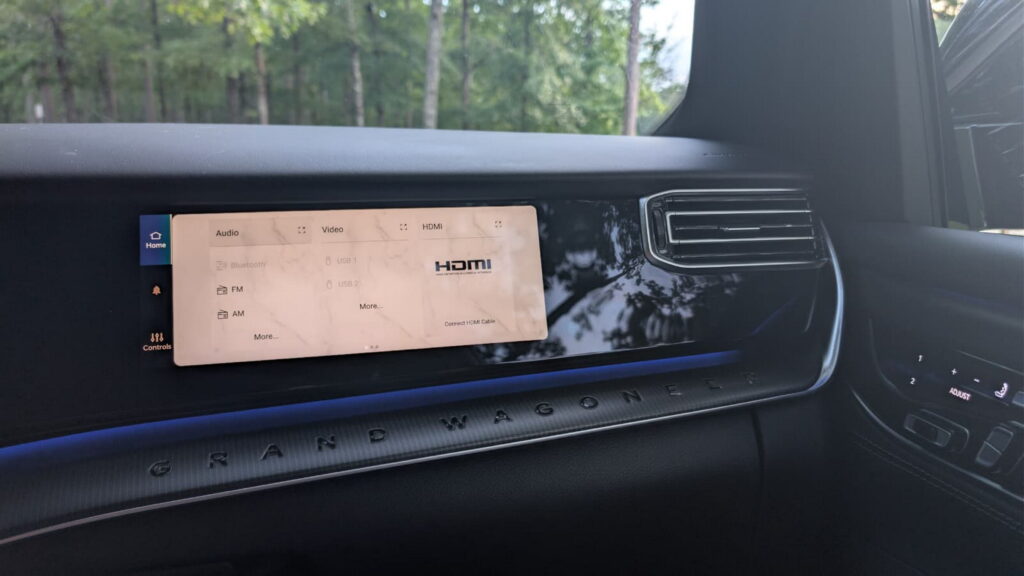
It looks impressive and offers many features, but it’s more complicated to use than it needs to be. Viewing independent content requires connecting headphones, compatible apps, and hoping everything works correctly. Ironically, it’s often easier for the front passenger to just watch what’s already playing on the rear screens. Speaking of which…
The second row is probably the best place to sit. Heated and ventilated captain’s chairs, huge legroom, four additional USB ports, a household outlet, 12V power, and large entertainment displays make it truly first-class. Now, about the third row.
Simply put, it’s excellent. Aside from the Grand Cherokee L, I can’t think of any three-row SUV where I’d willingly spend several hours in the third row. Adults actually fit. The leather quality matches the rest of the cabin, not feels secondary. Both passengers have power recline adjustment, charging ports, cupholders, and separate storage bins.
Cargo space is also impressive: 804 liters behind the third row, 2005 liters with the third row folded, and 2668 liters behind the front seats. Even better, the power-folding seats make reconfiguring the cabin easy — a feature that still isn’t universal among American SUVs in this price range.
And one more thing every passenger will appreciate, no matter where they sit. The McIntosh audio system is incredible. Not “good for an SUV.” Just incredible. It might be the best factory audio system available today in any mass-market luxury SUV.
Driving Impressions
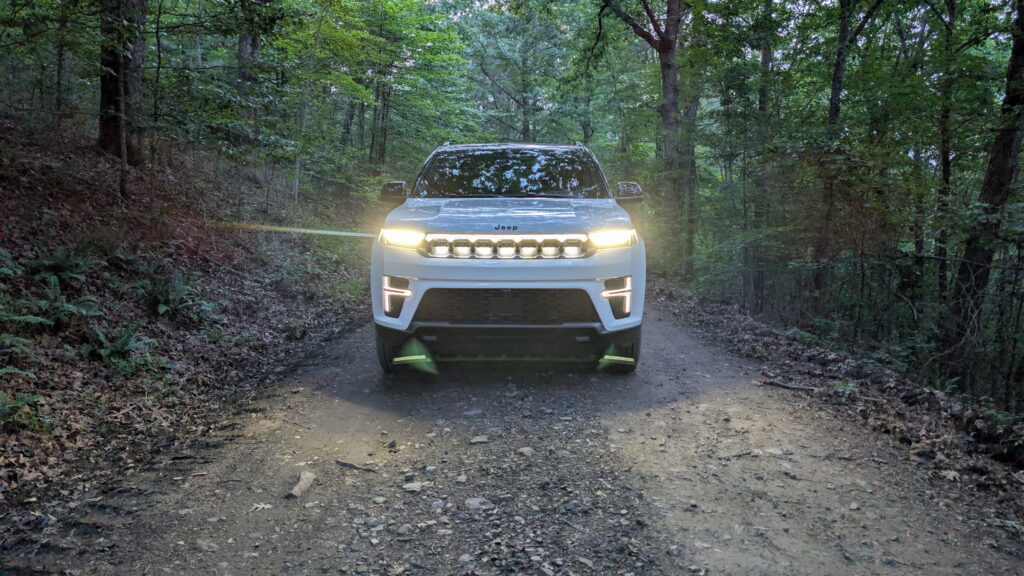
The interior is great, but the Grand Wagoneer differentiates itself where the rubber meets the road or the trail. I’ve driven the Escalade IQ, Chevrolet Suburban, and Ford Expedition. None of them move like this one. The closest comparison is, actually, a Range Rover.
No, it doesn’t corner like a Range Rover. But it has that rare ability to make something incredibly large feel smaller than it actually is. The steering is precise without being nervous, and body control is simply impressive given the massive weight. Body roll is almost non-existent.
Read that sentence again. This thing weighs approximately 2900 kg. That’s roughly twice as much as an adult beluga whale. Yes, seriously. Consider that a bonus whale fact. Nevertheless, it remains remarkably composed in long corners, while simultaneously providing an extremely quiet ride. Wind noise is minimal. Road noise barely intrudes. Even rough pavement feels like a subtle suggestion. The chassis is undoubtedly the star of the show.
Power, meanwhile, is like the passenger infotainment system: adequate. The 420-hp Hurricane never feels slow. Passing is easy, towing capacity (up to 4449 kg) remains excellent, and most buyers will never complain. But if you’ve driven the old 540-hp High Output version, you will miss it.
The extra verve transformed the Grand Wagoneer from surprisingly quick to genuinely entertaining. Losing that feels like an unnecessary downgrade, even if most owners won’t notice. It’s also worth noting that at 15.4 mpg, we fell significantly short of Jeep’s combined estimate of 18 mpg, so it’s not like we traded power for stellar economy.
Then I took it where few six-figure luxury SUVs dare to go. Off-road. Of course, I wasn’t rock crawling or mud bogging like in the Wrangler Moab 392 a few weeks prior.
But the trails we tackled were challenging enough to fully articulate the suspension while climbing and descending steep inclines. At one point, the front passenger wheel was completely off the ground, despite the suspension being at its maximum height.
The Jeep just kept going. No drama, no hesitation, and no truly alarming moments from behind the wheel. It’s easy to forget that this is, fundamentally, still a Jeep. Just remember one thing: forest roads aren’t designed for vehicles this wide. If another vehicle appeared from the opposite direction, someone would have to reverse.
Competition: The Enemy Within
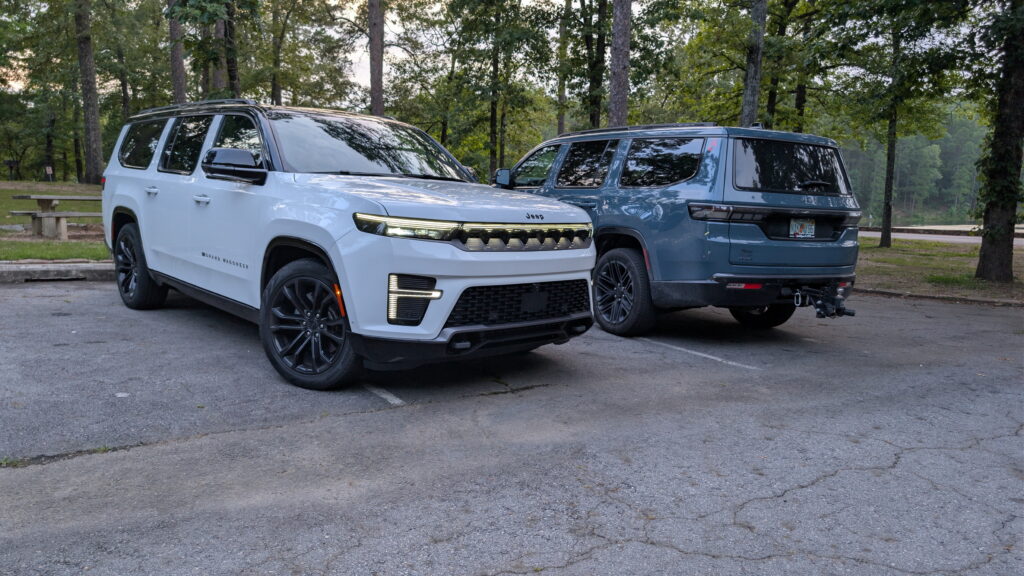
Oddly enough, the Grand Wagoneer’s biggest competitor isn’t the Cadillac Escalade. It’s not even the Navigator or Yukon Denali. It’s the Jeep showroom. Among full-size American luxury SUVs, I’d choose the Grand Wagoneer over any of them. It drives better than GM’s offerings, feels more cohesive than Ford’s products, and has an interior that exceeds expectations.
But I’d probably buy a Grand Cherokee L. It drives even better due to its smaller size, handles off-road terrain better, offers nearly identical interior quality, still has an excellent third row, and costs significantly less. If I absolutely needed the extra towing capacity or cargo space, I would also seriously consider a certified pre-owned Grand Wagoneer with the 540-hp Hurricane H.O. or even the superb 392 V8.
You’d save tens of thousands of dollars getting a more exciting engine that’s still under warranty. That’s a tough value proposition for a new six-figure SUV, even an excellent one, to overcome.
Verdict
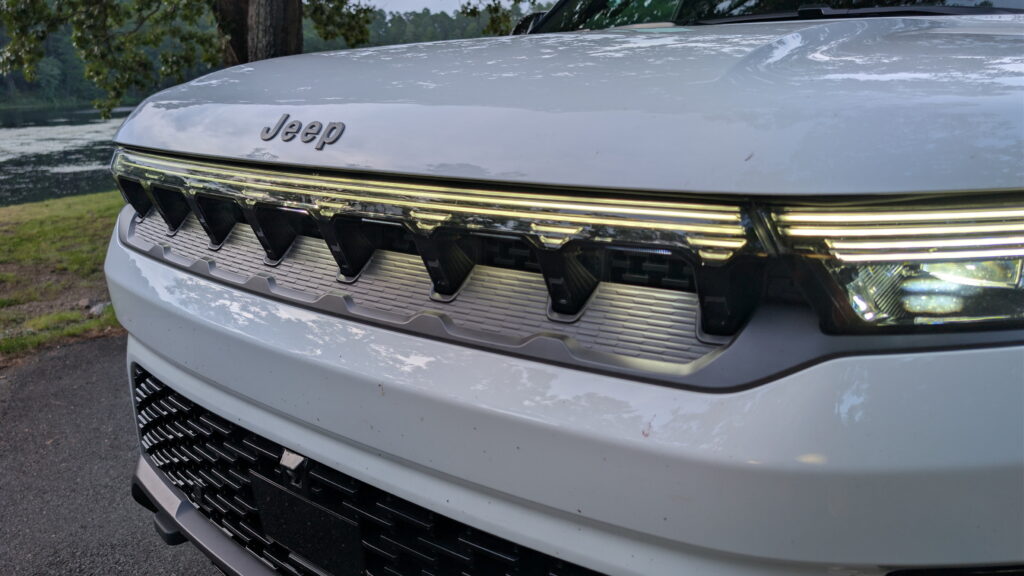
The 2026 Jeep Grand Wagoneer is undoubtedly the best version of this vehicle Jeep has ever built. It looks better, drives brilliantly, offers one of the best interiors in its price range, and remains surprisingly capable when the pavement ends. As a comprehensive package, I believe it is currently the best full-size American luxury SUV on the market.
I also believe that such large vehicles are becoming increasingly difficult to justify. They take up more road than many drivers need, create additional visibility issues for pedestrians and smaller vehicles, and simply demand a lot from modern infrastructure.
But if you are set on owning something this large, you won’t find a more complete package. This brings us back to the question from the beginning. What happens when the best full-size SUV isn’t the one you’d recommend? You split the recommendation based on the buyer.
If you genuinely need everything the Grand Wagoneer offers, including a fresh factory warranty, it is the best choice, unequivocally. If not, Jeep’s own Grand Cherokee L or a slightly used Grand Wagoneer with the High Output Hurricane engine might be a smarter purchase.
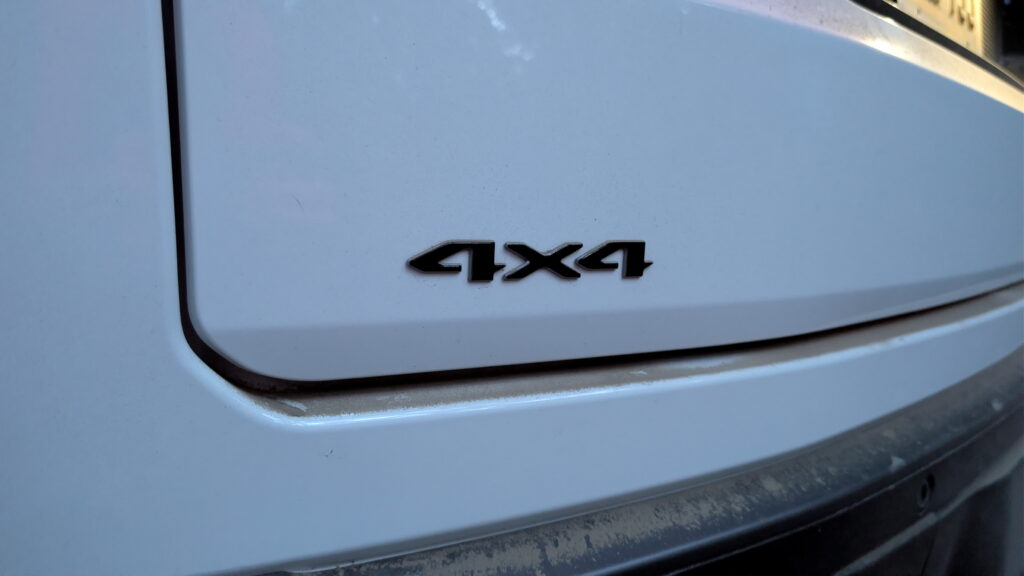
For all its virtues, the Grand Wagoneer finds itself in a paradoxical situation. It is so good that it almost convinces you of the necessity of its size and cost, yet its own lineup offers more rational alternatives. It’s an SUV that justifies its existence as a technological and engineering masterpiece, but in practice, it may be too cumbersome for daily life. Choosing it is a conscious decision for maximum versatility and luxury, even if a more practical and affordable option sits right beside it on the same dealer lot.