 by
by 2026 Cadillac Optiq V Review: An Electric Crossover Unlike Others
Pros: Performance, handling, attractive design, interior layout
Cons: High price, expensive options, some cheap plastics
If you haven’t been following this market segment, the Cadillac Optiq V might surprise you. Who exactly buys such a car? A fair question, and one we kept coming back to. At almost $80,000 in test trim, nobody makes such a decision impulsively.
It’s not the fastest electric crossover on the market, not the most luxurious, and not one chasing the biggest tech headlines. If you compare the specs, several competitors offer more car for the same money.
That’s precisely what makes it interesting. We spent a week studying Cadillac’s new electric performance crossover, and with each passing day, it became harder to categorize. It doesn’t behave like a traditional luxury crossover. It also doesn’t feel like a harsh sports car.
QUICK FACTS
Model: 2026 Cadillac Optiq V
Price: from $67,300 (base) / $78,526 (tested) + $1,495 destination
Dimensions: 4826 x 1913 x 1651 mm
Curb Weight: 2495 kg
Powertrain: Dual-motor all-wheel drive, 1-speed automatic
Power: 519 hp (387 kW) / 880 Nm
Fuel Economy: 103 city / 81 highway / 92 combined MPGe (EPA)
Range: 447 km (EPA), 402 km with optional summer tires
On Sale: Now
In fact, most of the time it feels like an electric hot hatch that’s been stretched upward to please modern buyers. In a market that looks exactly like that, maybe that’s the whole point.
Design
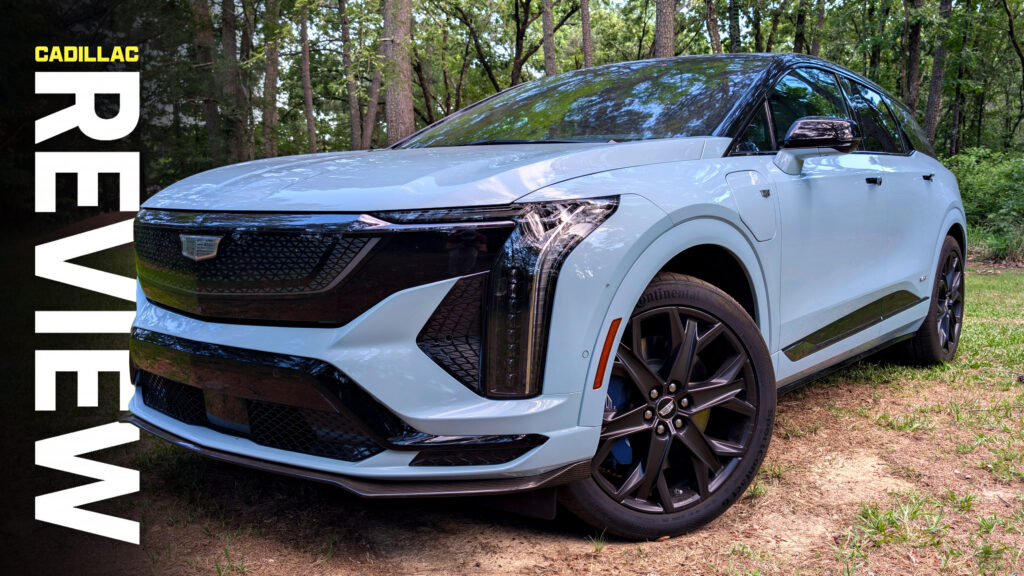
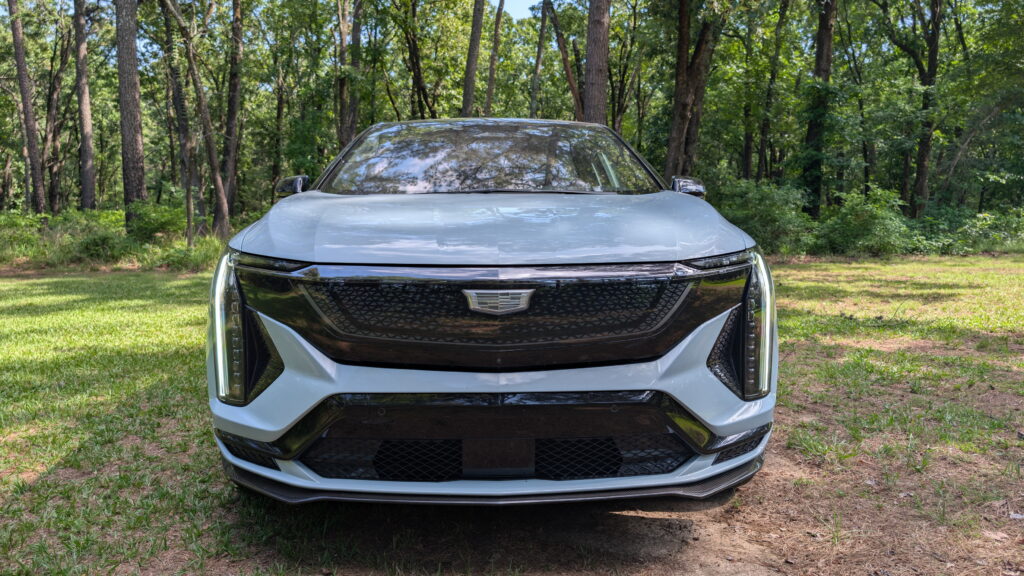
There’s no doubt the Optiq stands out. Despite being a crossover, it looks attractive. Angular body panels, sharp lighting lines, and a successful combination of black and glossy trim make it modern and premium without overloading on details. Cadillac’s new design language is still establishing itself, but the Optiq-V does a lot to strengthen the brand’s modern identity.
There are a few quirks. The two-tier spoiler arrangement remains somewhat odd even after getting acquainted with the car. And while the hidden door handles worked flawlessly during testing, the outward-protruding design feels like one of those solutions looking for a problem. They are more annoying than convenient, and I’m not sure it’s an improvement over traditional handles.
Nevertheless, overall the Optiq-V is attractive, distinctive, and looks premium. If I could change one thing, I would make the car lower. It would give it more of a hot hatch vibe, and frankly, that would be fitting. More on that later.
Interior
The Optiq-V’s interior is simultaneously impressive and disappointing. Like in several recent GM products, it can feel genuinely luxurious one moment and surprisingly cheap the next. Let’s start with the disappointments.
There’s simply too much black glossy plastic. It’s everywhere, including the steering wheel, where fingerprints appear almost instantly. It looks great in press photos. Much less impressive after five minutes of real-world use.
The blue accent inserts add visual interest to the cabin, but the material itself feels less premium than it looks. Similarly, the chrome trim on the steering wheel initially seems expensive but then reminds you it’s still just plastic.
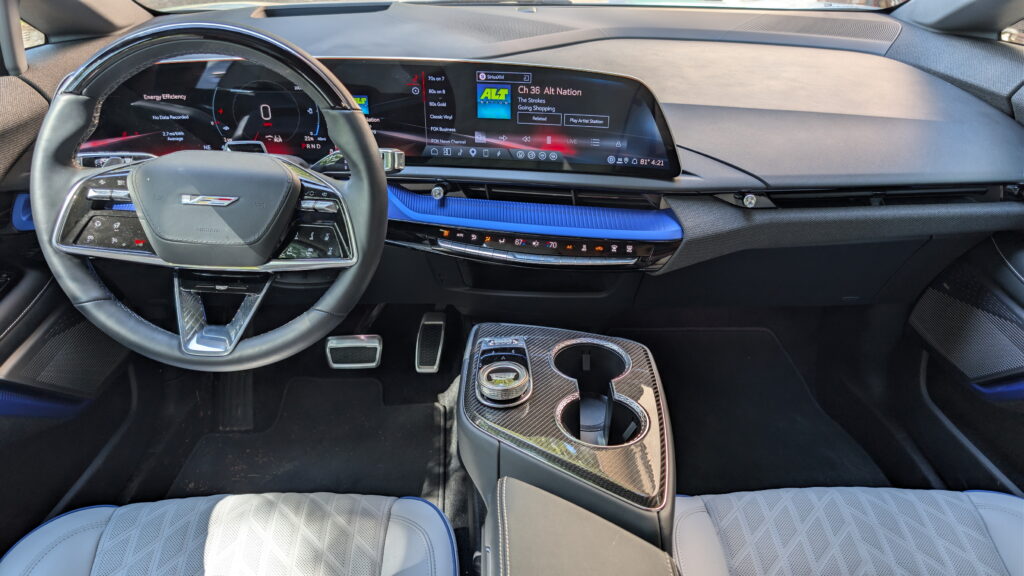
Fortunately, these shortcomings are offset by plenty of truly excellent decisions elsewhere. The leather upholstery looks rich. The contrast stitching is attractive. The fabric inserts on the doors add warmth and texture. The speaker grilles look fantastic. The steering wheel itself feels sturdy and pleasant in hand. The interior door handles have a reassuring weight. These details matter because these are the things occupants interact with daily.
Cadillac also deserves praise for retaining physical climate controls. In an era where seemingly every manufacturer tries to hide basic functions in the touchscreen, simple buttons and switches remain a win for usability.
The center console is also well thought out. The hidden wireless charging area, located partially under the console structure, securely holds the driver’s phone and partially hides it from view, while the console itself reveals upper and lower storage compartments. The seats also deserve praise. They are supportive enough for spirited driving, comfortable for long trips, and have a massage function for front passengers.
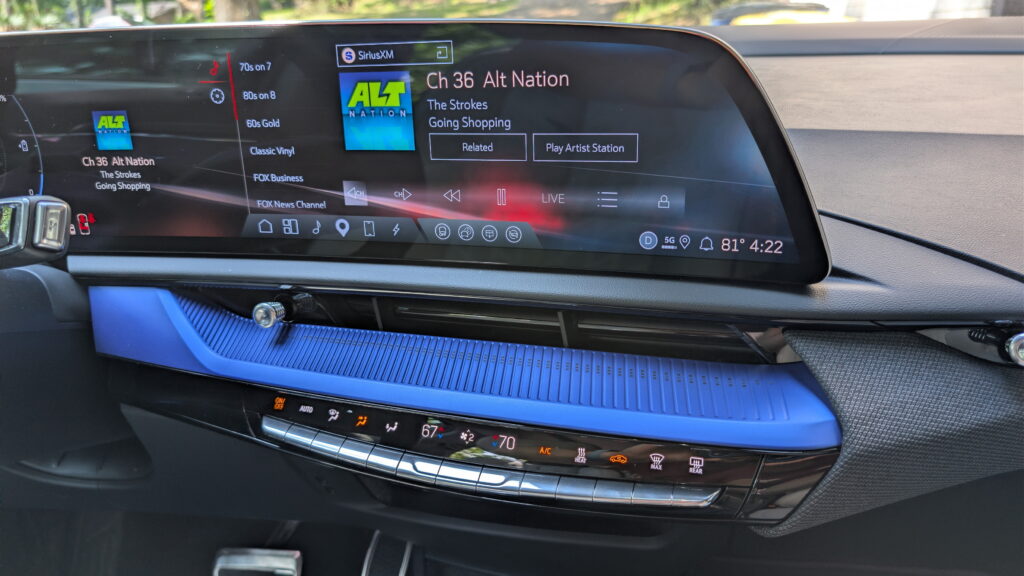
As for technology, the infotainment system works well. Response time is quick, menus are logical, and navigation is straightforward. I was less impressed with the tactile controls around the rotary dial on the center console. Since I still have to look down to ensure I’m pressing the right surface, I’d rather have traditional buttons. In this case, the touchscreen becomes almost more convenient. Nevertheless, having a physical volume knob remains pleasant, especially for front passengers.
Visibility is excellent in all directions, and rear-seat passengers get a surprisingly premium experience. The seats are comfortable, legroom is adequate, and amenities include USB ports, ventilation vents, and seatback pockets. A bit more lateral support wouldn’t hurt, but complaints are otherwise minor. Tall passengers won’t have much headroom, but most will manage without issue.
Behind the second row, the cargo area is spacious (0.74 cubic meters) and easy to load. Under the floor, there is additional storage space along with a tire repair kit.
Range, Reality, and Tesla Connectors
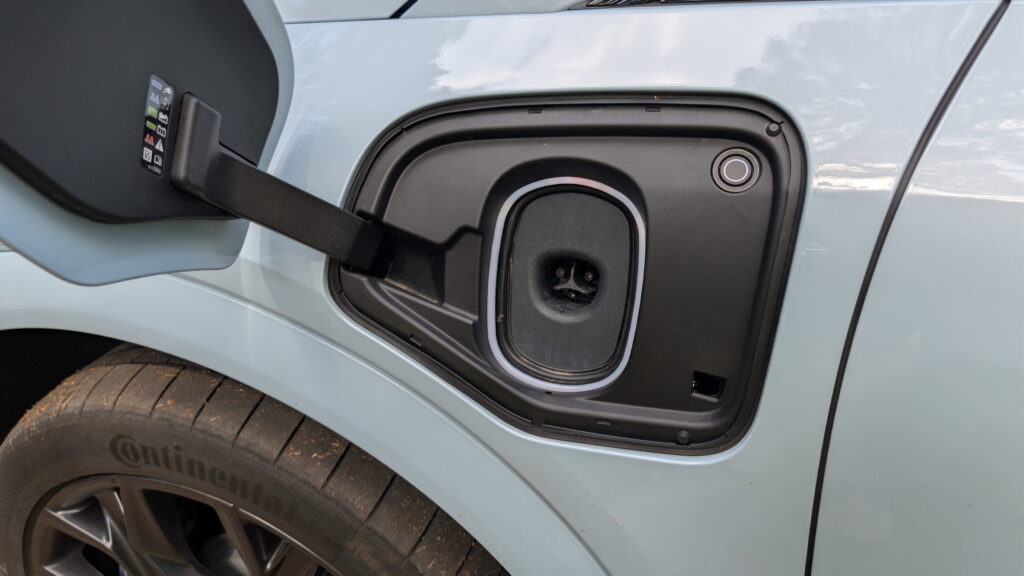
One of the biggest advantages of the Optiq-V is something owners might not think about daily. It comes standard with NACS charging compatibility. This means access to the Tesla Supercharger network without needing adapters or relying on future promises, which is an increasingly important factor for those planning trips.
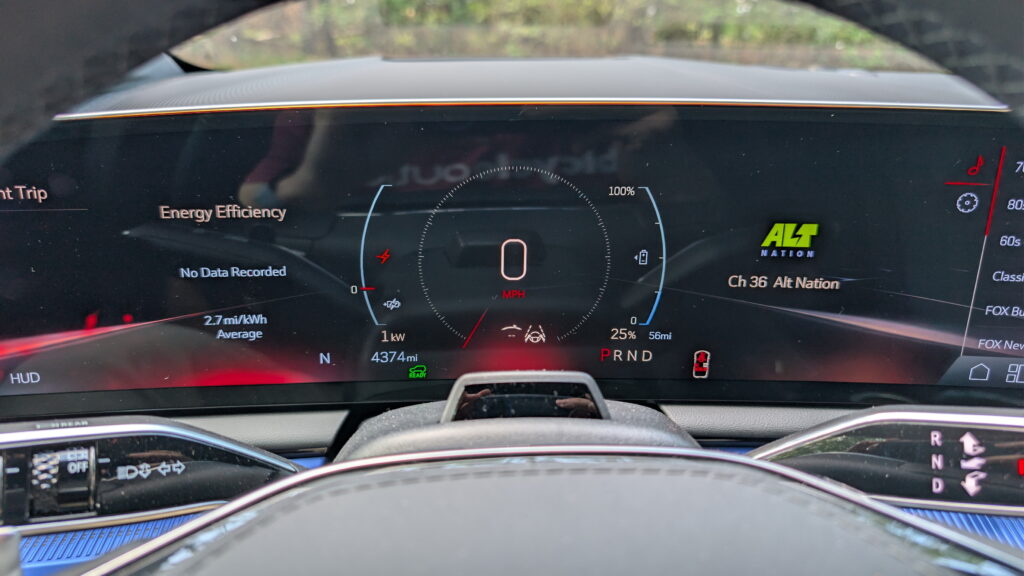
During testing, I achieved an average of 2.7 miles/kWh over approximately 220 miles (354 km) of mixed driving. Based on the Optiq-V’s 85 kWh battery pack, this gives a real-world range of approximately 230 miles (370 km) under sustained conditions. Cadillac’s EPA rating is significantly higher at 275 miles (443 km). As always, range heavily depends on speed, weather, terrain, and driving style. Given the Optiq-V’s performance, I suspect many owners will see figures somewhere between these numbers.
Driving Impressions
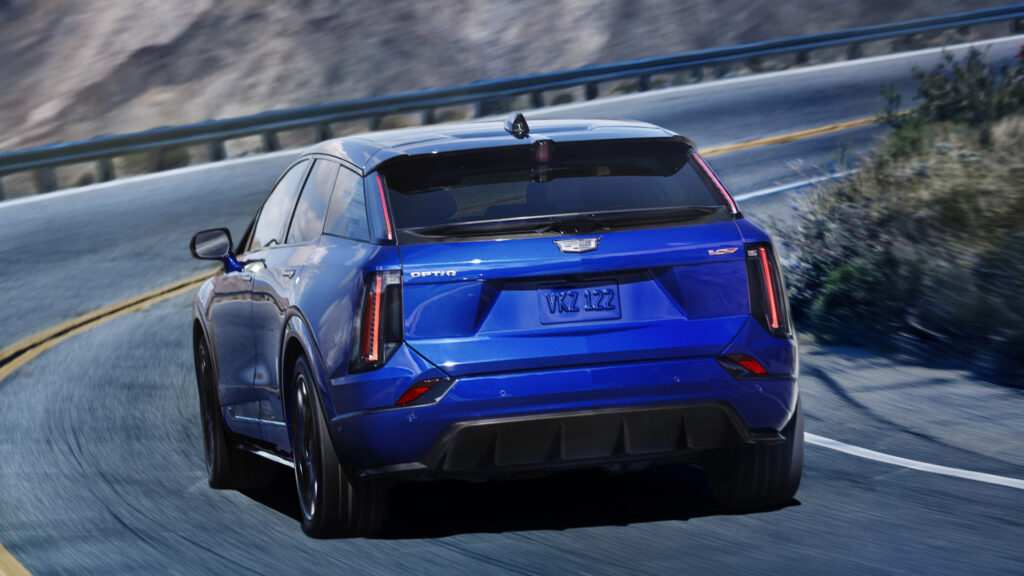
This is where the Optiq-V earns its badge. At 2466 kg, it absolutely should not feel as athletic as it does. Yet somehow Cadillac managed to hide most of that mass.
The dual-motor powertrain produces up to 519 horsepower (387 kW), which is more than enough for daily driving. Cadillac claims a 0-60 mph (0-97 km/h) time of 3.5 seconds, and although my testing occurred at approximately 21% battery charge, I still recorded a respectable 4.53 seconds without a one-foot (0.3 m) rollout and 4.21 seconds with it, using GPS equipment. With a fuller battery, Cadillac’s claim seems entirely plausible. However, more than straight-line performance, the chassis tuning is impressive.
The enhanced dual-valve dampers expertly control body movements while maintaining ride smoothness. The Optiq-V remains composed during aggressive cornering but never punishes passengers during regular trips. The upgraded Brembo brakes provide powerful and confident stopping, and the quicker steering gives the car a responsiveness that standard Optiq models lack.
Most importantly, Cadillac resisted the temptation to make the Optiq-V artificially stiff. Many electric performance cars seem eager to remind you how fast they are every second you’re behind the wheel. The Optiq-V doesn’t do this. It’s perfectly content cruising calmly in traffic before transforming into a genuinely engaging car when the road gets twisty. This balance is perhaps its greatest strength.
Competitors
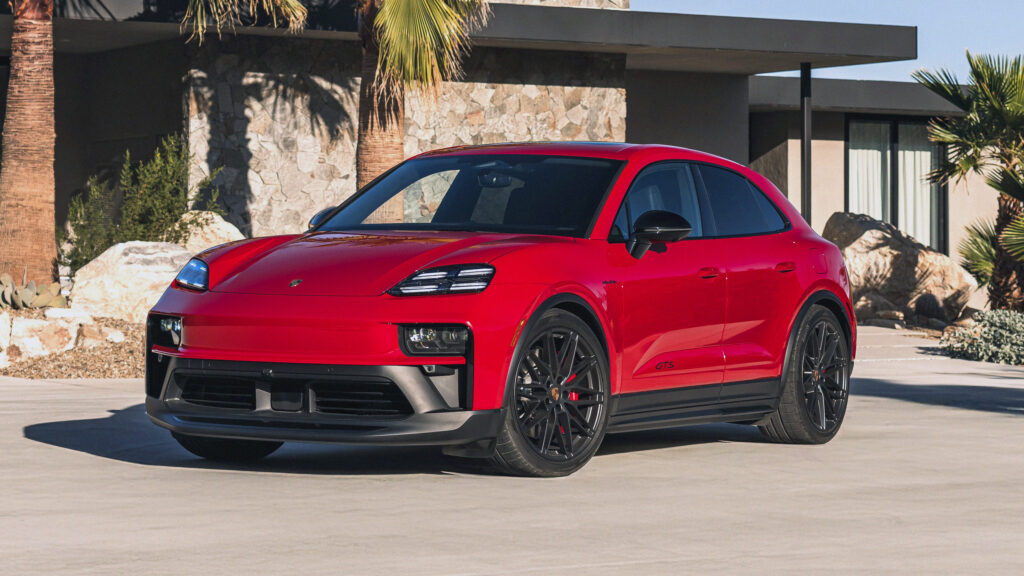
At a price of almost $79,000, the Optiq-V starts asking difficult questions. The anticipated Volvo EX60 seems ready to offer an attractive price-to-value ratio, although we’ll reserve judgment until we test it. The Porsche Macan Electric starts at roughly $82,000 and becomes a very real option if you’re already spending nearly eighty grand. You’ll lose significant power compared to the Cadillac, but you’ll get a Porsche badge and a benchmark driving experience.
Nevertheless, it’s easy to see why someone would choose the Optiq-V over other players in this space, such as the Mercedes-Benz GLC-Class EV or the Audi SQ6 e-tron. The design is no worse, perhaps even better; the power offered is good, and the price can be a deciding factor. Of course, price is where buyers need to be careful.
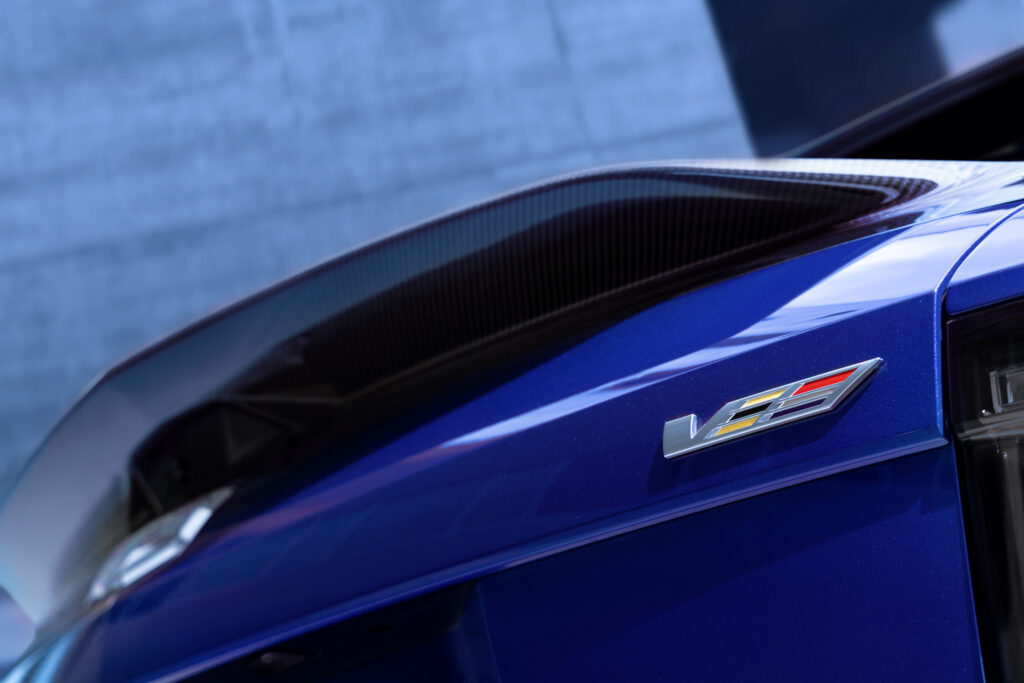
The carbon fiber package alone on our test car added $5,700. It looks nice, but it’s hardly necessary. Skip that option, add the “Charging & Convenience II” package for $2,555, and you get a car priced much closer to $71,000. At that price, the Optiq-V makes much more sense. It’s still not cheap, but it’s much easier to justify compared to competitors.
Verdict
The Optiq-V is not the fastest electric performance car. It’s not the lightest. It’s not the most technologically advanced. However, what it is is a surprisingly complete vehicle. It’s comfortable, quick, practical, luxurious, and unexpectedly fun to drive. It offers enough performance to satisfy enthusiasts without sacrificing the daily usability expected from a Cadillac.
Yes, it’s expensive. And yes, the audience willing to spend over $70,000 on a compact luxury electric performance crossover remains relatively small. But for buyers who like Cadillac, who value understated performance, and who want an EV that’s genuinely pleasant to live with every day, the Optiq-V makes a compelling argument.
Honestly, the biggest compliment I can give it is this: after a week behind the wheel, I stopped asking who it’s for and started understanding why someone would buy it. That’s a much harder trick than launching yet another absurdly powerful electric crossover.
Thus, the 2026 Cadillac Optiq V is not just another EV. It’s an attempt to find a sweet spot between luxury, performance, and practicality, and it seems the company has succeeded. It doesn’t try to be the best in any single category, but offers a balanced package that might appeal to those looking for something different from standard offerings. Its main advantage is its ability to be a comfortable daily driver that can still deliver genuine driving pleasure when appropriate. This makes it an interesting choice in a segment where many competitors focus on one thing.